Overview
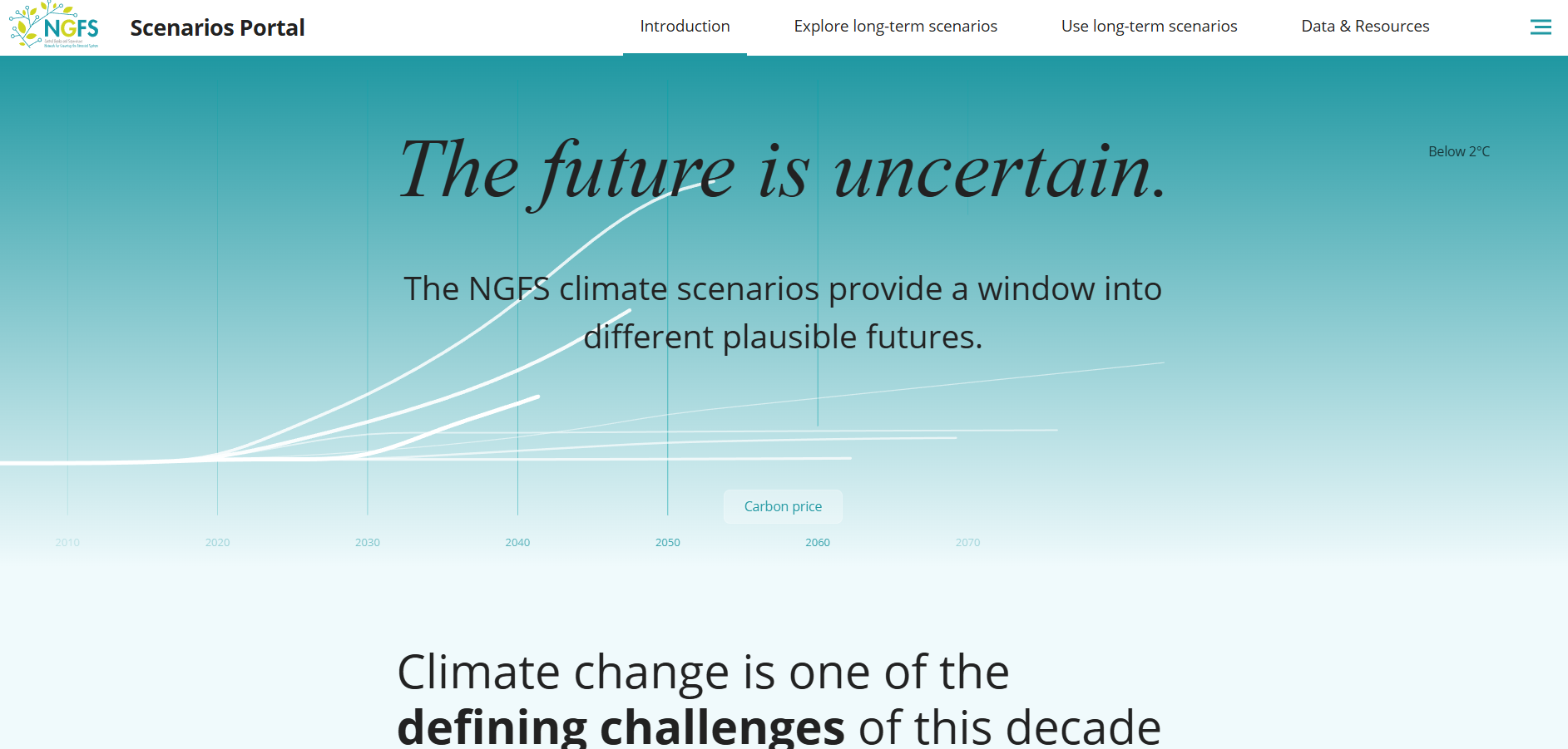
The NGFS Scenarios Portal is an online database offering harmonised climate, transition and macro-financial scenario data. It provides climate pathways and related economic indicators to support scenario analysis and risk assessment. Finance professionals can use it to explore plausible climate-related futures, assess impacts and inform risk frameworks. The NGFS also publishes short-term scenarios for near-term analysis.
Organisation behind the tool
The portal is developed and maintained by the Network for Greening the Financial System (NGFS), a global network of central banks and financial supervisors. It is supported by the NGFS Workstream on Scenario Design and Analysis and partner academic institutions from climate and economic research.
What the tool does
- Provides access to long-term climate and macro-financial scenario datasets.
- Offers short-term climate scenarios covering near-term impacts of climate change and policies.
- Enables users to explore transition pathways, physical climate impacts, and economic variables under different scenarios.
- Supplies downloadable data and technical documentation for analysis.
- Links to interactive data tools such as scenario explorers hosted by partner institutions.
Target audience
Primary users are central banks and financial supervisors. The portal and scenario datasets may also be relevant to financial institutions, risk analysts, researchers, policymakers and academics interested in climate scenario analysis.
Relevance to finance professionals
Risk assessment
- Analyse transition risk under varying climate policy pathways.
- Assess physical climate risk impacts on economies and sectors.
- Evaluate macroeconomic implications of climate scenarios for stress testing.
ESG analysis
- Support climate-related disclosure and reporting by providing scenario data.
- Map scenario outputs to environmental risk metrics for portfolios.
Market/commodity insights
- Inform understanding of energy system shifts, carbon pricing and investment flows under different futures.
Investment context
- Use scenario projections to evaluate long-term climate impacts on assets.
- Integrate scenario outputs into strategic planning and risk frameworks.