Overview
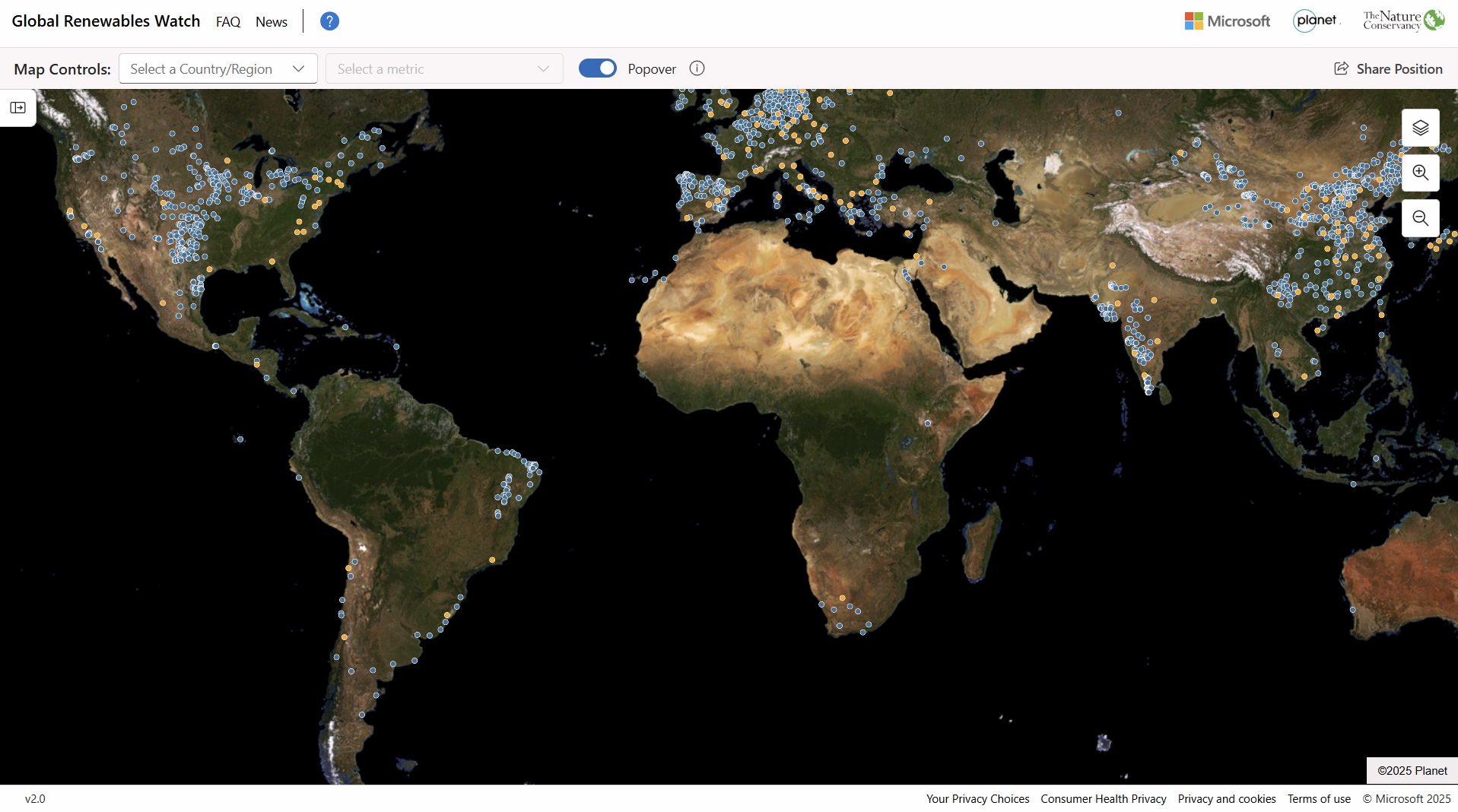
The Global Renewables Watch Atlas is an open-access, interactive data platform that maps large-scale solar and wind energy projects worldwide. Its purpose is to provide consistent, project-level information on renewable energy infrastructure. Finance professionals may find it relevant for assessing energy transition trends, infrastructure exposure and investment context across regions.
Organisation behind the tool
The Atlas is developed and maintained by Global Renewables Watch, a global initiative that brings together geospatial data and energy system expertise. It is supported through collaborations with research organisations and technical partners specialising in satellite imagery, data analysis and energy systems mapping.
What the tool does
The tool provides a global view of utility-scale renewable energy infrastructure, with a focus on wind and solar projects.
Key functions include:
- Interactive global maps showing the location of operational, under-construction and planned wind and solar projects.
- Project-level attributes such as technology type, estimated capacity and development status.
- Spatial analysis tools that allow users to filter by region, country or project status.
- Visual overlays that support high-level comparison of renewable deployment across geographies.
- Data designed for exploration and contextual analysis rather than financial modelling.
Target audience
The primary audience includes researchers, policymakers and analysts working on energy systems and climate transition topics. Other relevant users include:
- Finance and investment professionals
- Infrastructure and energy consultants
- NGOs and civil society organisations
- Academic institutions and students
- Relevance to finance professionals
For finance professionals, the Atlas can support contextual and strategic analysis rather than transactional decision-making.
Risk assessment
- Identifies geographic concentration of renewable infrastructure, supporting assessments of exposure to regional policy, climate or grid-related risks.
- Provides spatial context for physical and transition risk screening at a high level.
ESG analysis
- Supports environmental analysis related to energy transition progress and renewable deployment.
- Useful as contextual evidence when assessing alignment with climate transition or decarbonisation strategies.
Market and infrastructure insights
- Highlights global and regional trends in wind and solar capacity expansion.
- Helps compare levels of renewable infrastructure development across markets.
Investment context
- Informs long-term views on renewable energy growth and infrastructure build-out.
- Useful for macro-level analysis of energy transition pathways and regional investment focus areas.
The tool is best suited for high-level analysis and contextual understanding rather than detailed financial or project-specific due diligence.