

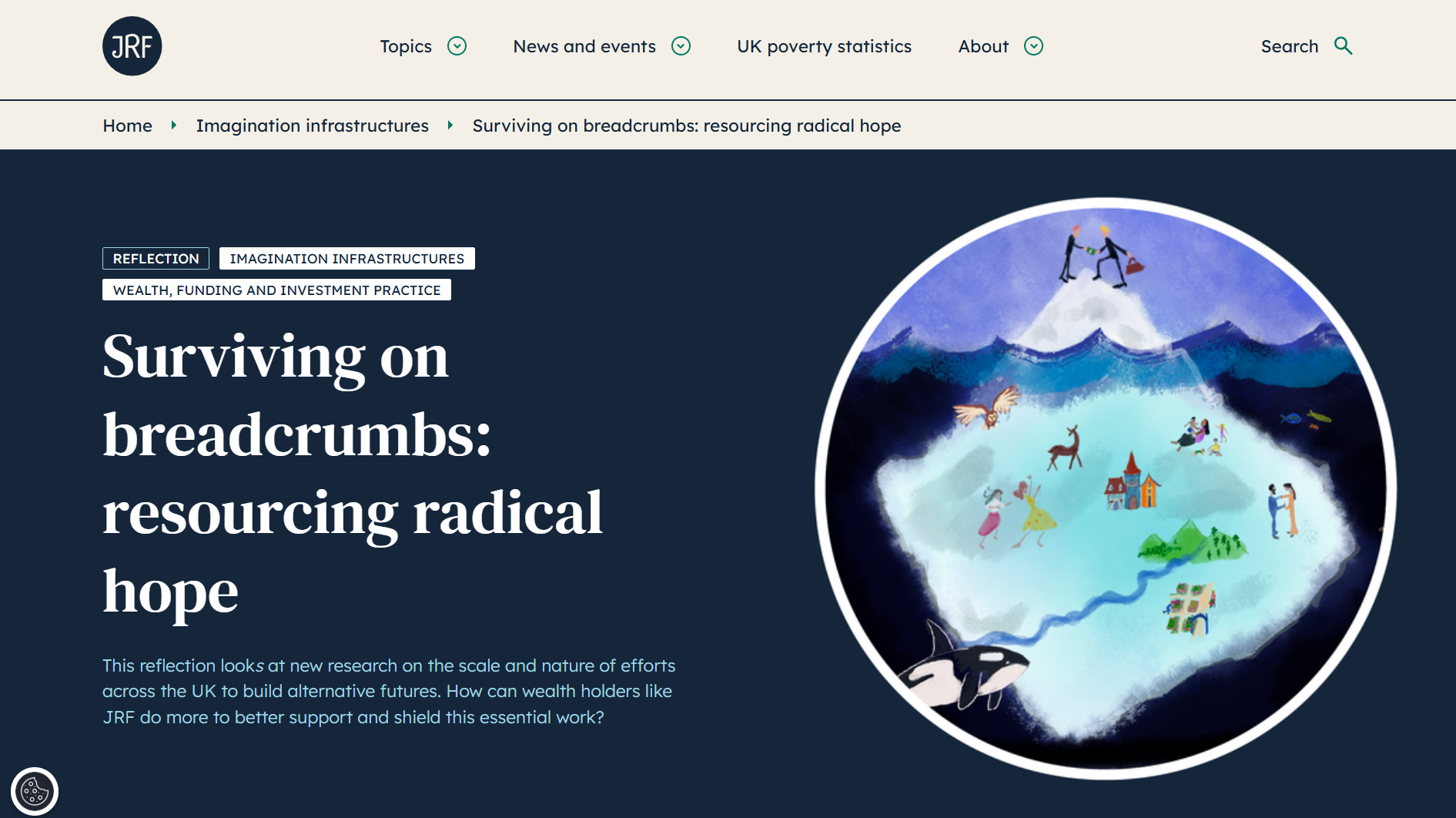
Surviving on breadcrumbs: Resourcing radical hope
The report reflects on UK research mapping about 2,000 organisations building alternative economic futures and examines funding challenges. It urges funders and wealth holders to reconsider investment practices, support ecosystem development, and allocate resources towards initiatives fostering regenerative, equitable economic models and systemic change.
Please login or join for free to read more.

OVERVIEW
Building the something else
This reflection examines emerging efforts across the UK to build alternative economic and social futures. It draws on research commissioned by the Joseph Rowntree Foundation (JRF) and undertaken by the Onion Collective, which mapped organisations experimenting with new economic and community models. The work highlights the tensions within current economic systems, which have generated significant wealth but also environmental degradation, inequality and political instability. The research explores how wealth holders and philanthropic organisations might support initiatives that seek systemic transformation rather than incremental reform.
The authors argue that the present period represents a moment of systemic transition. Instead of optimising existing economic structures, the research focuses on organisations attempting to create new institutional and cultural paradigms. These initiatives often operate at the margins of mainstream economic systems but aim to develop models that enable both human wellbeing and ecological sustainability.
Shifting towards fairness and regeneration
The research identifies several shifts necessary for more equitable and regenerative futures. These include moving from extractive economic systems towards regenerative models that restore ecosystems and communities. Another shift emphasises redistributing wealth and income to address inequality, rather than prioritising financial capital accumulation.
The research also highlights a transition from prioritising financial capital towards recognising multiple forms of capital, including social, human, natural and cultural capital. In addition, it calls for moving away from private ownership towards stewardship models, commons-based approaches and collective custodianship of resources.
These shifts are reflected in organisations working to develop practical alternatives to dominant economic models. Their work seeks to loosen the influence of neoliberal industrial capitalism and test approaches that could operate within more sustainable and equitable systems.
Building real-world alternatives
The report emphasises the importance of organisations developing practical alternatives to existing economic systems. Inspired by ideas such as Erik Olin Wright’s concept of “concrete utopias”, these initiatives attempt to demonstrate how alternative social and economic arrangements could function in practice.
Many organisations view their work as part of a broader transition beyond current economic paradigms. They experiment with new governance structures, community ownership models and collaborative economic activities that prioritise social and ecological wellbeing. These initiatives aim to act as “proofs of possibility”, demonstrating that viable alternatives to dominant economic systems can be developed and tested.
The research also emphasises that such efforts require supportive funding structures. Long-term investment, organisational stability and supportive ecosystems are necessary for these experimental models to develop and scale.
Supporting a connected ecosystem
The report stresses the importance of supporting networks and ecosystems rather than individual organisations in isolation. Many initiatives operate in fragmented and fragile environments where limited funding and weak connections constrain their development.
Over the past two years, JRF has provided small amounts of core funding to 28 organisations that demonstrate leadership in this space. These organisations act as “beacons of practice”, developing alternative approaches and sharing knowledge with others. Funding also supported convening activities that brought organisations together to learn collectively and strengthen collaboration.
Systems theory informs this approach. The research highlights the importance of building networks that connect actors across sectors and geographies. Such networks can enable ideas, knowledge and resources to circulate more effectively and support the emergence of new economic practices.
Mapping the ecosystem
To better understand this emerging field, the Onion Collective conducted a mapping exercise with support from Free Ice Cream. The research identified around 2,000 organisations across the UK engaged in activities aimed at building alternative futures.
These organisations operate at multiple scales, from neighbourhood initiatives to regional networks. Their activities span economic, cultural and ecological domains, including community organising, systems change work, ecological restoration and social innovation.
The research highlights the diversity and dynamism of this ecosystem. Organisations act as community builders, network stewards, storytellers and system innovators. Their work connects themes such as economics and culture, ecology and community wellbeing, and social justice and healing.
Despite this energy, many initiatives remain marginal within dominant economic systems and face significant resourcing constraints.
3 questions for funders and wealth holders
The report outlines three key questions intended to guide philanthropic organisations and wealth holders.
First, funders should examine the balance between investments that optimise existing systems and those that support alternatives beyond them. The research shows that the emerging ecosystem is significantly under-resourced. The median funding level among organisations studied was approximately £5,000 per year, while 40% reported receiving no direct funding for their future-building work.
Funding gaps also have social equity implications. The research notes that racialised funding patterns intensify challenges for Black- and Brown-led organisations. Overall, only around £96 million—roughly 2% of annual UK grant funding—is estimated to support future-building initiatives.
Second, funders should assess whether endowment investments align with their organisational missions. Traditional philanthropic investment models often allocate significant capital to markets that contribute to environmental harm and inequality. The report suggests that philanthropic institutions should consider aligning their endowment strategies with their social missions. JRF has begun this process by committing an additional £50–100 million in spending over the next five years to support transformative work.
Third, funders should consider how ecosystems and networks can be strengthened. Supporting connective infrastructure—such as collaboration platforms, shared learning systems and network leadership—can help emerging initiatives develop more resilient and coordinated ecosystems.
Future potential, now
The research concludes that a growing network of organisations is already experimenting with alternative economic and social models. These initiatives demonstrate emerging coherence around regenerative and community-centred approaches to economic development.
The report suggests that wealth holders and philanthropic institutions have an opportunity to accelerate this transition by directing capital towards ecosystem development, collaborative networks and experimental models. By supporting these initiatives, funders can contribute to building systems that prioritise social equity, ecological sustainability and long-term community wellbeing.




