

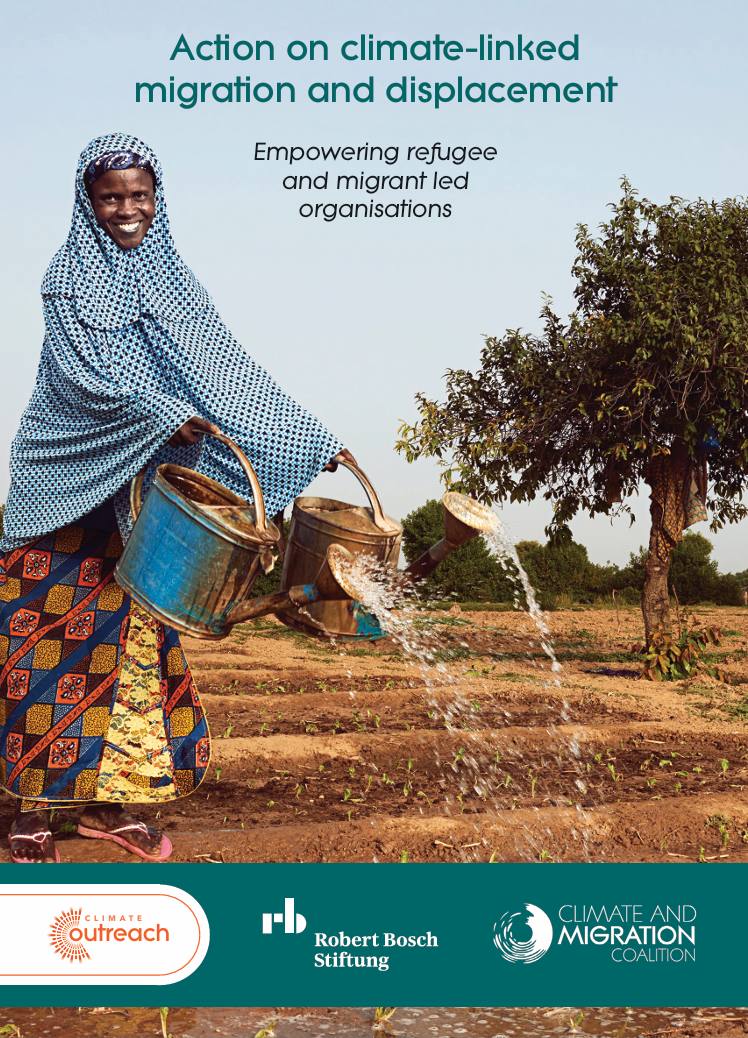
Action on climate-linked migration and displacement: Empowering refugee and migrant led organisations
Analyses climate-linked migration, highlighting impacts on displacement patterns and vulnerabilities. Evaluates roles, motivations and barriers for refugee- and migrant-led organisations, and proposes funding and policy interventions to strengthen their engagement in climate advocacy and support adaptive, rights-based responses.
Please login or join for free to read more.

OVERVIEW
Global context and current civil society engagement
The report analyses how climate change is reshaping human mobility, with around 20 million people displaced annually by sudden disasters such as floods and storms. Slow-onset events like drought drive rural–urban migration, often seasonal and short-distance. Planned relocation is emerging due to sea-level rise, while “immobility” traps vulnerable populations without resources to move.
Climate impacts disproportionately affect marginalised groups, including those facing poverty, conflict or discrimination. Most movement remains internal or between neighbouring countries, challenging common narratives of mass cross-border migration. Refugees and migrants already in settlements face heightened exposure to extreme weather risks.
Civil society engagement varies. Refugee- and migrant-led organisations are underrepresented in policy processes despite their operational roles. Key intervention areas include legal protection, where frameworks remain inadequate; resilience and adaptation projects to reduce displacement; and “migration as adaptation”, which frames mobility as a coping strategy supported by services and infrastructure.
Drivers of – and barriers to – engagement
Motivations for engagement stem from recognition of climate impacts on communities, particularly in the global south where effects such as drought-driven migration are immediate. Organisations in the global north are influenced by historical commitments to refugee rights and growing public attention to climate issues. Individual leadership often drives initial engagement, with staff acting as internal advocates.
Organisations also highlight interconnected drivers of displacement and climate change, including colonial legacies and structural inequality, reinforcing the need for integrated responses. Increased public salience, driven by activism and media coverage, has further encouraged engagement, though narratives can be misleading.
Barriers are significant. All organisations cited funding constraints as limiting programme development. Northern organisations face crowded advocacy spaces, while southern organisations encounter political instability and operational risks. Internal resistance arises from competing priorities, limited expertise and resource allocation concerns.
Additional challenges include lack of tailored training materials, staff capacity constraints, and mental health pressures. Organisations in crisis contexts struggle to balance immediate humanitarian needs with longer-term climate-related work.
Options for strategic intervention
The report outlines actions to strengthen engagement by refugee- and migrant-led organisations. Expanding funding is critical to increase participation and support organisations at different stages of development. Early-stage support is particularly important to build capacity and sustain long-term engagement.
Targeted support for organisations in the global south is recommended to elevate local experience into international advocacy. Creating supportive structures—such as peer learning, training resources and access to expertise—can accelerate organisational readiness and reduce isolation.
Funding should also support individual champions within organisations to build internal consensus and embed climate-related work. Collaboration between migration and climate organisations is encouraged, but with leadership from refugee- and migrant-led groups to ensure their perspectives shape narratives and policy engagement.
A diversity of approaches should be funded, from grassroots initiatives to policy advocacy, while aligning with organisational strengths. Long-term, flexible funding is essential given slow policy progress and shifting political contexts.
Finally, funders are encouraged to demonstrate leadership by convening stakeholders, promoting the issue publicly, and encouraging broader philanthropic engagement. These interventions aim to elevate migrant voices, influence policy processes and improve outcomes for vulnerable populations affected by climate-linked mobility.




