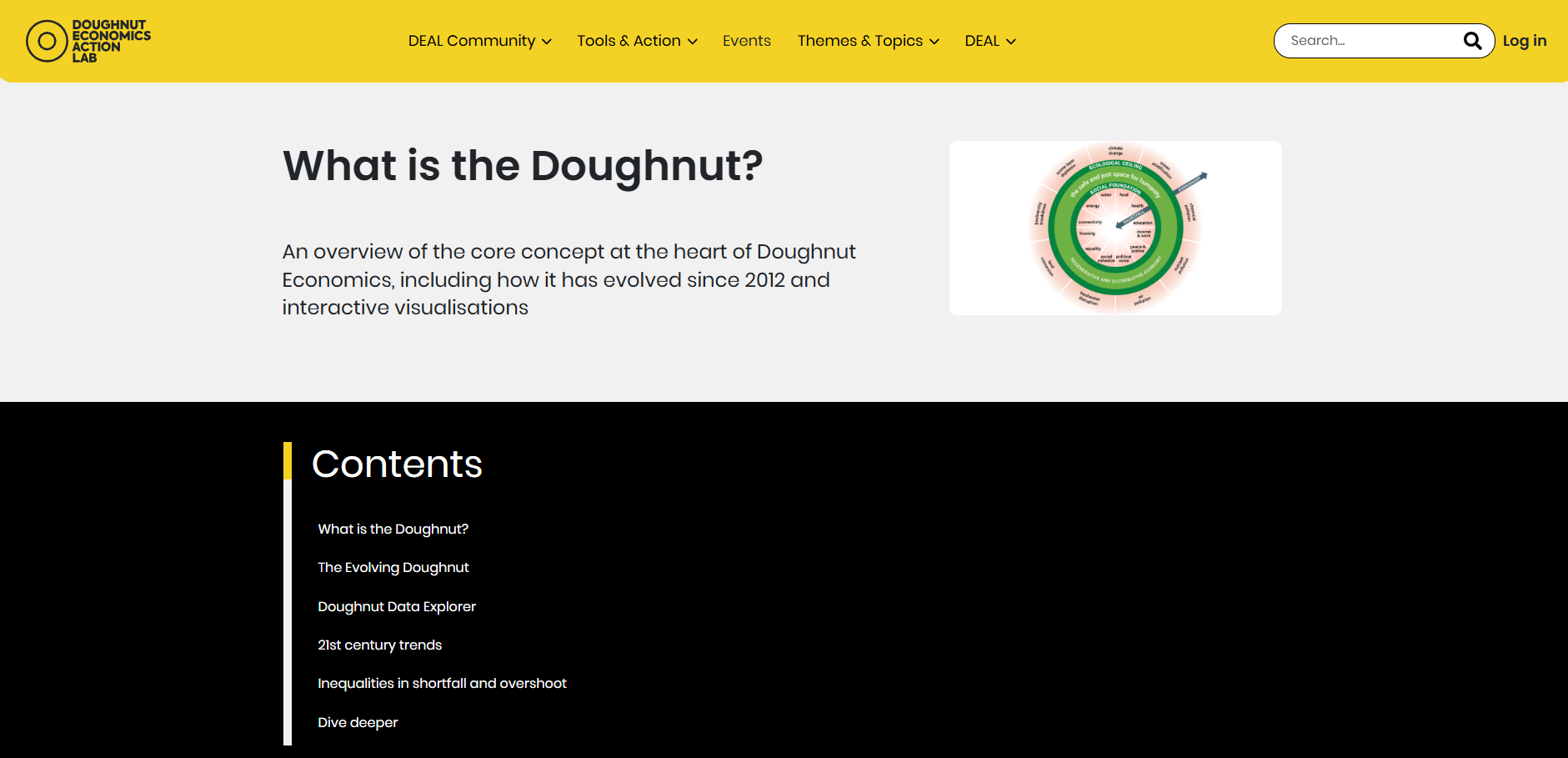
Doughnut of Social and Planetary Boundaries
The Doughnut of Social and Planetary Boundaries is a visual monitor tracking global progress across social foundations and ecological limits.
Please login or join for free to read more.

OVERVIEW
The Doughnut of Social and Planetary Boundaries (the Doughnut) is a visual monitor and conceptual framework designed to track progress towards meeting the needs of all people within the means of the living planet. Developed to offer an ecologically safe and socially just space for humanity to thrive, the tool combines a social foundation based on the UN Sustainable Development Goals with an ecological ceiling defined by key Earth-system processes. Finance professionals can use this framework to understand systemic global risks, track long-term environmental and social trends, and evaluate macroeconomic stability.
Organisation behind the tool
The tool is maintained and promoted by the Doughnut Economics Action Lab (DEAL), an organisation dedicated to putting the concepts of Doughnut Economics into practice. The latest 2025 quantitative assessment, titled “Doughnut of social and planetary boundaries monitors a world out of balance”, was published in collaboration with researchers in the journal Nature.
What the tool does
The tool provides an interactive Doughnut Data Explorer that allows users to monitor global performance across 12 essential social dimensions and 9 planetary boundaries from 2000 to 2022. Users can hover over individual wedges to explore indicator details, track shifts in social shortfalls and ecological overshoots over time, and view disaggregated data for different country income clusters (the poorest 40%, middle 40%, and richest 20%). The framework also offers downloadable Doughnut diagrams and unrolled bar charts illustrating 21st-century environmental and social trends.
Target audience
The primary audience includes researchers, policymakers, local governments, educators, and communities looking to downscale the framework to nations and cities. It is also highly relevant to businesses, civil society, and finance professionals seeking a systemic perspective on sustainability boundaries.
Relevance to finance professionals
- Risk assessment: Helps professionals evaluate systemic environmental risk by illustrating which planetary boundaries, such as chemical pollution or species extinction, have been transgressed.
- ESG analysis: Provides high-quality, long-term metrics and data sources covering both critical human deprivation (such as access to energy and corruption perception) and planetary degradation.
- Investment context: Offers macro-level insights into global trends and resource inequalities, showing how social progress and ecological pressures diverge across different country income clusters.