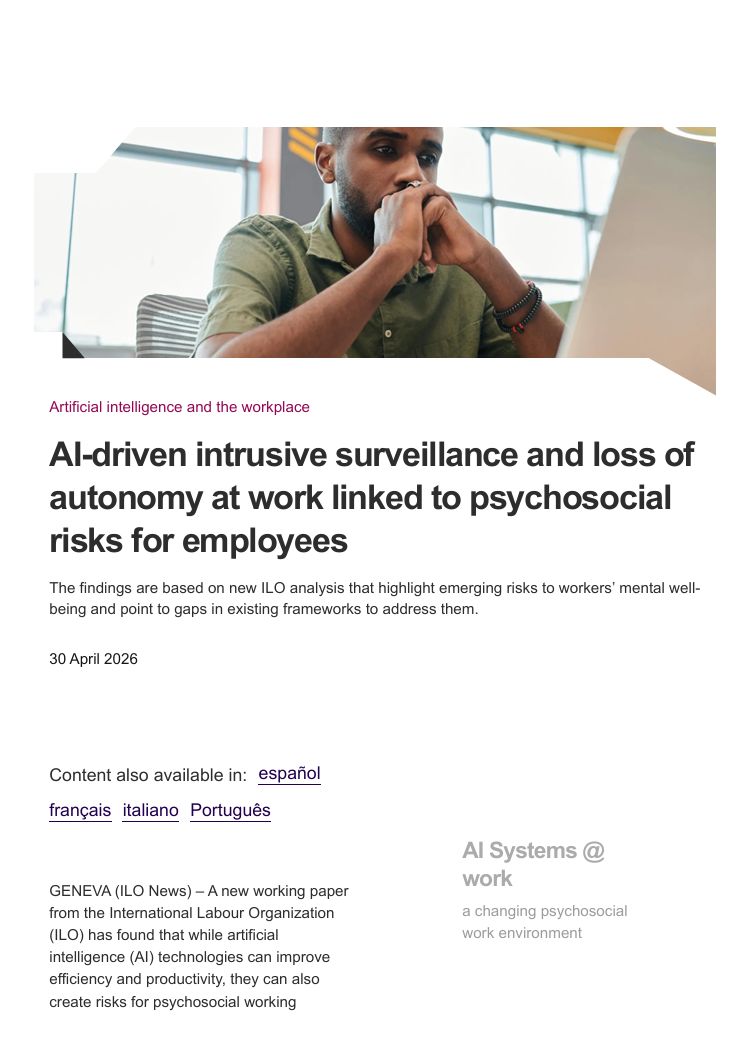
AI-driven intrusive surveillance and loss of autonomy at work linked to psychosocial risks for employees
ILO research finds AI-driven workplace surveillance and reduced employee autonomy may heighten psychosocial risks, including stress, privacy concerns and work intensification. The paper highlights gaps in occupational safety frameworks and calls for integrated regulation covering labour rights, data protection and mental wellbeing.
Please login or join for free to read more.

OVERVIEW
Artificial intelligence and the workplace
The International Labour Organization (ILO) examined how artificial intelligence (AI) systems are reshaping workplace management and psychosocial working conditions. The report found that AI can improve productivity and efficiency but may also increase psychosocial risks through intrusive surveillance, work intensification, reduced job autonomy and privacy concerns.
AI-driven intrusive surveillance and loss of autonomy at work linked to psychosocial risks for employees
The report highlighted that AI systems are increasingly being used across the employment cycle, including recruitment, monitoring, scheduling and performance management. These technologies differ from traditional management approaches because they rely heavily on continuous data collection, automated decision-making and algorithmic oversight.
The ILO identified several emerging psychosocial risks linked to AI-enabled management systems. These include increased workplace surveillance, reduced employee autonomy, intensified workloads and uncertainty around data privacy and personal information use. The report noted that algorithmic monitoring systems can create pressure for constant performance optimisation, potentially affecting workers’ mental and social wellbeing.
The paper also found that transparency remains limited in many AI-driven decision-making systems. Employees may not fully understand how workplace algorithms assess performance, allocate tasks or influence employment outcomes. The report noted that these concerns apply both to digital platform work and traditional workplaces where AI-based monitoring systems are increasingly adopted.
AI systems @ work: A changing psychosocial work environment
The report stated that existing occupational safety and health frameworks in many countries continue to focus primarily on physical hazards rather than psychosocial and mental health risks. As a result, current regulatory systems may not adequately address harms associated with AI-driven workplace management.
The ILO noted that there is currently no comprehensive legislation specifically addressing AI-related changes in the workplace. The organisation argued that an integrated policy approach is required to manage risks associated with digital technologies and AI systems. Recommended measures include combining labour regulation, occupational safety and health protections, equality and non-discrimination measures, and data protection frameworks.
The report emphasised that policymakers should develop frameworks that balance technological change with worker wellbeing protections. It argued that AI governance should include safeguards addressing transparency, privacy, autonomy and psychosocial health risks while supporting fair working conditions.
World day for safety and health at work 2026
The report referenced broader workplace mental health concerns, noting related ILO findings that approximately 840,000 deaths annually are linked to psychosocial risks at work. This highlights the scale of work-related mental health and stress-related issues that may be intensified through poorly managed AI systems and digital workplace monitoring practices.