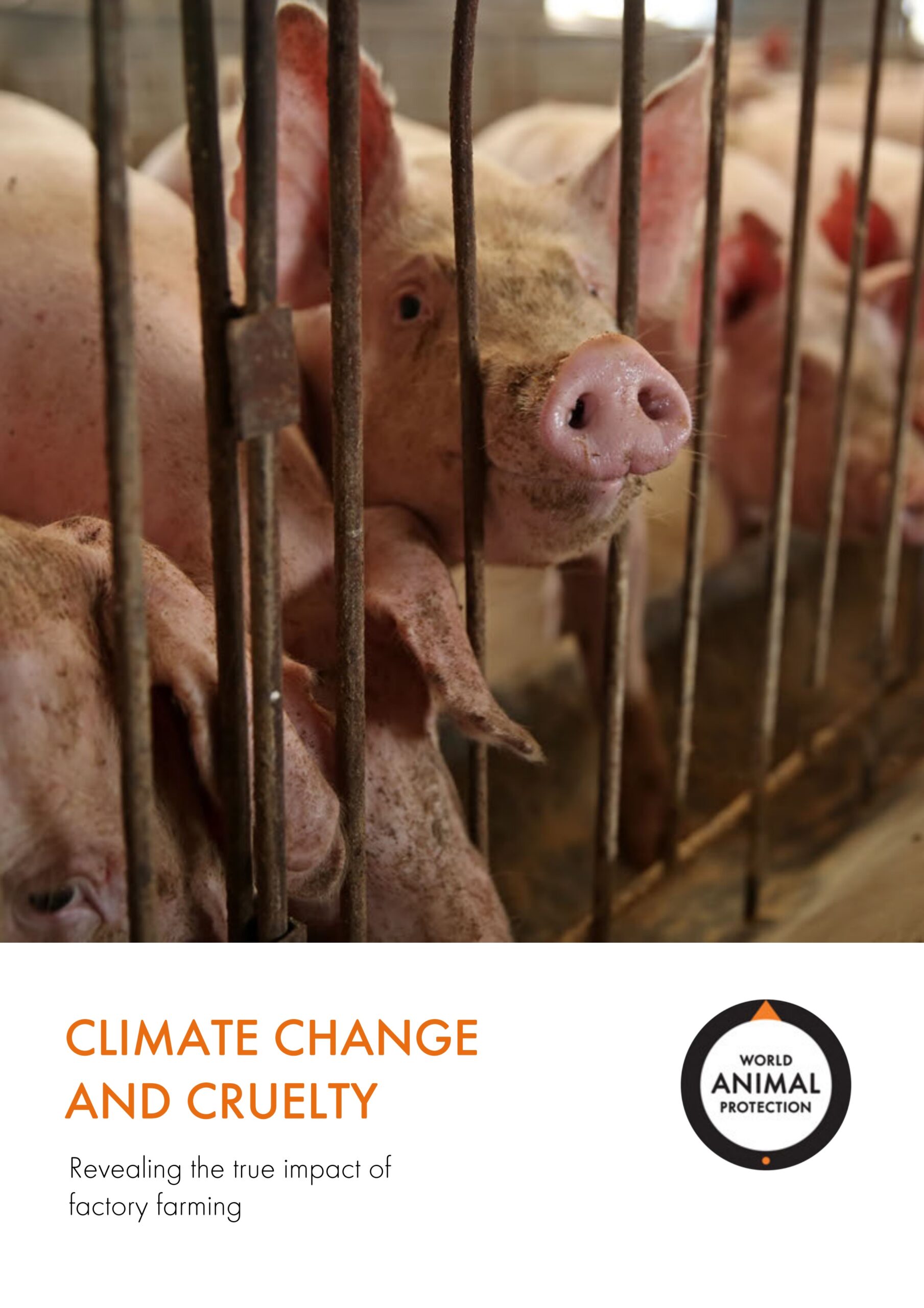
Climate change and cruelty: Revealing the true impact of factory farming
This World Animal Protection report examines the climate and environmental impacts of factory farming in Brazil, China, the USA and the Netherlands. It models scenarios for reduced meat consumption and higher welfare production, finding that eating less and better could halve the climate impacts of chicken and pork by 2040.
Please login or join for free to read more.

OVERVIEW
Agriculture’s impact on climate change is about more than beef
Factory farming is described as the “silent culprit” we are failing to address, despite the clear climate impact of the 69 billion meat chickens and 1.5 billion pigs factory farmed each year (p.4). Overall demand for meat is expected to increase by as much as 30% in Africa, 18% in Asia Pacific, 12% in Latin America, and 9% in North America by 2030 (p.4).
Tackling climate change means changing our food system
Governments have committed to limiting the planet to a 1.5 degrees Celsius rise in temperature under the Paris Climate Agreement, but this cannot be achieved without tackling factory farming. The report examines current climate and environmental impacts from chicken and pork consumption in four factory farming hot spots: Brazil, China, Europe and the USA. Factory farming is not a precondition for food security — it undermines it. A moratorium on factory farming is called for.
What are the key climate and environmental impacts of factory farms?
The factory farming system drives deforestation to grow animal feed crops, causing habitat destruction. Pesticides and fertilisers pollute water and soil. Animal manure generates methane. The report argues no new factory farms should be built for the next ten years whilst regulations catch up.
How we calculated the climate and environmental impacts of factory farming
Researchers modelled data from Brazil, China, the USA and the Netherlands across scenarios for 2030, 2040 and 2050. Three scenario sets were assessed: conventional versus higher welfare production; reduced meat consumption; and a combined “eat less and better” approach.
Key findings — impacts from factory farming now
Consumption rates vary: people in the Netherlands consume around 33kg of pork and 23kg of chicken per person per year; Brazilians 41kg of chicken and 12kg of pork; Americans 50kg of chicken and 24kg of pork; and in China 26kg of pork and 14kg of chicken (p.9). Across the 4 hot spots, annual consumption of chicken alone creates the same climate change impact as keeping 29 million cars on the road for a year (p.9).
Methane from animal manure accounts for 21% of pork emissions in the Netherlands, 22% for the USA, and 24% for Brazil (p.9). Deforestation for feed crops more than triples the climate impact of meat chicken production in Brazil, doubles the overall climate impacts in the Netherlands, and increases impacts by more than one and a half times in China (p.9). For every 100 calories of crops fed to farmed animals, only 17–30 calories reach humans in the food chain (p.9). Meat and dairy provide only 18% of overall calories and 37% of protein for humans, but use 83% of farmland (p.9).
What happens if animal welfare standards are improved?
More than 80 billion animals are farmed each year (p.10). Higher welfare pork production leads to slightly less climate change impacts; higher welfare chicken leads to slightly more due to slower-growing breeds requiring more feed. The report finds there is no excuse to delay improving welfare standards on climate grounds.
What happens if meat consumption is reduced?
A 50% reduction in pork consumption per person by 2040 would result in decreases in climate change impacts of 41% for China, 54% for the EU, 44% for Brazil and 43% for the USA (p.11). For chicken, a 50% reduction would result in decreases of 44% for China, 48% for the EU, 42% for Brazil and 41% for the USA (p.11).
The sweet spot: ‘eat less and better’
A 50% reduction in consumption of both chicken and pork by 2040, combined with 50% adoption of higher welfare products, would halve the annual climate impacts across the 4 countries analysed — equivalent to taking up to 45 million cars off the road for a year (p.11).
What needs to happen now: key recommendations
The factory farming industry should ensure no further habitat destruction for animal feed production by 2023, and commit to reducing animal production by at least 50% by 2040. From 2030, the industry should begin phasing out the use of human-edible feed for farmed animals.
Governments should introduce compulsory minimum farmed animal welfare standards (FARMS), impose a moratorium on new factory farms or expansions for the next ten years, and redirect subsidies and policy support to humane, sustainable and plant-based food.