

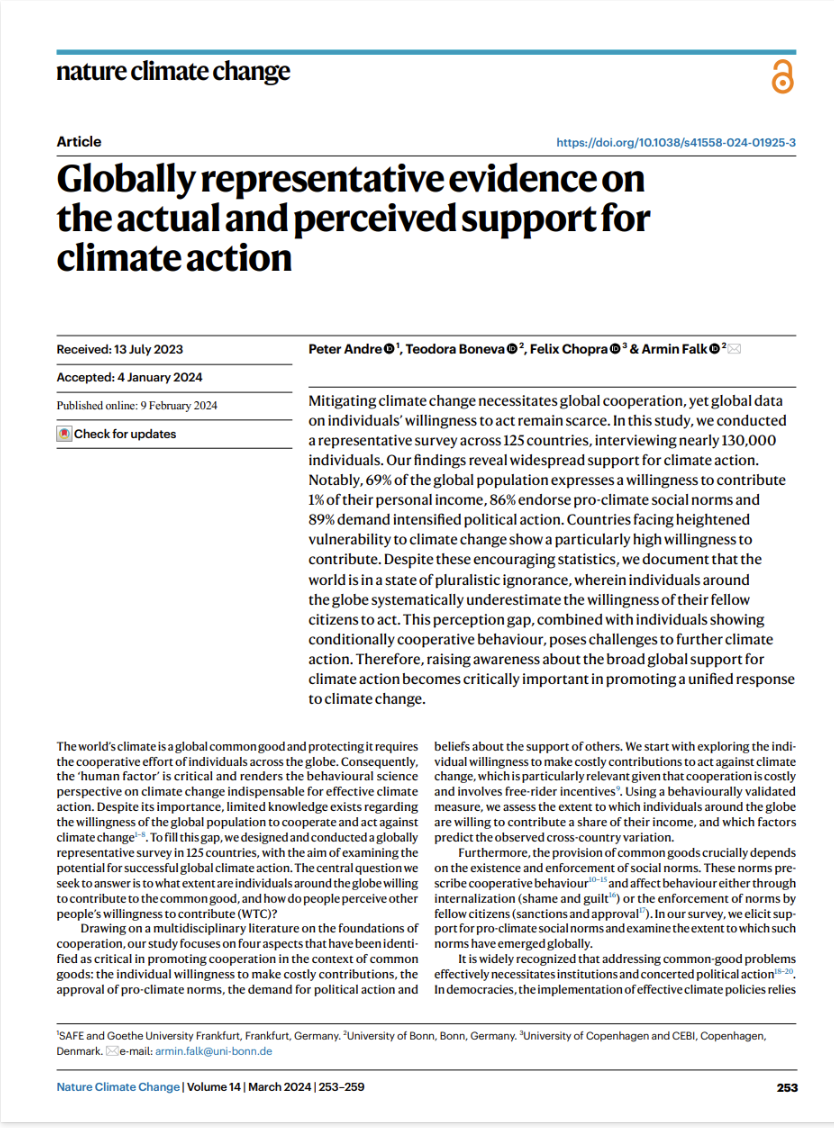
Globally representative evidence on the actual and perceived support for climate action
Using a survey of 130,000 people across 125 countries, the study finds strong global support for climate action, but widespread underestimation of others’ willingness to act. This perception gap may hinder cooperation; correcting it could materially strengthen climate action.
Please login or join for free to read more.

OVERVIEW
Widespread global support for climate action
The study draws on a globally representative survey of 129,902 individuals across 125 countries, covering 92% of the world’s population, 96% of global GDP and emissions. Results show broad support for climate action. Globally, 69% of respondents are willing to contribute 1% of household income monthly to address global warming, with a further 6% willing to contribute a smaller amount. Support for pro-climate social norms is high, with 86% stating people should try to fight global warming, and 89% believe national governments should do more. In most countries, support exceeds two-thirds of respondents.
The global survey
The survey was implemented through the Gallup World Poll 2021/2022, using nationally representative samples of individuals aged 15 and over. Interviews were conducted via telephone or face-to-face, with rigorous translation and weighting procedures to ensure cross-country comparability. Willingness to contribute income is used as a behaviourally validated proxy for costly cooperation, shown to correlate with actual pro-climate donations and behaviours in prior studies. Beliefs about others’ willingness, support for social norms, and demand for political action are measured consistently across countries.
Stronger willingness to contribute in vulnerable countries
Willingness to contribute varies substantially across countries. There is a negative relationship between willingness to contribute and GDP per capita (ρ = −0.47), with 78% willing to contribute in the poorest quintile of countries compared with 62% in the wealthiest. Conversely, willingness is higher in warmer countries more exposed to climate risks (ρ = 0.35). Using an IPCC vulnerability index, countries with higher vulnerability show significantly stronger willingness to contribute. By contrast, support for pro-climate norms and political action is consistently high across income levels, indicating that income effects primarily influence willingness to incur personal financial costs.
Beliefs and systematic misperceptions
The study identifies a strong link between individual behaviour and beliefs about others’ actions, consistent with conditional cooperation. At the individual level, a one-percentage-point increase in perceived willingness of others to contribute is associated with a 0.46-percentage-point increase in one’s own likelihood of contributing. However, beliefs are systematically biased. Globally, respondents estimate that only 43% of others are willing to contribute 1% of income, compared with an actual figure of 69%, a perception gap of 26 percentage points. This underestimation occurs in 81% of countries and is larger in hotter, more vulnerable regions. Such pluralistic ignorance may suppress collective action despite strong underlying support.
Discussion
The findings indicate that the global population largely agrees on the need for climate action, supports pro-climate norms and demands stronger government intervention. The main barrier identified is not lack of support, but misperceptions about others’ willingness to act. Given the strong role of conditional cooperation, correcting these misperceptions could unlock higher individual contributions and reinforce policy support. The authors highlight the importance of communication strategies and political messaging that accurately reflect majority support for climate action, rather than amplifying sceptical minority views. By improving awareness of global support, policymakers may strengthen cooperation and accelerate collective climate responses.




