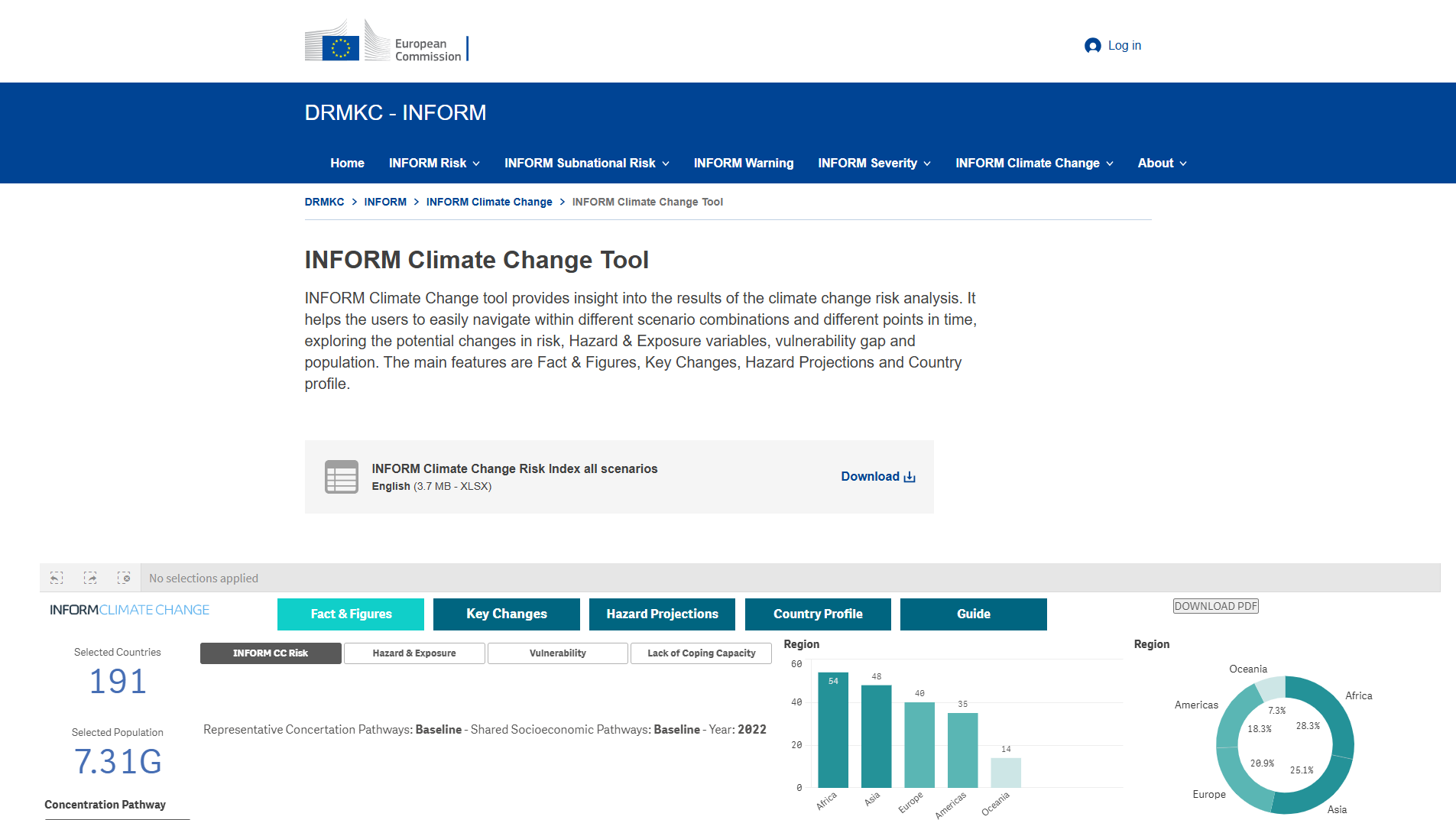
INFORM Climate Change Tool is an interactive online resource that presents the outcomes of the INFORM Climate Change Risk Index, enabling exploration of future climate-related risk under different emission and socio-economic scenarios. It provides navigation through projections for risk, hazard exposure, vulnerability gaps and population changes over time. Finance professionals may find it relevant for analysing environmental risk patterns and contextualising long-term climate impacts on countries and sectors.
Organisation behind the tool
The tool is developed and maintained by the Disaster Risk Management Knowledge Centre (DRMKC), with technical leadership from the Joint Research Centre (JRC) of the European Commission. It is part of the broader INFORM suite, a global risk assessment collaboration involving INFORM partners.
What the tool does
- Shows projected climate change-related risk scores (0–10 scale) over future timeframes (e.g. 2050, 2080).
- Allows comparison of outcomes across different emission and population scenarios.
- Displays changes in hazard exposure, vulnerability and population at risk relative to baseline.
- Offers features such as Fact & Figures, Key Changes, Hazard Projections and Country profiles.
- Enables download of underlying data (e.g. risk index values).
Target audience
The primary audience includes researchers, policymakers, humanitarian and disaster risk professionals. The tool can also support analysts, academics and the general public interested in climate risk projections.
Relevance to finance professionals
Risk assessment
- Provides quantitative projections of climate-related hazard exposure and future risk trends.
- Enables assessment of potential increases in population exposure to flooding, drought and other hazards.
ESG analysis
- Supplies data useful for climate-related environmental metrics in reporting frameworks.
- Offers scenario analysis supporting disclosure requirements (e.g. TCFD/ESRS climate risk narratives).
Market/commodity insights
- Insights into geographic shifts in climate risk may inform infrastructure, agriculture and water resource investment decisions.
Investment context
- Supports long-term analysis of socio-economic and climate impacts on countries’ risk profiles.
- Offers context for sovereign risk considerations and adaptation financing needs over multiple decades.