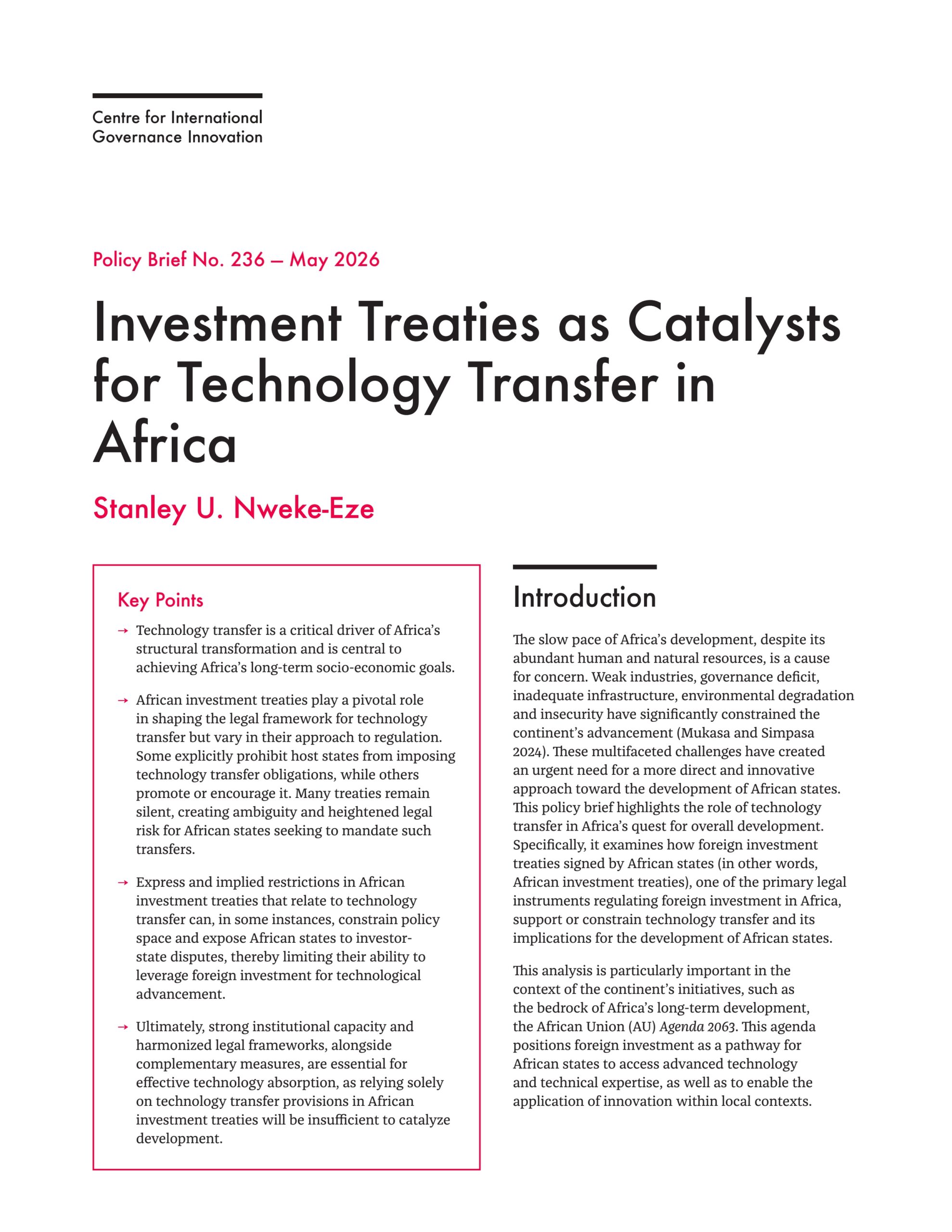
Investment treaties as catalysts for technology transfer in Africa
This policy brief analyses how African investment treaties — more than 1,000 signed to date — support or constrain technology transfer. It examines express and implied treaty restrictions, associated investor-state dispute risks, and recommends that African states adopt precisely drafted provisions and strengthen institutional capacity to enable meaningful technological advancement.
Please login or join for free to read more.

OVERVIEW
Introduction
This policy brief examines how African investment treaties — the primary legal instruments governing foreign investment in Africa — support or constrain technology transfer, and the implications for African development. The analysis is set against the backdrop of the AU Agenda 2063, which positions foreign investment as a pathway to access advanced technology and technical expertise.
The Role Of Technology Transfer In Africa’s Development
Africa faces multiple development challenges. According to the United Nations’ regional commissions report in 2024, 36 percent of Africans in sub-Saharan Africa and 43 percent in Eastern and Southern Africa live below the extreme poverty line (p.2). Most African states allocate less than one percent of their GDP to R&D, limiting innovation and the adoption of advanced technology (p.2).
Technology transfer — the movement of technology and related expertise from regions where it is highly advanced to regions where it is lacking — can generate employment, foster skills development, upgrade local industries and support a clean energy transition.
The AU Agenda 2063’s aspirations 1 and 2 emphasise industrialisation, inclusive growth and technology-driven structural transformation, while aspiration 7 reinforces sustainable energy access and climate resilience. The AfCFTA Investment Protocol, adopted in February 2023, further reinforces technology transfer within a broader regional integration agenda.
African Investment Treaties Vis-À-Vis Technology Transfer Obligations
African states have signed more than 1,000 investment treaties, with approximately half currently in force (p.4). These treaties vary in their approach: some expressly prohibit host states from imposing technology transfer obligations; others actively promote or encourage it; many remain silent, creating ambiguity and legal risk.
Express restrictions — such as prohibitions on performance requirements in the Japan-Kenya BIT (2016), Canada-Senegal FIPA (2014) and Japan-Mozambique BIT (2013) — can directly constrain policy space. Implied restrictions through provisions such as the fair and equitable treatment (FET) clause, national treatment clause and expropriation clause may also limit a state’s ability to mandate technology transfer.
While there are no known publicly reported investor-state arbitration cases directly contesting compelled technology transfer under African investment treaties, this may reflect a deterrent effect, with states pre-emptively avoiding such requirements to escape costly arbitration.
Policy Implications And Recommendations
African states should carefully weigh the implications of including or excluding technology transfer provisions in treaty negotiations. Provisions should include clear definitions, preserve intellectual property rights and avoid forced transfer. Well-crafted provisions that incentivise rather than compel disclosure are more likely to achieve the desired outcome.
Institutional capacity must also be strengthened. Africa accounts for less than one percent of global R&D expenditure, with average spending at about 0.45 percent of GDP — well below the global average of roughly 1.7 to 1.95 percent (p.7). Egypt leads the continent at approximately 1.03 percent (as of 2023), while sub-Saharan countries remain far below the AU’s target of one percent of GDP (p.7).
Conclusion
The success of technology transfer is contingent upon the strength of Africa’s regulatory environment. African nations must ensure investment treaties are articulated with precision — including calibrated exceptions and interpretive guidance — to safeguard development policy space while maintaining investor protections. Without robust frameworks, Africa may struggle to translate foreign investment into the structural technological upgrading needed to overcome systemic developmental hurdles.