

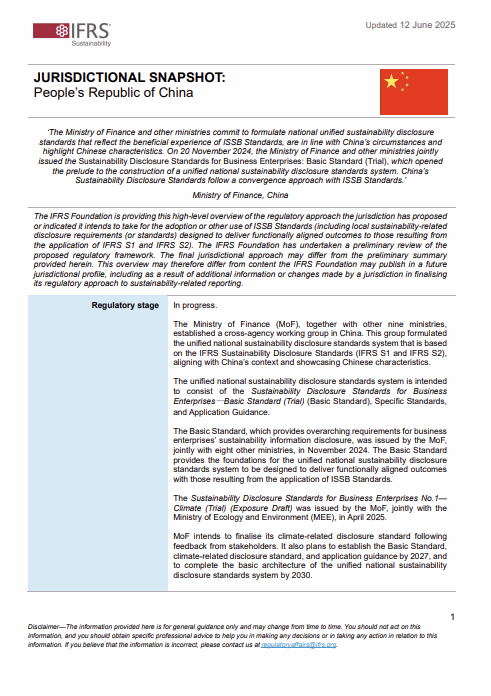
Jurisdictional snapshot: People’s Republic of China
China is developing unified national sustainability disclosure standards aligned with ISSB Standards. Led by the Ministry of Finance, the Basic Standard (Trial) was issued in November 2024, with climate disclosures proposed in 2025. Application is initially voluntary, with phased expansion and potential mandatory adoption by 2030.
Please login or join for free to read more.

OVERVIEW
Disclaimer
The information is provided for general guidance and may change over time. It should not be relied upon as professional advice. The IFRS Foundation notes that this snapshot reflects a preliminary assessment and may differ from China’s final regulatory framework.
Jurisdictional snapshot: People’s Republic Of China
China is developing a unified national sustainability disclosure standards system that converges with ISSB Standards while reflecting domestic circumstances and Chinese characteristics. The framework represents a structured move towards investor-focused, decision-useful sustainability reporting at the national level.
Regulatory stage
The regulatory framework is in progress. The Ministry of Finance (MoF), together with nine other ministries, has established a cross-agency working group to design the national sustainability disclosure standards system aligned with IFRS S1 and IFRS S2.
The Sustainability Disclosure Standards for Business Enterprises—Basic Standard (Trial) was issued in November 2024. In April 2025, the MoF and the Ministry of Ecology and Environment released an exposure draft for a climate-related disclosure standard. Authorities intend to finalise the Basic Standard, climate standard, and application guidance by 2027, with the core architecture of the system expected to be completed by 2030. During this transition period, sector-specific disclosure guidance may be introduced and refined over time.
Relevant authority or authorities
The lead authority is the Ministry of Finance of the People’s Republic of China. Other participating authorities include the Ministry of Foreign Affairs, National Development and Reform Commission, Ministry of Industry and Information Technology, Ministry of Ecology and Environment, Ministry of Commerce, People’s Bank of China, State-owned Assets Supervision and Administration Commission of the State Council, National Financial Regulatory Administration, and China Securities Regulatory Commission.
Proposed requirements
The framework comprises the Sustainability Disclosure Standards for Business Enterprises—Basic Standard (Trial) and Sustainability Disclosure Standards for Business Enterprises No.1—Climate (Trial) (Exposure Draft). This snapshot focuses on the Basic Standard, which establishes overarching sustainability disclosure principles.
Date when requirements become effective
The Basic Standard was issued on 20 November 2024. Until implementation scope and mandatory requirements are defined, application of the standard remains voluntary.
Reporting entities
Reporting entities are yet to be formally determined. The standards are intended to apply initially to listed companies and expand gradually to non-listed entities. Coverage is expected to progress from large enterprises to small and medium-sized enterprises, from qualitative to quantitative disclosures, and from voluntary to mandatory reporting.
Required or permitted
At present, enterprises are permitted to apply the Basic Standard voluntarily. Mandatory adoption will depend on future regulatory decisions.
Focus
The primary users of sustainability information are investors and lenders, while government departments and other stakeholders are also recognised. Disclosures must ensure that material sustainability-related risks and opportunities relevant to investors and lenders are not obscured by broader sustainability impact information.
Scope of sustainability-related risks and opportunities on which entities must report
The Basic Standard provides a foundation for disclosures covering all sustainability-related risks and opportunities. It is designed to support consistent and comparable reporting across topics, beginning with climate.
Materiality filter for disclosures
Disclosures are subject to a materiality filter aligned with IFRS S1. Material information is defined as information that influences the decisions of existing and potential investors and lenders. Enterprises must not obscure material information through excessive non-material disclosures. Sustainability impact information must be clearly distinguishable and assessed based on scale, scope, and likelihood.
Timing, location and reporting entity
Reporting timelines are aligned with ISSB Standards and generally coincide with the publication of financial statements. The Basic Standard does not prescribe a specific location for sustainability disclosures. Reporting entity requirements are aligned with ISSB Standards.
Extension of transition reliefs
The Basic Standard does not provide extensions of transition reliefs.
Jurisdictional Modifications From Requirements In ISSB Standards
Industry-specific information is required, although the format is not yet specified. The Basic Standard does not require consideration of SASB Standards, with further detail to be addressed through application guidance.
Additional disclosure requirements
Disclosures addressing investor and lender needs must remain clearly distinguishable and not be obscured by sustainability impact disclosures aimed at broader stakeholders.
Assurance requirements
Assurance of sustainability disclosures is encouraged but not mandatory.
Further information
The Basic Standard establishes the foundation for future sustainability disclosure requirements, with climate identified as the first priority area.
Relevant document(s)
Relevant documents include the notice issuing the Sustainability Disclosure Standards for Business Enterprises—Basic Standard (Trial) and the consultation letter on the climate disclosure exposure draft.




