Overview
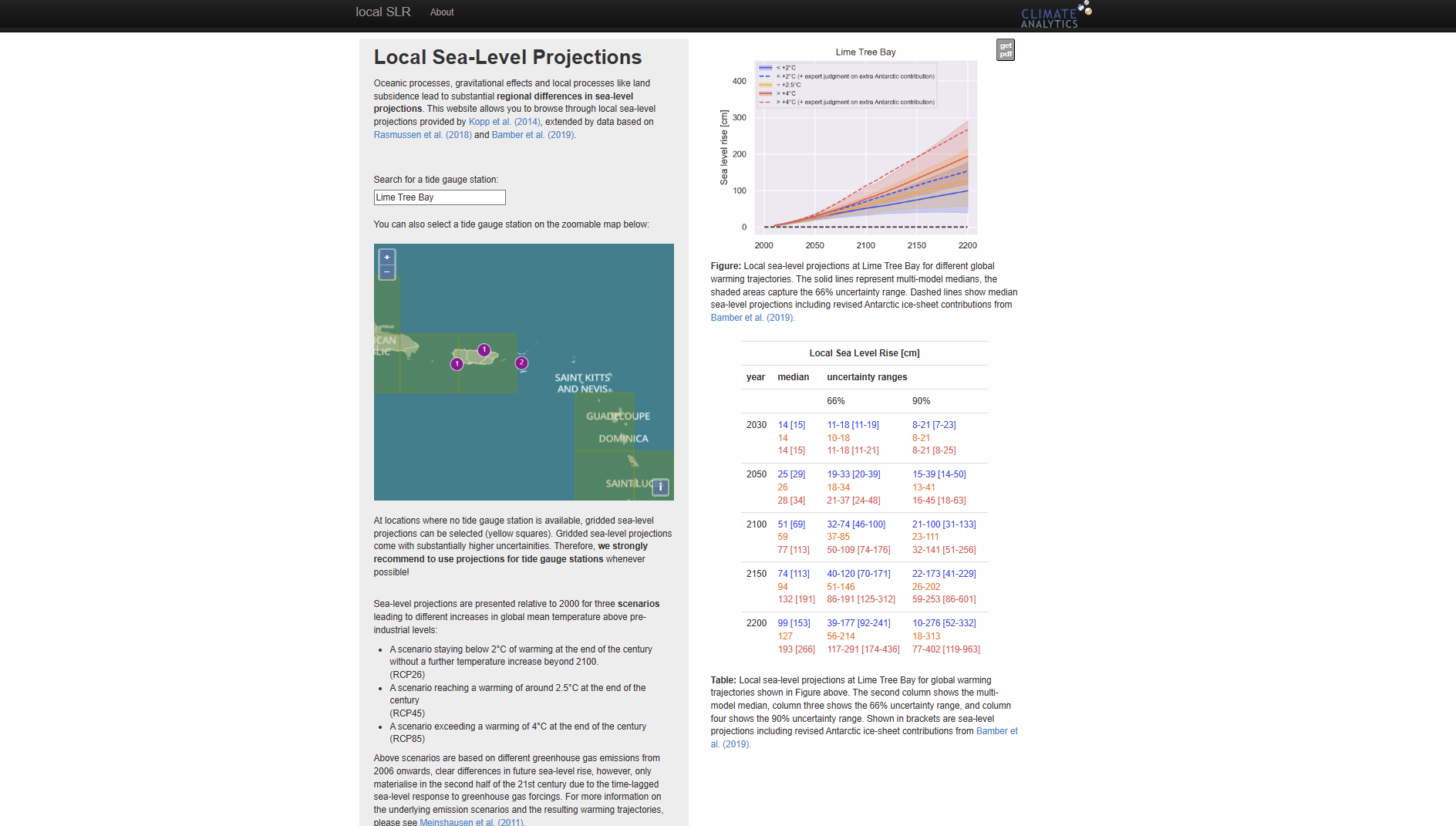
The Local SLR tool provides localised sea-level rise projections based on scientific datasets that reflect regional influences such as oceanic processes, land subsidence and gravitational effects. It enables users to explore how sea level may change at specific locations under different global warming scenarios. Finance professionals may find it relevant for assessing climate-related physical risk and informing long-term planning.
Organisation behind the tool
Climate Analytics, a research organisation focused on climate science, analysis and policy support, developed and maintains the Local SLR tool. The tool’s data are derived from academic research by Kopp et al. (2014), Rasmussen et al. (2018) and Bamber et al. (2019) and are hosted under a Creative Commons licence.
What the tool does
- Allows users to browse local sea-level rise projections for specific tide gauge locations.
- Offers gridded sea-level projections for areas without tide gauges, with noted higher uncertainty.
- Displays projections relative to the year 2000 for multiple warming scenarios (e.g. RCP2.6, RCP4.5, RCP8.5).
- Includes options to examine uncertainty ranges and alternative Antarctic ice-sheet contributions.
- Provides a map interface with zoom and selection tools for geographic navigation.
Target audience
The primary intended users are climate researchers and policymakers needing local sea-level projections. The tool is also accessible to planners, coastal risk analysts, educators and the general public interested in understanding regional sea-level rise outcomes.
Relevance to finance professionals
Risk assessment
- Assessing exposure of assets and infrastructure in coastal regions to projected sea-level changes.
- Informing physical climate risk evaluations for long-term portfolios.
ESG analysis
- Supporting environmental disclosure practices with location-specific climate data.
- Contributing to scenario analysis for climate-related reporting.
Market/commodity insights
- Providing background for sectors sensitive to coastal impacts, such as real estate, insurance, utilities and infrastructure.
Investment context
- Aiding long-term strategic planning using climate scenario projections.
- Offering scientific evidence for adaptation investment decisions linked to climate change impacts.