

LSTA Sustainable Lending Library
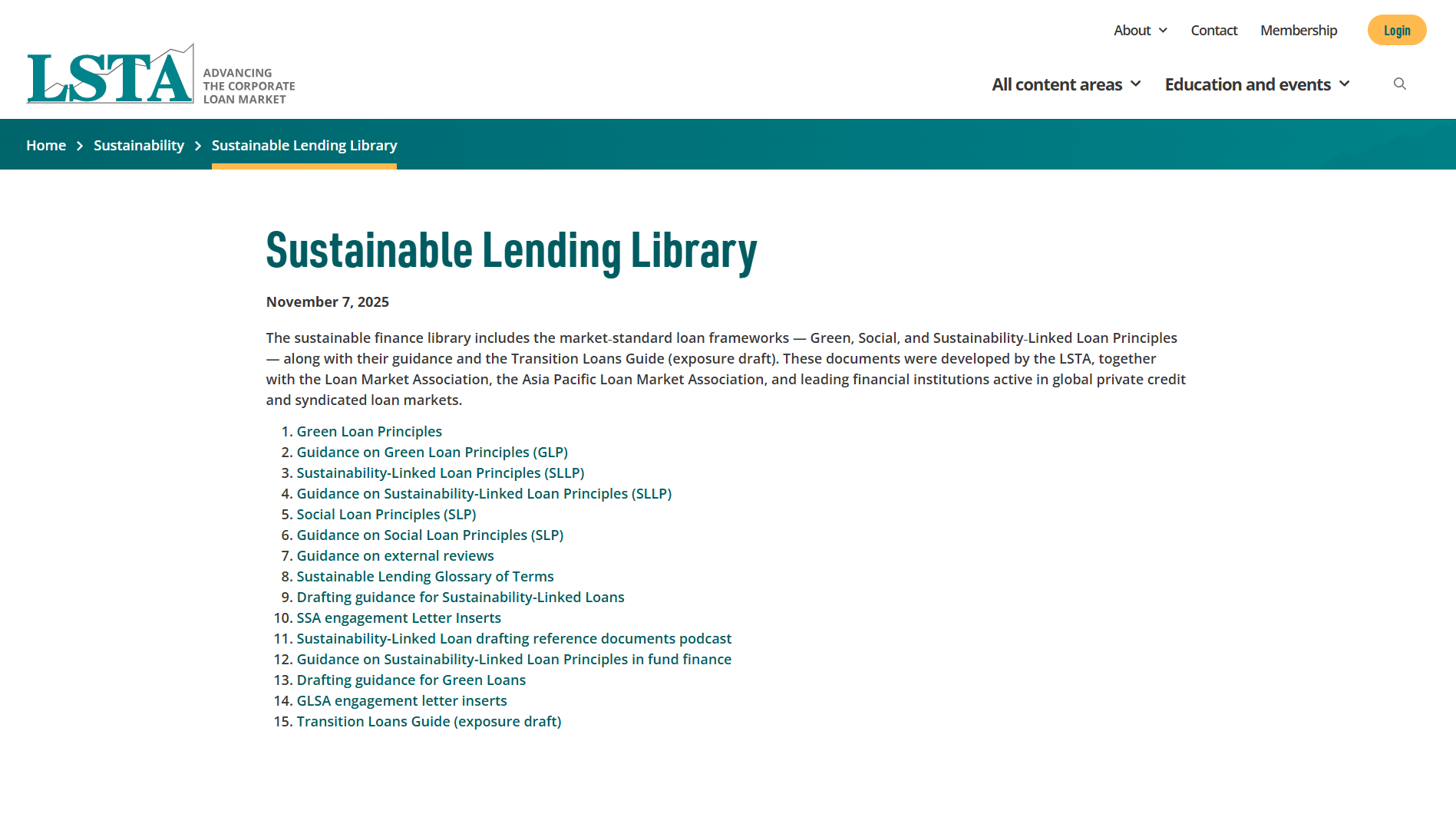
The LSTA Sustainable Lending Library compiles market-standard frameworks and guidance for green, social and sustainability-linked loans, plus a draft Transition Loans Guide. Developed with LMA and APLMA, it supports consistent application of sustainable finance principles in private credit and syndicated loan markets.
Please login or join for free to read more.

OVERVIEW
Introduction
The Sustainable Lending Library is an initiative of the Loan Syndications and Trading Association (LSTA), developed in collaboration with the Loan Market Association (LMA) and the Asia Pacific Loan Market Association (APLMA). It centralises market-standard documentation and guidance to support the consistent application of sustainable finance principles across global loan markets. The resource is intended for participants in private credit and syndicated lending markets seeking practical tools aligned with recognised sustainable lending frameworks.
Green, social and sustainability-linked loan principles
The Library provides access to the Green Loan Principles (GLP), Social Loan Principles (SLP) and Sustainability-Linked Loan Principles (SLLP). These frameworks set out voluntary, high-level guidelines to promote integrity and transparency in sustainable lending.
For green and social loans, the principles focus on use-of-proceeds structures. They outline four core components: use of proceeds, process for project evaluation and selection, management of proceeds, and reporting. Borrowers are expected to allocate funds to eligible green or social projects and provide ongoing reporting to lenders on allocation and impact.
For sustainability-linked loans, the framework shifts from use of proceeds to borrower-level sustainability performance. The SLLP require the selection of material, measurable and externally verifiable key performance indicators (KPIs), calibrated against ambitious sustainability performance targets (SPTs). Loan pricing is typically linked to achievement of these targets, creating a financial incentive for improved ESG performance.
Guidance documents and supporting materials
The Library includes guidance documents that provide further clarity on the application of the GLP, SLP and SLLP. These materials address practical considerations such as KPI selection, target calibration, reporting expectations and external review.
The guidance emphasises that KPIs should be relevant to the borrower’s core business and material ESG risks. SPTs should represent a meaningful improvement beyond business-as-usual trajectories. Transparency and robust disclosure are highlighted as critical to maintaining market credibility.
Sample documents and reference materials are also available to support market participants in drafting and negotiating sustainable loan provisions. These resources aim to promote standardisation and reduce documentation uncertainty.
Transition loans guide
The Library includes a draft Transition Loans Guide, reflecting market efforts to support borrowers in carbon-intensive or hard-to-abate sectors. The guide outlines considerations for loans that finance credible transition strategies aligned with long-term decarbonisation objectives.
It stresses the importance of science-based pathways, clear transition plans and interim targets. Borrowers are expected to articulate how financed activities align with broader climate goals and demonstrate progress through transparent reporting. The guidance seeks to mitigate greenwashing risk by reinforcing the need for credible, measurable and time-bound commitments.
Market integrity and consistency
Across all components, the Sustainable Lending Library reinforces the importance of market integrity, comparability and alignment with internationally recognised standards. By consolidating principles, guidance and draft documentation, the initiative supports consistent interpretation and application of sustainable lending practices across jurisdictions.
The collaboration between LSTA, LMA and APLMA reflects a coordinated global approach. The Library serves as a practical reference point for lenders, borrowers and advisers seeking to structure green, social, sustainability-linked and transition loans in a manner consistent with evolving sustainable finance norms.




