Setting the scene
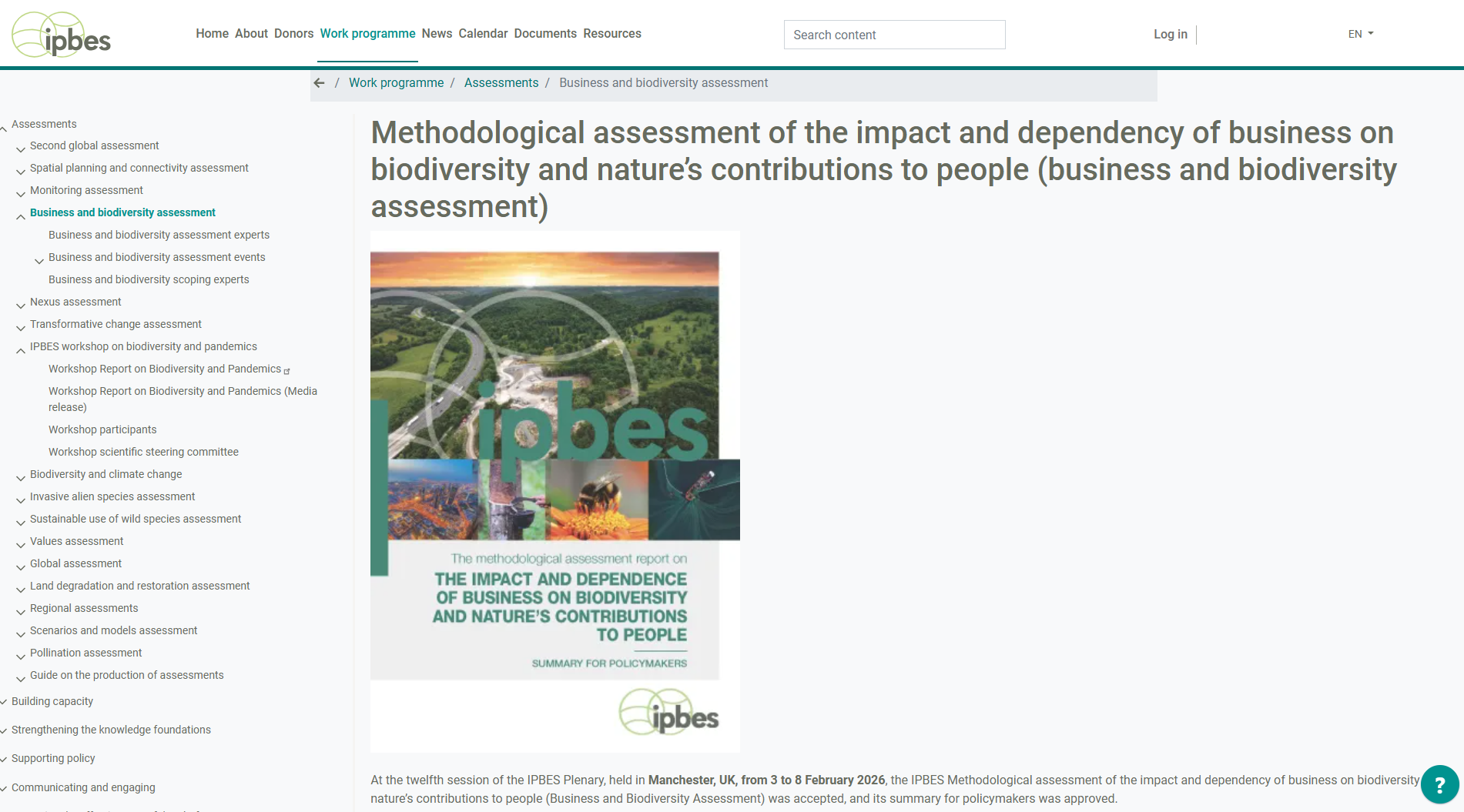
The IPBES Methodological Assessment Of The Impact And Dependency Of Business On Biodiversity And Nature’s Contributions To People evaluates how businesses and financial institutions depend on and affect biodiversity. Developed over three years by 100+ experts from 35 countries, it supports Target 15 of the Kunming-Montreal Global Biodiversity Framework, which calls for biodiversity risk assessment, monitoring and disclosure by business and finance. The report links biodiversity loss to systemic economic and financial risk and positions business as central to achieving global biodiversity goals.
How does business depend on biodiversity?
All sectors depend on biodiversity and nature’s contributions to people, directly through raw materials (such as timber, fish and crops) and indirectly through ecosystem regulation, including pollination, climate regulation, soil formation and water purification. These dependencies vary by sector and geography but are often under-recognised in corporate strategy and risk management. The assessment highlights that failure to account for such dependencies can expose businesses and investors to operational, supply chain and reputational risks.
How does business impact biodiversity?
Business activities drive both negative and positive biodiversity outcomes. Major pressures include land-use change, resource extraction, pollution, invasive species and climate change. Sectors such as agriculture, forestry, fisheries, mining, infrastructure and energy are identified as having significant impacts across value chains. The report notes that public and private financial flows harmful to biodiversity substantially exceed investment in conservation and restoration. It also highlights limited transparency, with fewer than 1% of publicly listed companies disclosing biodiversity-related impacts, dependencies or risks.
Approaches for measurement of business dependencies and impacts on biodiversity
The assessment reviews available tools, metrics and frameworks used to measure biodiversity impacts and dependencies. While numerous methodologies exist, application is inconsistent and often focused more on impacts than dependencies. Measurement challenges include data gaps, limited spatial resolution and difficulty capturing indirect and cumulative effects. The report stresses that metrics must be decision-useful, aligned with corporate strategy and integrated into risk management and reporting systems. Improved data availability, standardisation and interoperability are identified as priorities.
Businesses as key actors in transformative change: Options for action
The report outlines over 100 action options for businesses and financial institutions. These include integrating biodiversity into governance, strategy and risk frameworks; assessing and disclosing impacts and dependencies; setting science-based targets; transforming supply chains; and aligning capital allocation with biodiversity outcomes. Voluntary action alone is considered insufficient to achieve the required scale and pace of change. Internal incentives, strengthened accountability and collaboration across sectors are needed to shift business models towards biodiversity-positive outcomes.
Creating an enabling environment for business: Options for action by governments, the financial sector, indigenous peoples and local communities and civil society
Governments and financial actors play a critical role in creating enabling conditions. The report calls for coherent policy frameworks, regulatory requirements, reform of harmful subsidies, improved enforcement and greater alignment between financial flows and biodiversity objectives. Engagement with Indigenous Peoples and local communities is emphasised, recognising their knowledge and stewardship roles. Systemic change requires coordinated action across policy, finance and civil society to realign economic systems with biodiversity conservation and sustainable use.