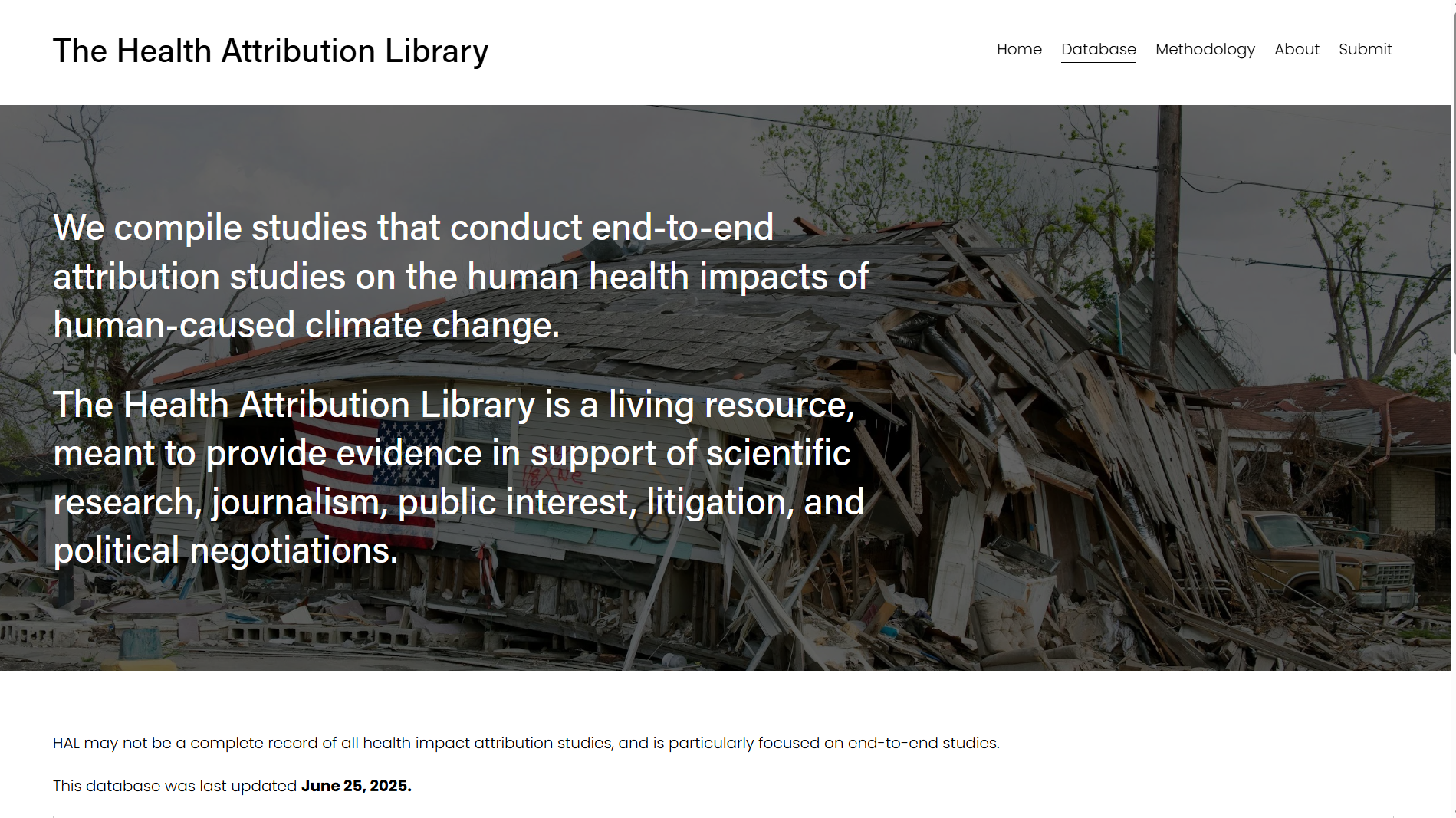
The Health Attribution Library (HAL) compiles peer-reviewed, “end-to-end” studies that attribute human health outcomes to anthropogenic climate change. It provides a searchable, living collection of evidence linking climate change to mortality, morbidity and other health impacts — useful to analysts tracking climate-related risks and long-term environmental liabilities.
Organisation behind the tool
HAL is maintained by the Carlson Lab at Yale University School of Public Health. The database is curated and updated periodically, most recently in mid-2025.
What the tool does
- Aggregates studies that use detection and attribution methods to quantify how human-driven climate change has affected human health.
- Provides a searchable interface to explore studies by region, health outcome, hazard type (e.g. heatwaves, extreme weather, pollution).
- Allows users to view metadata and summaries of individual studies; many entries include downloadable reports or references to original peer-reviewed publications.
- Serves as a “living resource” intended to support research, journalism, public interest work, litigation and policy analysis.
Target audience
Primary users include climate researchers, public-health scientists, and policy analysts. Secondary audiences comprise journalists, legal practitioners, public-interest organisations, and decision-makers concerned with climate and health.
Relevance to finance professionals
- Risk assessment – Enables evaluation of health-related risks tied to climate hazards (heatwaves, air pollution, extreme weather), which can influence insurance, public-sector liabilities and infrastructure planning.
- ESG analysis – Offers quantifiable health impacts from climate change that may inform environmental and social risk reporting or disclosures.
- Market/commodity insights – Data on climate-linked health stressors could affect sectors such as healthcare, insurance, pharmaceuticals, or infrastructure demand.
- Investment context – Provides evidence of long-term climate-driven health and social trends — relevant for investors assessing exposure to climate-related liabilities, or opportunities in adaptation and resilience.