
Library | Resource Types
Research
We summarise credible research and reports on sustainable finance and ESG issues. Our summaries, along with our AI ChatBot saves members time reading large reports, to focus on knowledge building and action.
Refine
1831 results
REFINE
SHOW: 16


Carbon tariffs, emissions leakage, and production relocation
This paper examines whether carbon tariffs prevent emissions leakage from firm relocation in a North-South duopoly model. It finds that carbon tariffs combined with export rebates form the optimal carbon tax regime, preventing leakage when the northern firm's emissions intensity exceeds fifty percent of the southern firm's, and can benefit both countries.
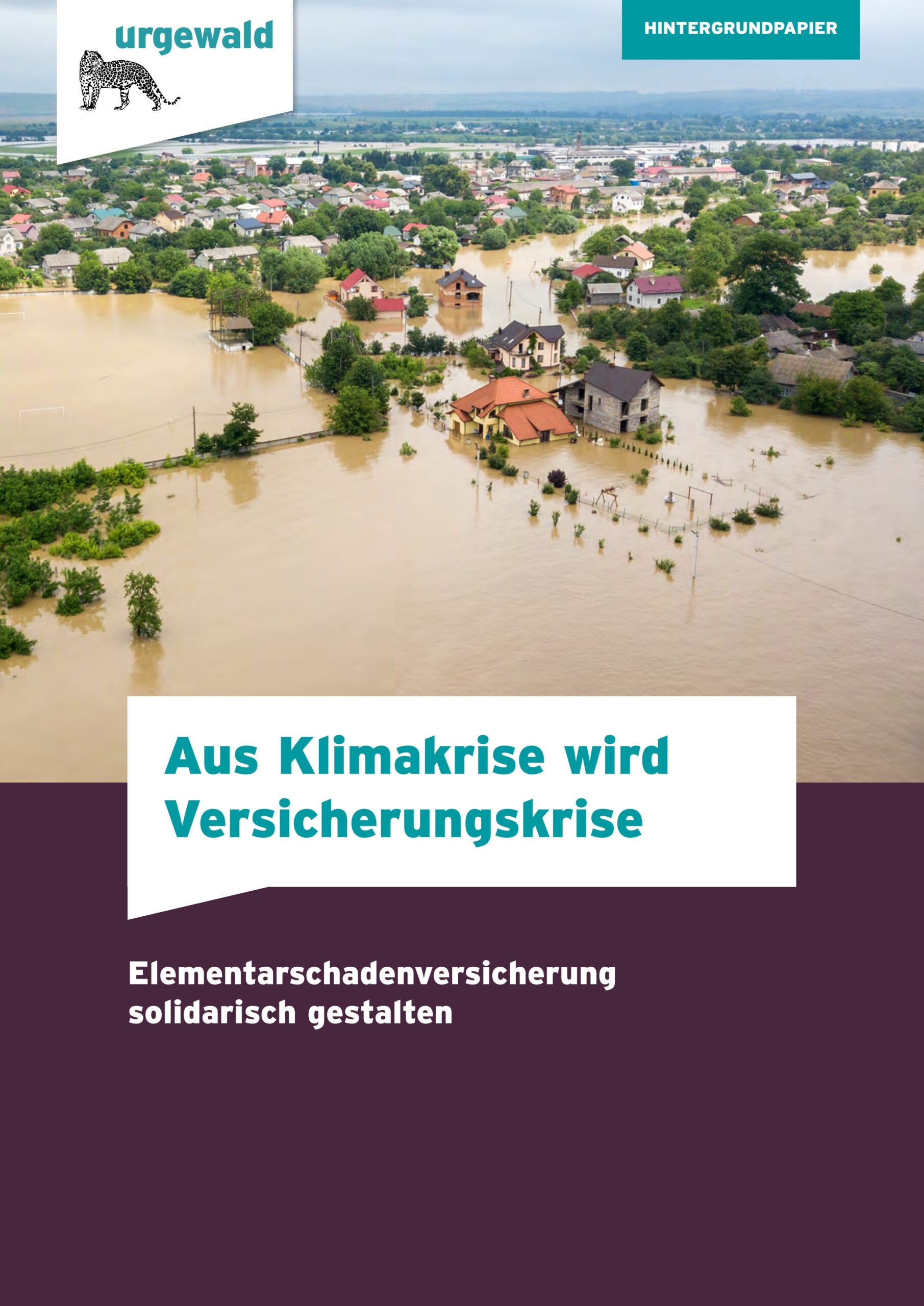
From climate crisis to insurance crisis: Designing solidarity-based natural disaster insurance
This report examines rising climate-related insurance losses and Germany's lack of comprehensive natural disaster coverage, with only 57% of residential buildings insured against such risks. It analyses international public-private insurance models — particularly France's CatNat system — and recommends a solidarity-based approach alongside measures to hold the fossil fuel industry financially accountable.
Looking beyond greenhouse gas emissions: Interlinkages between the commercial vehicle industry and nature
Published by WWF Sweden in collaboration with TRATON GROUP, this report examines the commercial vehicles sector's interlinkages with nature across its full value chain. It analyses six key commodities and value chain stages, identifies nature-related risks for businesses, and calls for sector-wide collaborative action towards a nature-positive future.
Shareholder proposals and corporate governance in a season of regulatory uncertainty
This report analyses the 2025–2026 proxy season following the SEC's suspension of its no-action review process. Shareholders filed approximately 20% fewer proposals; companies filed over 100 fewer exclusion notices. Exclusions disproportionately affected novel and revised proposals, with proponents increasingly turning to litigation and alternative strategies to preserve shareholder rights.
Widening the lens: Scaling climate adaptation and resilience through sustainable finance
This report examines climate adaptation and resilience in sustainable finance, highlighting a significant financing gap in emerging markets and limited formal allocation in labelled debt markets. It argues for a broader lens that recognises resilience outcomes already embedded in policy-driven investments, using Ecuador's sovereign housing framework as a case study.
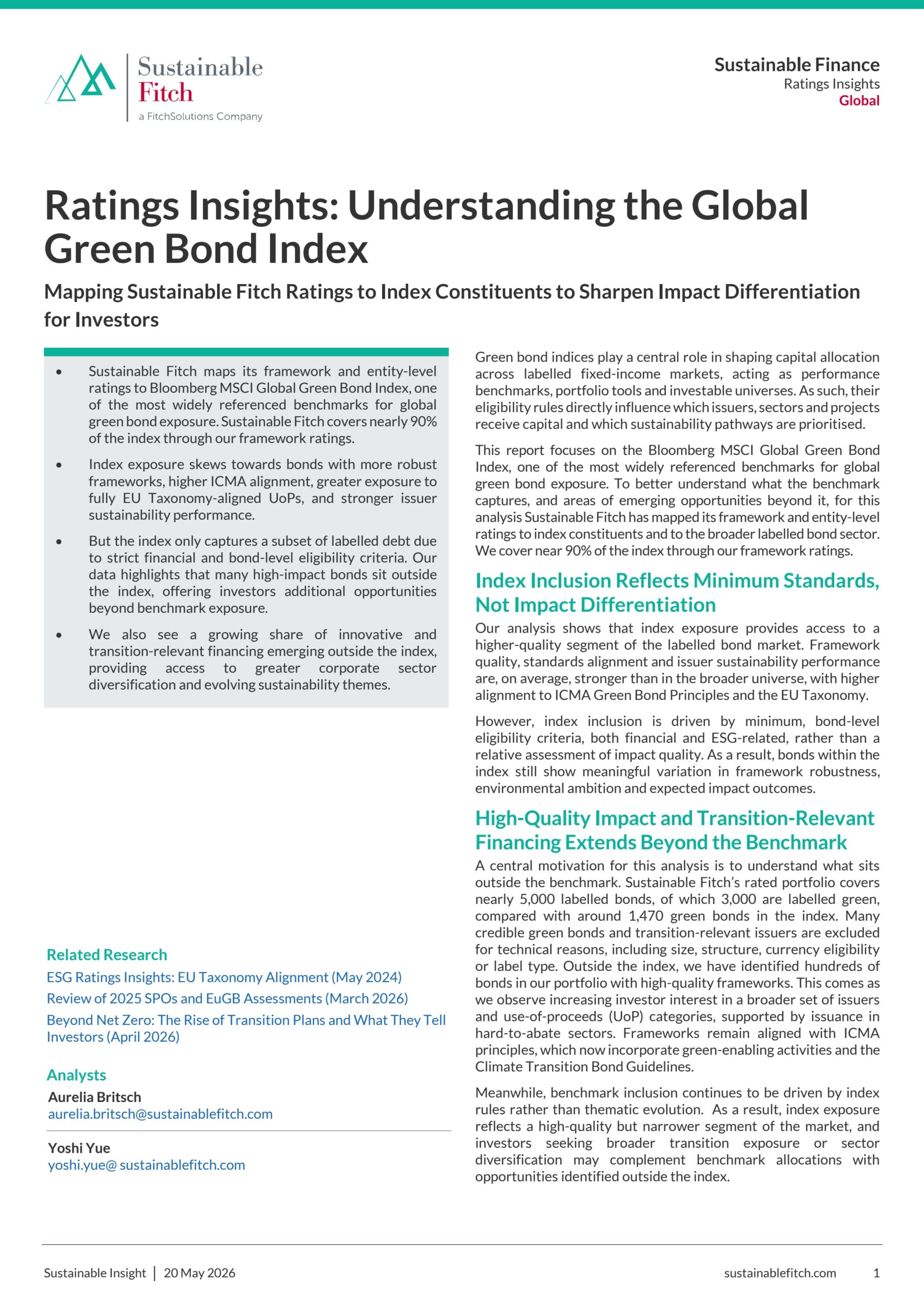
Ratings insights: Understanding the global green bond index
Sustainable Fitch maps its framework and entity-level ratings to the Bloomberg MSCI Global Green Bond Index, covering 88% of index bonds. While index constituents show stronger framework quality and ICMA alignment than the broader market, many high-quality and transition-relevant bonds sit outside the benchmark due to financial eligibility constraints.
Navigating towards water resilience: An introductory guide for central bankers, financial supervisors and regulators
This WWF Greening Financial Regulation Initiative guide introduces central banks, financial supervisors and regulators to the financial risks posed by the global water crisis. It covers physical, transition and systemic risks, emerging responses from the financial sector, available assessment tools, and policy recommendations for integrating water risks into supervisory frameworks.
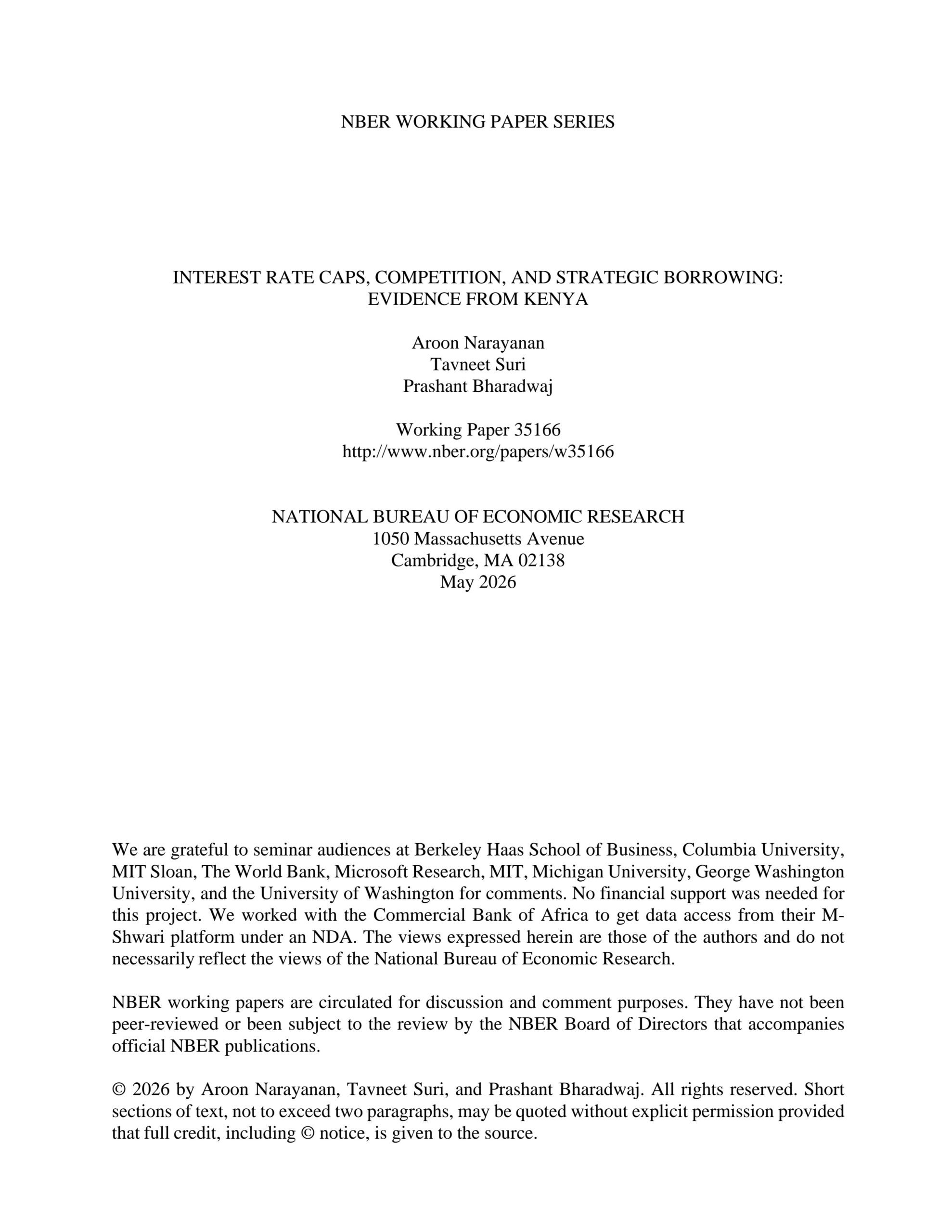
Interest rate caps, competition, and strategic borrowing: Evidence from Kenya
This paper examines Kenya's 2016 interest rate regulation, which capped bank lending rates but exempted the digital platform M-Shwari. Using borrower-level administrative data and a structural model, the authors find that the M-Shwari carve-out preserved credit access for high-risk borrowers, while a uniform cap would have eliminated it entirely.

The ICJ's advisory opinion on climate change
This edited volume analyses the ICJ's July 2025 advisory opinion on climate change obligations, examining its legal framework, due diligence standards, human rights implications, and statehood findings. Contributing authors also assess the opinion's notable silences on historical responsibility, military emissions, and differentiated obligations.
Potential business cases in measuring biodiversity state and impact in agriculture
A joint Mistra FinBio and Svensk Kolinlagring report identifying three business cases linking biodiversity data to agricultural finance: baseline databanks for bank and insurance risk assessment, and an MRV system for biodiversity claims. It highlights the financing gap in regenerative agriculture and outlines potential biodiversity-linked financial products.
Credible climate financing and fossil fuel phase-out commitments are possible but remain marginal amongst major financial institutions
WBA's analysis of 400 major financial institutions finds that transition planning is emerging but capital allocation to low-carbon solutions and fossil fuel phase-out commitments remain marginal. Only two institutions demonstrate robust fossil-fuel restrictions, and low-carbon activities account for an average of just 2.7% of total financed activities globally.
Ethical & impactful usage of AI
This report by Do Harvey outlines an ethical framework for AI usage, highlighting environmental impacts, security risks, and bias concerns. It advocates for transparent, client-opt-in adoption underpinned by human oversight, and summarises five modes of AI use to guide teams in making values-aligned, informed decisions.
State of the Sustainability Profession 2026
The 2026 State of the Sustainability Profession report by Trellis Group surveys more than 500 professionals at companies with at least $1 billion in revenue. Most large businesses are maintaining sustainability commitments despite political headwinds, though investment has slowed, communications are being scaled back and professionals report growing dissatisfaction.

Stuck on you: How to make social media good again
This IPPR paper examines how social media platforms have shifted from user-led spaces to algorithm-driven, influencer-dominated environments through 'sticky gatekeeping'. A UK survey found only 18 per cent of feed posts were personal content. The report recommends regulatory reform, algorithmic transparency, and development of a public social media platform.
AlphaGlass: Interpretable characteristic-based portfolio choice
AlphaGlass is an interpretable machine-learning framework for characteristic-based portfolio construction that directly optimises the Sharpe ratio. Applied to U.S. equities from 2000 to 2021, it achieves a monthly out-of-sample Sharpe ratio of 0.47, outperforming random forests, neural networks, and EBM benchmarks, while providing transparent attribution to firm characteristics.
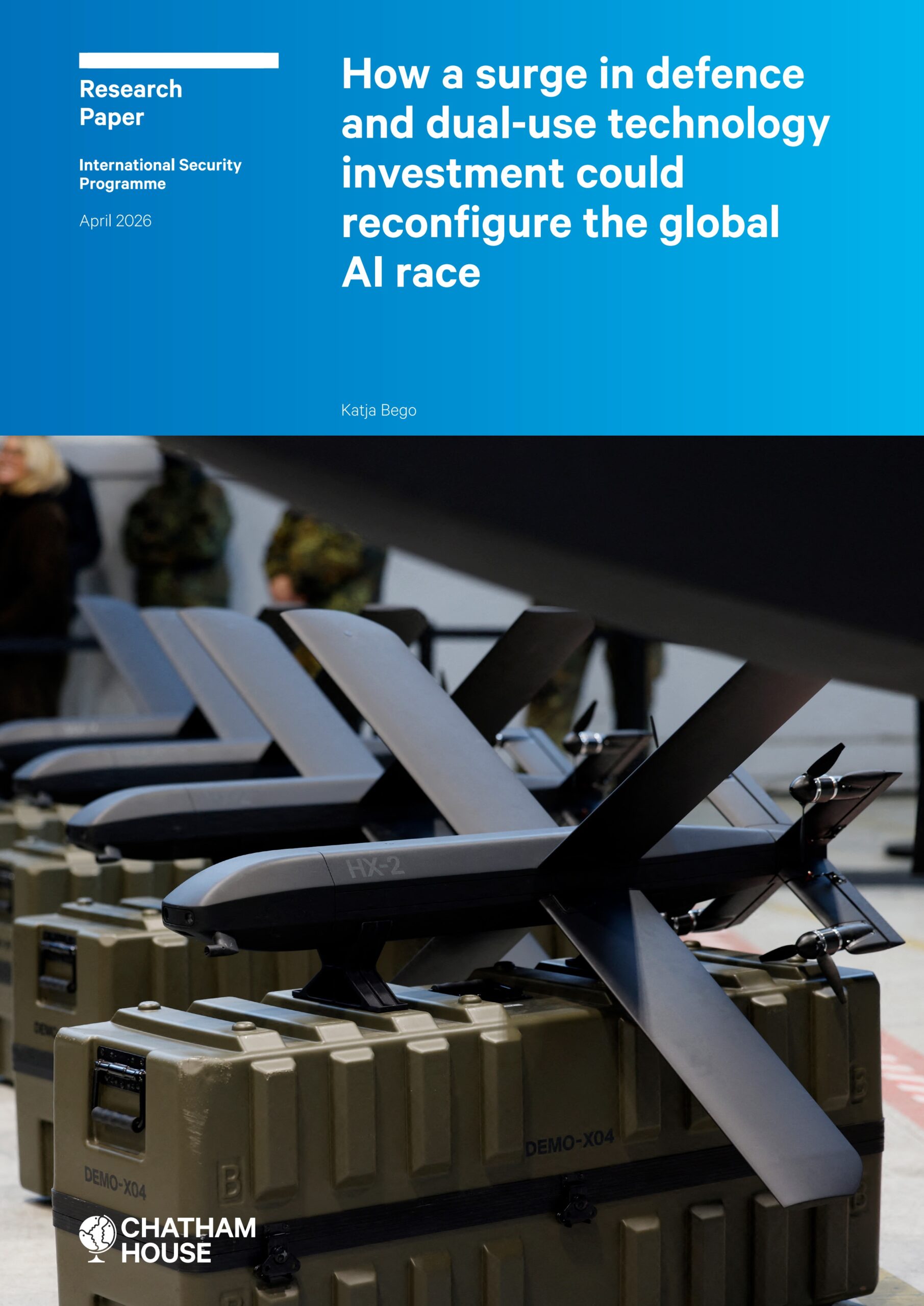
How a surge in defence and dual-use technology investment could reconfigure the global AI race
This Chatham House paper examines four trends — rising defence and dual-use investment, the growth of 'patriotic tech', the push for sovereign AI, and concerns over an AI valuation bubble — that could multipolarise the global AI race, and offers recommendations for private sector preparedness.


