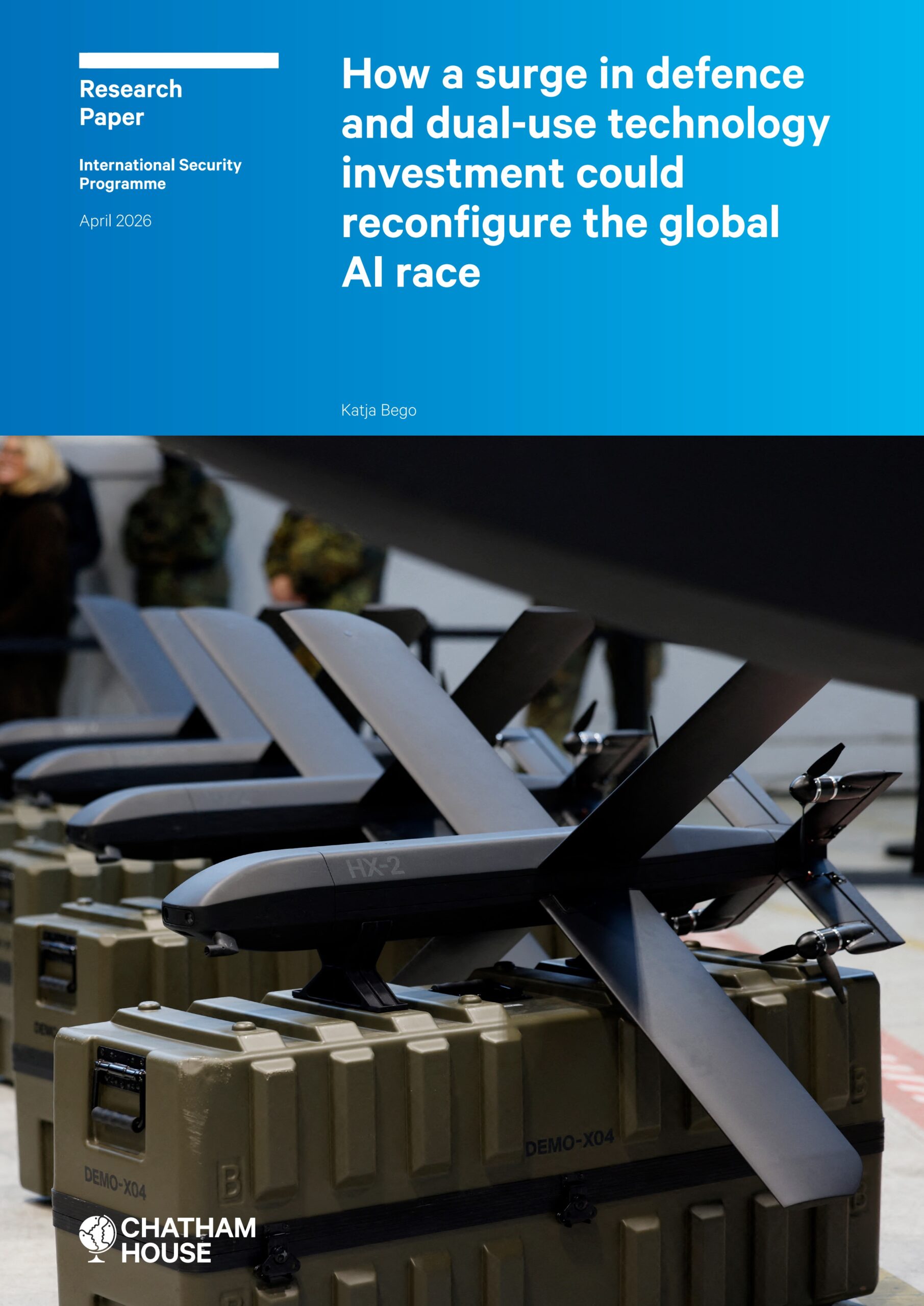
How a surge in defence and dual-use technology investment could reconfigure the global AI race
This Chatham House paper examines four trends — rising defence and dual-use investment, the growth of ‘patriotic tech’, the push for sovereign AI, and concerns over an AI valuation bubble — that could multipolarise the global AI race, and offers recommendations for private sector preparedness.
Please login or join for free to read more.

OVERVIEW
Introduction
The global AI race, long dominated by the US and China, may become more fragmented and multipolar as current trends continue. Geopolitical tensions, rising defence spending and growing concerns over technological dependency are prompting more countries to develop independent AI capabilities. This paper examines four trends from 2025 and early 2026 that could significantly reconfigure the AI race.
Trend 1: A ‘boom’ in dual-use and defence tech
Investment in dual-use and defence AI has accelerated sharply. VC-backed defence startups in the US and Europe raised a combined $7.7 billion between January and October 2025 – more than double 2024’s total – while overall private defence investment in 2025 exceeded $48 billion (p.10). The EU spent approximately €381 billion on defence in 2025, nearly double what its member states spent a decade earlier, with VC-backed investment increasing by around 80 per cent between 2024 and 2025 (p.12).
Governments are treating high defence spending as industrial policy, with spillover benefits potentially enabling smaller AI ecosystems to mature. Countries such as South Korea, Ukraine and Israel demonstrate how battlefield experience and government–industry integration can cultivate competitive dual-use technology sectors.
Trend 2: The rise of ‘patriotic tech’ and the blurring of boundaries between civil and military
Commercial AI firms are increasingly embedded in national security ecosystems. By 2025, Anthropic, Meta and OpenAI had each signed deals with the US Department of Defense (p.11), while the Pentagon’s GenAI.mil platform, launched in December 2025, provides secure generative AI access to its 3 million staff members (p.11). Beijing’s doctrine of ‘civil–military fusion’ formalises similar entanglement in China.
This growing intimacy can boost strategic capacity but risks creating a powerful tech–military complex, increasing geopolitical distrust and accelerating decoupling. Companies must balance compliance with home government demands against the risk of eroding global trust in their products and services.
Trend 3: The pursuit of sovereign AI
Governments worldwide are reassessing their technology stacks amid fears of weaponised dependency. Three US-based companies (Amazon, Google and Microsoft) account for around 70 per cent of the European cloud storage market (p.23). A March 2026 poll found that 86 per cent of Europeans consider the possibility of the US restricting access to critical technologies ‘plausible’ and something that ‘should not be ruled out’ (p.23).
Countries are increasingly willing to pay a ‘sovereignty premium’, favouring domestic or allied solutions over cutting-edge but geopolitically unreliable alternatives. Notable examples include Japan, India and EU-wide initiatives such as EuroStack. Over time, this push may produce incompatible ‘sovereign’ technology stacks across regions.
Trend 4: Growing concerns about a potential AI valuation bubble
US-based companies attracted 75 per cent of total global VC investment in AI in 2025, with AI capturing 61 per cent of all global VC spending (p.28). Major hyperscalers spent at least $300 billion on new AI infrastructure in 2025 (p.29), with more recent projections suggesting this could reach $700 billion in 2026 (p.29). Deutsche Bank estimated the major AI players face a shortfall of around $800 billion by 2028 (p.29).
A market correction could shift focus from capital-intensive frontier models towards cheaper, open-source alternatives, potentially enabling smaller actors – including China’s open-source AI champions – to gain greater market share.
How can the private sector prepare? Likely outcomes and recommendations
A more multipolar AI market introduces new risks: greater instability, reduced interoperability and heightened exposure to geopolitical tensions and bad actors. The paper recommends that companies establish dedicated geopolitical risk functions to monitor ‘buy local’ policies and map supply-chain dependencies; conduct regular ‘tech decoupling’ stress tests modelling the implications of sudden market access loss or forced infrastructure decoupling; develop infrastructure architectures compatible with data-localisation and sovereignty requirements; structure corporate entities to allow genuine legal and operational separation across regions; and invest in cybersecurity and crisis preparedness — including in-house cyber capabilities, ‘airgapping’ critical systems and mapping physical infrastructure vulnerabilities — to counter increasingly sophisticated AI-enabled threats.