
Library | ESG issues
Business Ethics
Business ethics encompass the moral principles and values guiding corporate conduct, extending beyond legal requirements to promote integrity and trust among stakeholders. Key considerations include corporate governance, conflicts of interest, insider trading, bribery, discrimination, human rights, social responsibility, and fiduciary duties.
Refine
129 results
REFINE
SHOW: 16


Making Xinjiang sanctions work: Addressing forced labour through coercive trade and finance measures
This is a comprehensive and rigorous analysis of the measures adopted and implemented to address the issue of forced labour in Xinjiang, China. Based on open-source data and expert analysis, the report highlights key themes and outlines a set of recommendations designed to improve the effectiveness of current trade and financial measures.

Net zero: Practical guide for finance teams
This guide is a valuable resource for organisations striving towards net zero emissions. From developing internal culture to accessing finance, this guide provides practical advice for finance teams seeking to develop an effective strategy.

The Ethical Trading Initiative (ETI) base code
This report describes the ETI Base Code, an internationally recognised code of good labour practice promoting ethical trade. Its nine standards aim to protect workers and prevent exploitation in global supply chains. The code is implemented by forward-thinking companies, trade unions, and NGOs to promote decent work.

Investor ESG guide on private security and human rights
This investor guide highlights that private security-related adverse human rights impacts are common and typically include excessive use of force, unfair working conditions and sexual exploitation. As fiduciaries, institutional investors are obligated to identify and mitigate these potential adverse impacts.

Integrating nutrition and obesity prevention considerations into institutional investment decisions regarding food companies: Australian investment sector perspectives
This study investigates views of stakeholders in the Australian investment sector on the incorporation of nutrition and obesity prevention considerations within institutional investment decision-making regarding food companies and identifies several key challenges and opportunities to the integration of nutrition and obesity prevention considerations.

The purpose action gap: The business imperative of ESG
This report examines the gap between what consumers and brands believe and how they act when it comes to purpose and sustainability. Based on studies of 2,500 consumers and interviews with 125 large consumer companies, the report offers valuable insights for businesses looking to meet consumer and investor expectations.

Resources, energy and modern slavery: Practical responses to managing risks to people
This report provides practical responses for managing modern slavery risks in the resources and energy sectors. Covering topics such as risk to people and business, human rights risks, and key responses for addressing these risks, the report is an essential guide for companies seeking to effectively identify and manage modern slavery risks.

Impact Capital Managers
Explore Impact Capital Managers, a prominent player in impact investment. Specialising in sustainable finance, they provide expertise in aligning financial goals with positive social and environmental outcomes. Visit the website for insights into impactful investment strategies, empowering you to make a difference through your financial decisions.

Toward a G20 framework for artificial intelligence in the workplace
This report advocates for creating a high-level, G20 framework using a set of principles for the introduction and management of big data and AI in the workplace. The paper identifies main issues and suggests two paths towards adoption.

The state of AI in 2022 - and a half decade in review
The adoption of AI has more than doubled, with a peak of 58% in past years. The report highlights the importance of best practices and investing in AI as it is shown to bring financial returns. However, the majority of organisations are not mitigating risks associated with AI despite increasing use.
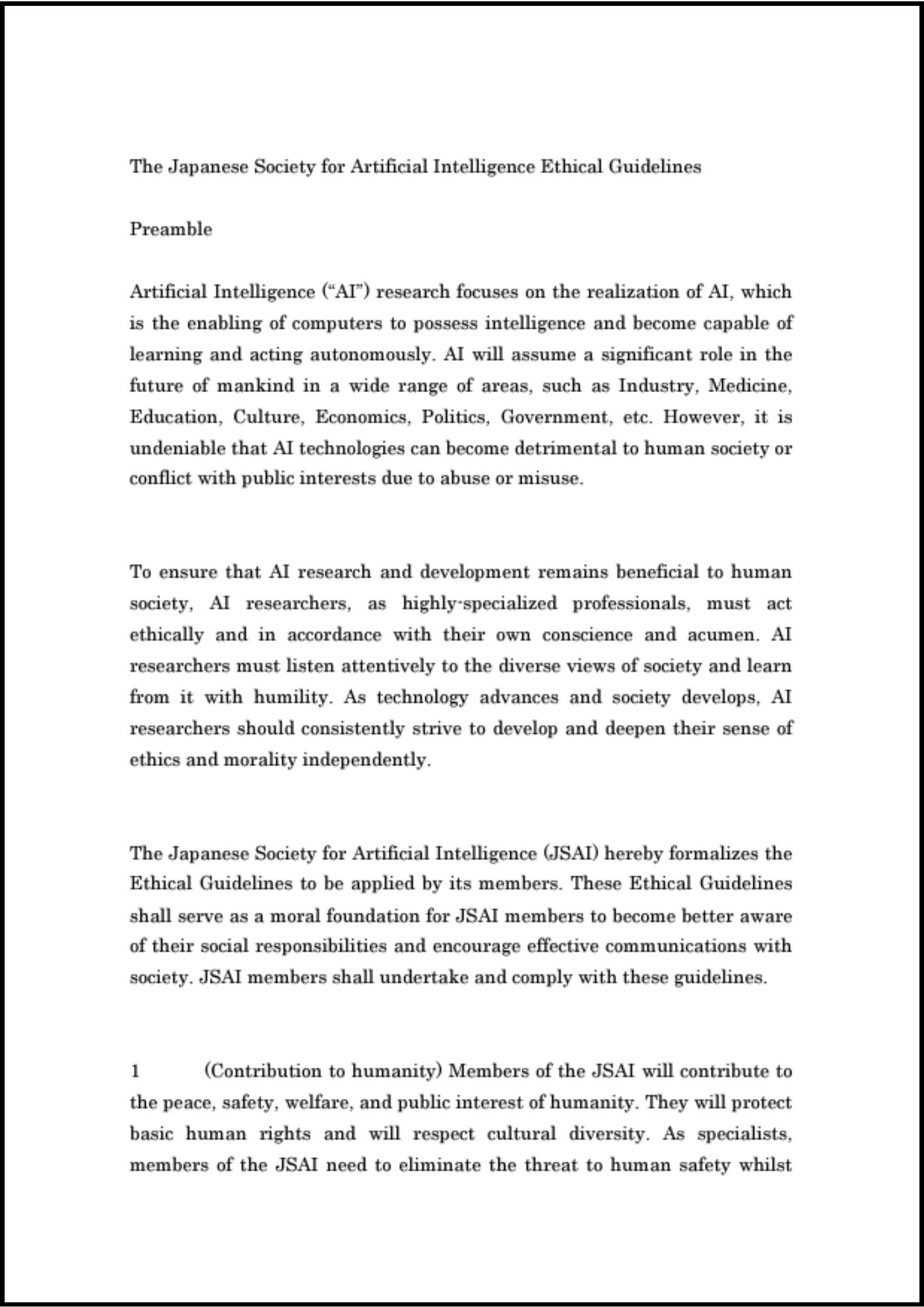
The Japanese society for artificial intelligence ethical guidelines
The Japanese Society for Artificial Intelligence has released ethical guidelines that aims to protect basic human rights and promote the peace, welfare, and public interest of humanity. The eight guidelines include: contributing to humanity, abiding by laws and regulations, respecting others' privacy, being fair, maintaining security, acting with integrity, being accountable and socially responsible, and communicating with society and self-development.

Montreal declaration for a responsible development of artificial intelligence
This report outlines a framework for responsible development of artificial intelligence. It provides principles that should guide ethical use of AI for the well-being of sentient beings, respect for autonomy, protection of privacy and intimacy, solidarity, democratic participation, equity, diversity inclusion, caution, responsibility, and sustainable development.

Ethically aligned design: A vision for prioritising human well-being with autonomous and intelligent systems
This report is a call-to-action for technologists to align creation of autonomous and intelligent systems to defined values and ethical principles prioritising human well-being. Emphasising the importance of embedding values and morals into these systems, it discusses a range of topics, including job automation, personal data protection, A/IS education, law, and more.

Engaging the ICT sector on human rights: Discrimination
This report examines the risks of discrimination in the Information and Communication Technologies sector and its impact on human rights. It provides company guidance on eliminating discrimination and promoting inclusion, as well as investor guidelines for holding companies accountable.

Engaging the ICT sector on human rights: Child rights
This briefing explores the risks and opportunities Information and Communication Technologies (ICT) companies face in relation to children's rights. It highlights the importance of adhering to international standards and implementing internal policies and practices that prioritise the most severe impacts on children. Investors are encouraged to hold companies accountable.

Dutch pension funds agreement on responsible investment
The Dutch Pension Funds Agreement on Responsible Investment outlines the policies and procedures needed for pension funds to prevent, mitigate, and remediate against negative social and environmental consequences of investments. The agreement promotes long-term shareholder engagement and encourages due diligence in outsourcing, reporting, and transparency.


