
Library | ESG issues
Environmental
The environmental pillar in ESG (environmental, social, and governance) assesses an organisation’s impact on the planet. It includes issues such as climate change, biodiversity, waste management and water management. Strong environmental practices help businesses reduce risks, comply with regulations, and drive long-term sustainability.
Refine
1580 results
REFINE
SHOW: 16


Beyond compliance in the renewable energy sector: Assessing UK and Australian Modern Slavery Act statements
This report assesses the statements of 60 renewable energy companies under the UK and Australian Modern Slavery Acts, identifying their compliance gaps. Though most firms disclose their modern slavery policy, few extend it beyond tier one, limiting worker protection. The report calls for improved guidance, supply chain transparency, and stronger government enforcement measures.

Rethinking climate change: How humanity can choose to reduce emissions 90% by 2035 through the disruption of energy, transportation, and food with existing technologies
This report examines how existing technologies in energy, transportation, and food could lead to a 90% reduction in greenhouse gas emissions by 2035. Using the Seba Technology Disruption Framework, they forecast disruptive changes and identify how markets could drive emissions mitigation.

Unused tools: How central banks are fueling the climate crisis
This report dissects the role of central banks in fossil fuel finance and climate change, presenting 10 criteria for assessment and analysing 12 central banks worldwide. While there is increased recognition among global central banks of the severity of climate change, they continue to prop up fossil fuels and largely maintain an industrial structure that uncritically exacerbates the climate crisis.

Measuring what matters most: Seven systems transformations for benchmarking companies on the SDGs
This report provides guidance on developing benchmarks to transform systems towards achieving Sustainable Development Goals (SDGs). It identifies seven critical transformations: social, agriculture and food, decarbonisation and energy, circular, digital, urban, and financial systems. These benchmarks aim to hold companies accountable and drive meaningful change across industries to support sustainable development.

Physical risk framework: Understanding the impacts of climate change on real estate lending and investment portfolios
This report provides lenders and investors with a four-step process to assess the physical impact of climate change on their real estate and infrastructure portfolios. The report emphasises the importance of using insurers’ extreme weather models within this framework to estimate natural catastrophe risks.

Transition risk framework: Managing the impacts of the low carbon transition on infrastructure investments
This report introduces a transition risk framework aiding investors and regulators in navigating risks and seizing opportunities in the low-carbon transition. It enhances comprehension of how transition risks impact financial performance in infrastructure investments, offering a transparent, adaptable, and robust methodology for assessing the financial implications of a shift towards a low-carbon economy.
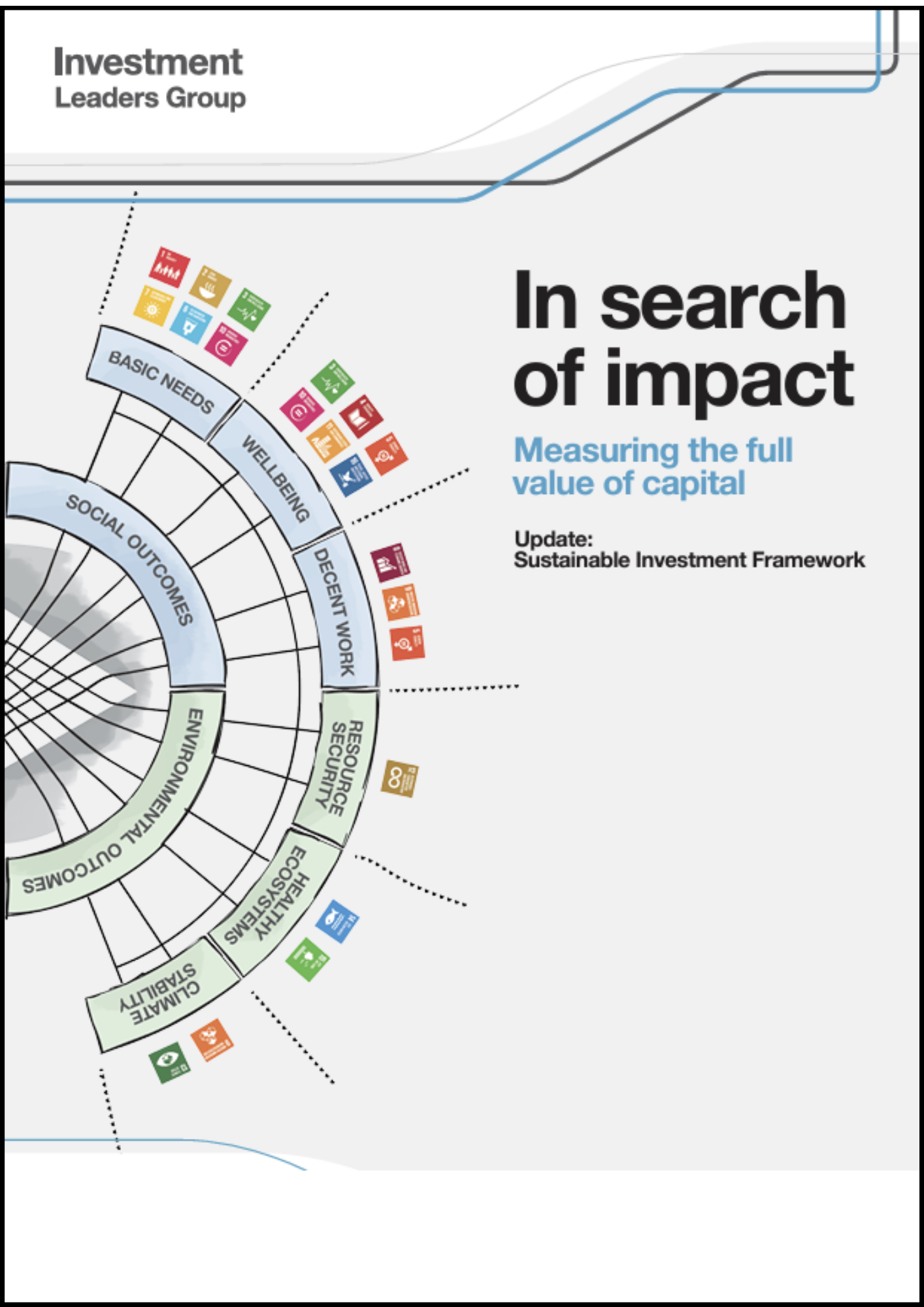
In search of impact: Measuring the full value of capital
This report outlines a sustainable investment framework, designed to empower individuals and organisations to better understand and make informed investment choices. The framework utilises six themes to communicate the impact of financial flows into the economy and contains theoretically grounded metrics that can be practically applied.

The comprehensive business case for sustainability
Sustainable businesses redefine the corporate ecosystem by creating value for all stakeholders, including employees, shareholders, supply chains, civil society, and the planet. Managing sustainability risks requires making investment decisions today for longer-term capacity building and developing adaptive strategies. Significant cost reductions can result from improving operational efficiency, and sustainable companies deliver significant positive financial performance.

Opportunity NOCs: How investors can jumpstart energy transitions in national oil companies
This report outlines how national oil companies (NOCs) must begin decarbonising to meet the goals of the Paris Agreement, and how investors can influence and incentivise the energy transition. It shows that NOCs constitute half of the world’s oil and gas production and control two-thirds of global reserves, making them of great interest to investors.

The climate crisis is a child rights crisis: Introducing the Children's Climate Risk Index
The report highlights how one billion children are at extreme risk due to climate change with small island states and countries already facing existential threats. It is a call to action for businesses and governments to reduce greenhouse gas emissions and commit to sustainable practices.

Do socially responsible firms walk the talk?
This study evaluates U.S. firms that signed the Business Roundtable's stakeholder capitalism pledge. Despite claims of social responsibility, signatories performed worse on environmental, labor, and governance metrics than peers, both before and after signing. The results suggest these public commitments lacked substance and may have been strategic signaling.

An integrated framework to assess greenwashing
Companies, nonprofits, and governments are increasingly engaging in greenwashing despite regulations for misleading advertisements. This report provides a framework for detecting greenwashing in such claims for all actors, whether non-commercial or non-advertisements.

SDG action manager technical guide
This guide provides businesses with a web-based impact management solution to take action on the Sustainable Development Goals (SDGs) through 2030. The guide describes the overall structure, module design, baseline module, SDG-specific modules, scoring methodology, and development process of the SDG Action Manager in a concise manner.

Sustainable investing: Establishing long-term value and performance
The study finds that corporations with a commitment to sustainable investing have superior risk-adjusted returns. While fund managers face challenges in capturing the outperformance with some exceptions, they have not generally underperformed. Integrated reporting can be used to improve the transparency and accuracy of ESG information.
Renewable energy and Indigenous people
This paper outlines challenges and opportunities for Indigenous Australians in adopting renewable energy, emphasising successful partnerships with experienced developers. It stresses the importance of building knowledge and capability at various project scales and recommends support mechanisms to empower Indigenous communities in advancing their renewable energy projects.

At the crossroads: 10 years of implementing the UN Guiding Principles on Business and Human Rights in Australia
The report examines the implementation and impact of the UN Guiding Principles on Business and Human Rights in Australia over the past decade.


