
Library | ESG issues
Reporting & Disclosures
Reporting and disclosures provide transparency on a company’s financial performance, strategy, and sustainability practices. Clear, reliable disclosures improve stakeholder trust, inform investment decisions, and drive corporate accountability.
Team Altiorem recommends


Refine
708 results
REFINE
SHOW: 16


Corporate Health Check 2026: The annual state of Earth-positive business action
The CDP 2026 Corporate Health Check, produced with Oliver Wyman, demonstrates that environmental leadership aligns with financial performance. While a 15% leadership cohort achieves 4% annual emission reductions, a major gap persists in adaptation finance. The report identifies four key levers for building resilience and capturing emerging commercial opportunities.
Regenerative agriculture: Moving from ambition to credibility
This report evaluates regenerative agriculture commitments across 78 global agri-food companies. While disclosures have increased, quantified targets have declined to 28%. Significant gaps remain in financial support for farmers and pesticide reduction targets, with the pork and poultry sectors largely overlooked in transition planning.
Assessing climate finance quality in practice: Lessons from six cases
This research report analyses six case studies to determine what constitutes high-quality public climate finance. It introduces a two-pronged framework assessing design, delivery, and results. Findings emphasise context-specific calibration, the importance of building enabling environments, and identifying data gaps that hinder systematic reporting across public climate finance providers.
Cyber risk stress testing for banks
This report examines cyber risk stress testing for banks, contrasting system-focused and firm-focused approaches. Drawing on exercises by the Bank of England, the Danish Financial Supervisory Authority, and the European Central Bank, it outlines scenario design, operational resilience, and the role of disclosure in establishing best practices.
Gaining ground: State of private investment in nature 2026
This report analyses the growth of private investment in nature between 2016 and 2025, documenting a fivefold increase in annual capital deployment to $14 billion. It highlights the shift towards institutional-grade natural capital and recommends clearer policy drivers and standardised metrics to unlock investment and bridge the $700 billion finance gap.
The price and distributional impact of flood risk disclosure: Evidence from US housing platforms
This research quantifies the impact of property-level flood risk disclosure on US housing prices and demographics. Homes labelled with 'extreme' risk saw a 3.3% price discount. Disclosure caused significant resorting, with lower-income, older, and FHA-financed buyers increasingly purchasing high-risk properties primarily due to reduced transaction prices.
Asset-level physical climate risk register template
The Asset-level physical climate risk register template, developed by the Investor Group on Climate Change (IGCC), enables consistent documentation of climate hazard assessments. It helps investors and managers track risks such as floods and wildfires at the individual asset level to support financial reporting and resilience planning.
The role of investors in measuring and achieving lower embodied carbon in real estate and infrastructure
This guidance outlines strategies for Australian investors to manage and reduce embodied carbon in real estate and infrastructure. It details a maturity pathway from benchmarking to achieving reductions, highlighting mandatory reporting requirements and strategic benefits. The document provides specific actions for equity and debt investors to align with net-zero pathways.
Responsible investing maturity matrix: Emerging markets
A maturity framework for VC funds and LPs to assess ESG and responsible investment integration across emerging market fund operations.
Fair Finance Ghana ESG policy assessment report
This report assesses ESG policies across five Ghanaian banks using international benchmarks. Results show low sustainability integration, particularly regarding climate change and transparency. It recommends adopting global frameworks, extending ESG accountability to lending portfolios, and improving standardised reporting to align the sector with international best practice.
Global energy review series
The Global Energy Review is an annual benchmark series published by the International Energy Agency (IEA) that assesses trends across the entire energy sector, covering all fuels, technologies, regions, and energy-related CO2 emissions for the preceding calendar year.
Mapping the landscape of net-zero nature-positive finance: A review of definitions and frameworks
This report provides a comprehensive review of definitions and frameworks for net-zero, nature-positive, and climate-nature finance. It identifies alignment areas and implementation gaps, advocating for integrated risk and investment approaches to achieve global sustainability goals under the Paris Agreement and the Kunming-Montreal Global Biodiversity Framework.
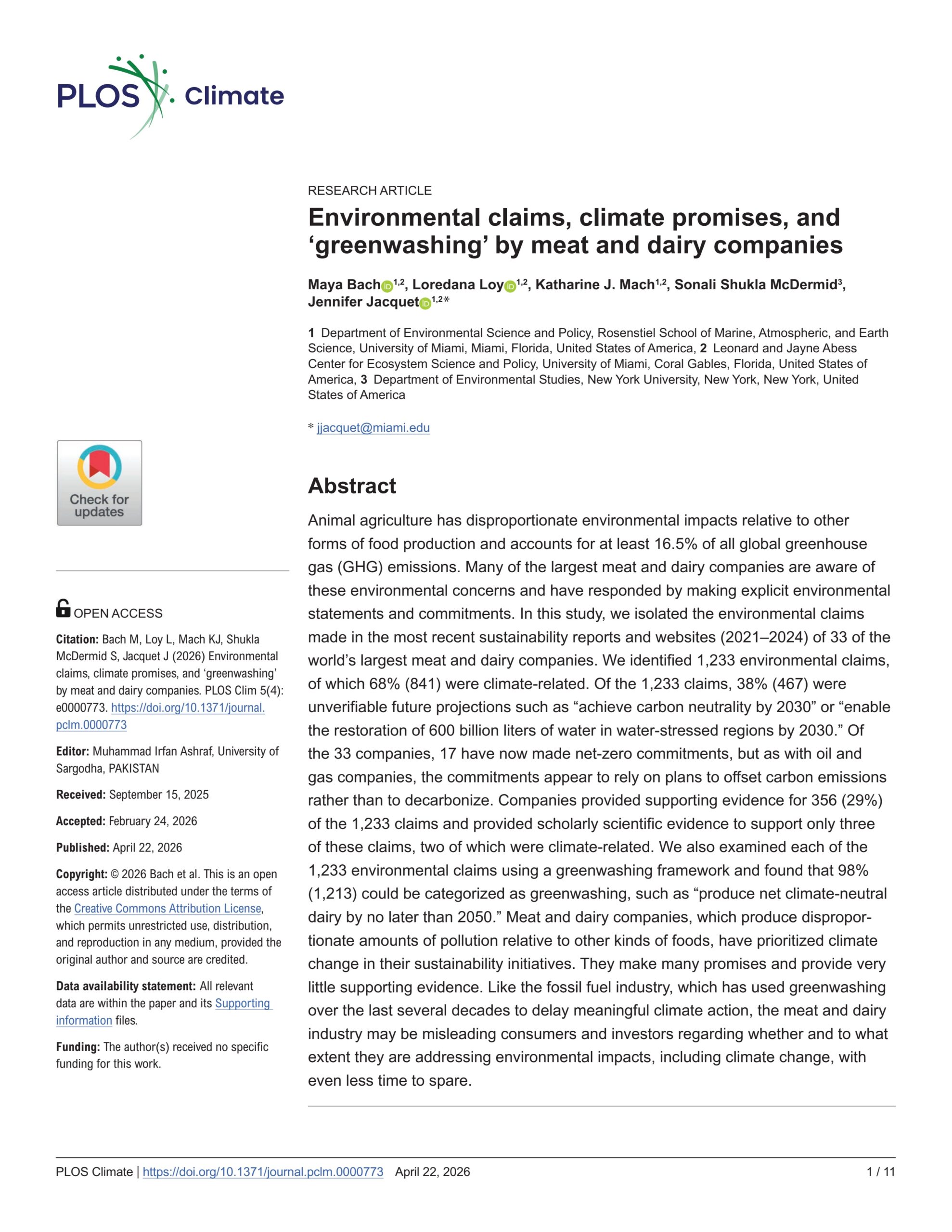
Environmental claims, climate promises, and ‘greenwashing’ by meat and dairy companies
This research examines environmental claims from 33 major meat and dairy companies. It finds that 98% of 1,233 identified claims constitute greenwashing. While most claims are climate-related, many are unverifiable future promises lacking scientific evidence. The industry’s sustainability reporting often mimics tactics used by the fossil fuel sector.
The emancipatory potential of biodiversity reporting: Evidence from the United Kingdom and South Africa
This research evaluates the emancipatory potential of biodiversity reporting within the United Kingdom and South Africa. Analysing disclosures from 2018 to 2022, it finds significant increases in reporting intensity. The study presents a principles-based framework to distinguish between compliance-oriented disclosures and transformative, action-oriented environmental reporting.
Just transition metrics benchmark
Just Transition Metrics is a benchmark series developed by Shift in collaboration with multiple organisations. It provides a foundational, sector-agnostic set of quantitative metrics designed to assess the 'justness' of companies' climate-related transition plans, covering workforce, communities, and value chain impacts.

Rate the raters series
Rate the Raters is a benchmark series by the ERM Sustainability Institute tracking corporate perceptions of ESG rating agencies. It examines quality, usefulness, trust, and engagement with ESG raters across regions and industries, offering a longitudinal view of the evolving ESG ratings landscape for companies and investors.


