
Library | ESG issues
Social
The social pillar in ESG (environmental, social, and governance) assesses a organisation’s impact on people and society. It covers labour practices, diversity and inclusion, human rights and community engagement. Prioritising social responsibility not only benefits society but also mitigates risks, strengthens reputation, and creates long-term value for businesses and investors.
Refine
1331 results
REFINE
SHOW: 16



Blocking a better world altogether: Rabobank’s bogus policy about animal welfare and sustainable agriculture
World Animal Protection argues Rabobank’s sustainability policies fail to match its financing practices, alleging continued support for companies linked to animal cruelty, deforestation and high emissions. The report urges stricter lending conditions, stronger monitoring and reduced investment in industrial livestock expansion to align with climate and animal welfare goals.
Building the financial case for urban adaptation: Guidance and case studies
C40 and Rebel outline how cities can structure urban adaptation projects to attract private finance, using ten case studies. Bankability depends on revenue logic, risk allocation, public de-risking, early financier engagement and credible monitoring.
The thematic assessment report on the interlinkages among biodiversity, water, food and health
IPBES assesses links between biodiversity, water, food, health and climate, finding siloed decisions worsen trade-offs. It identifies integrated governance, sustainable consumption, ecosystem restoration and finance reform as response options to support more just and sustainable outcomes.
Climate finance as a catalyst for peace
Research across 85 developing countries found climate finance was associated with lower resource-related conflict risk, particularly through reduced water scarcity and greater renewable energy access. The study suggests climate finance may support stability in fragile regions, with stronger effects observed where higher funding levels were directed towards adaptation and social infrastructure.
A Lens on the transition: Trends shaping the future economy: Sector in focus: Healthcare
Impax Asset Management reviews sustainability-driven trends shaping healthcare, highlighting AI-enabled productivity gains, regulatory pressures, and supply chain localisation. The report examines opportunities in healthcare equipment, life sciences and managed care, alongside risks from regulation, product liability, affordability concerns and geopolitical tensions.
AI in your portfolio: Risks & opportunities
Briefing paper outlining AI investment opportunities alongside systemic risks including bias, privacy, workforce disruption and environmental impacts. It highlights governance frameworks, due diligence tools and investor engagement strategies to support responsible AI investment practices and long-term portfolio resilience.
Hedging ambiguity with pro-social preferences: An illustration from green finance
The paper argues that pro-social preferences can offset ambiguity aversion in green finance by acting as a behavioural hedge. Using ambiguity-based investment models, the authors show socially motivated investors may accept uncertain green assets, lowering effective hurdle rates and supporting private capital flows into sustainable projects.

Massachusetts Institute of Technology (MIT)
Massachusetts Institute of Technology (MIT) is a leading research university in Cambridge, Massachusetts, specialising in science, engineering, technology, artificial intelligence and business education. MIT supports innovation through interdisciplinary research, entrepreneurship and hands-on learning. Its academic programmes, laboratories and global partnerships attract students, researchers and industry collaborators from around the world.

Goethe University Frankfurt
Goethe University Frankfurt is a leading public research university in Germany, offering more than 200 degree programmes across 16 faculties. Based in Frankfurt am Main, Goethe University is recognised for research, international study opportunities, finance, law, medicine and social sciences, attracting students and academics from around the world.
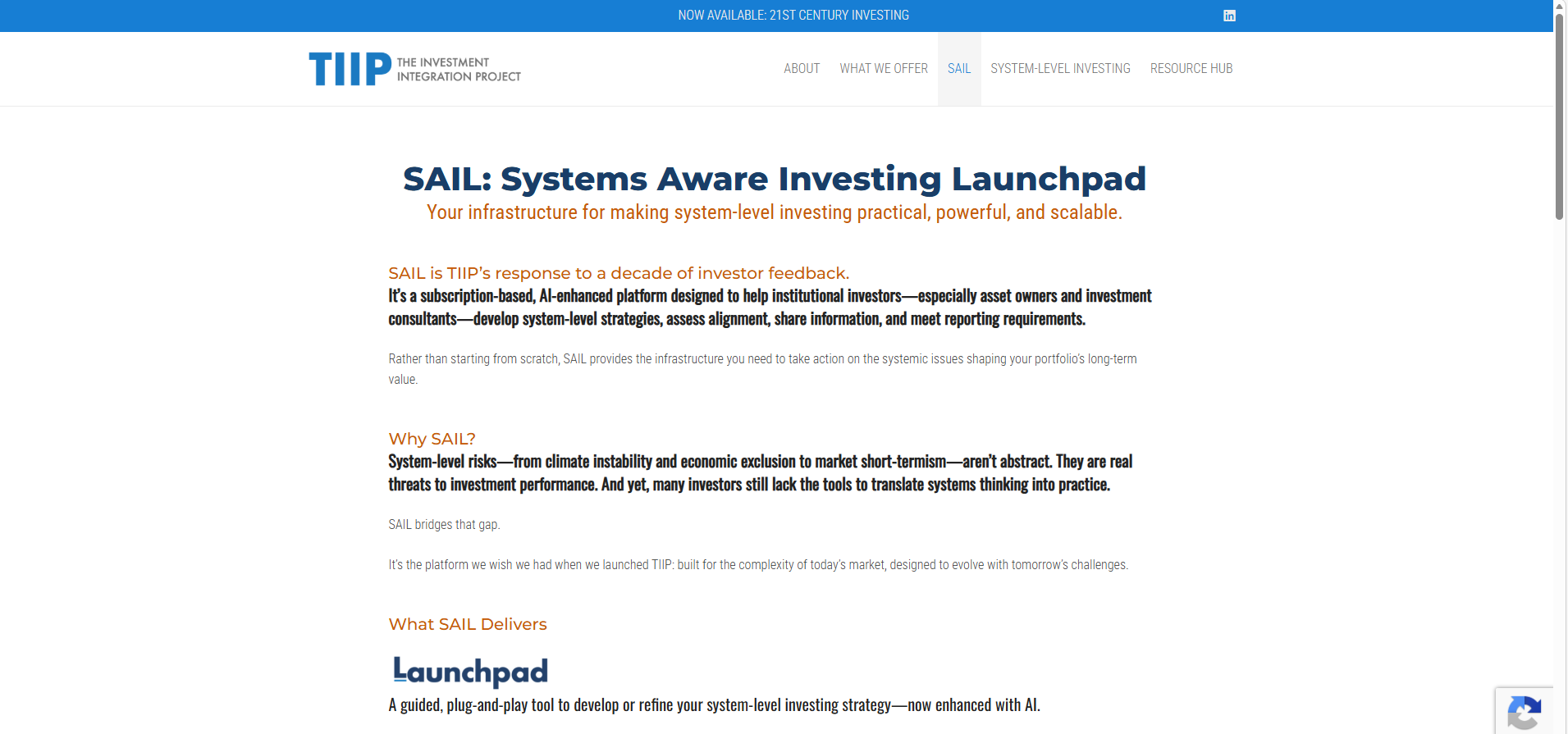
SAIL: Systems Aware Investing Launchpad
SAIL (Systems Aware Investing Launchpad) is an AI-enhanced platform developed by TIIP to support institutional investors in implementing system-level investing strategies. It provides tools for strategy development, benchmarking, reporting and collaboration, helping users assess and manage systemic environmental, social and financial risks.
2026 Living Wage Dataset
The 2026 Living Wage Dataset by Valuing Impact is a free global database covering 217 countries and eight household scenarios. It uses the Anker and Anker methodology with updated cost-of-living data to estimate living wages for urban and rural households, supporting sustainability, labour practice and supply chain analysis.
Tackling governance and financing for sustainability transitions
The report argues current financial systems misallocate capital towards resource-intensive activities, hindering sustainability transitions. It recommends policy, governance and financial reforms to redirect investment towards resource efficiency, low-carbon development and equitable transition pathways, particularly in resource-dependent economies.
Indigenous wisdom and co-creation towards decolonisation: A review of Indigenous inclusion in management education
This review finds Western business schools have often excluded Indigenous knowledge, and argues decolonising management education requires Indigenous self-determination, truth-telling, trust-building, co-created curricula and relational pedagogies grounded in Indigenous wisdom and communities.

Free to be exploited: The abuse of platform-based food delivery riders in Saudi Arabia and the UAE
Report finds migrant delivery riders in Saudi Arabia and UAE face systemic exploitation via third-party logistics, including coercive employment, wage abuses, unsafe conditions, and restricted mobility. Weak enforcement and outsourcing obscure accountability. Recommends stronger regulation, corporate oversight, and international labour standards.

Equidem
Equidem is an independent human rights and labour rights organisation working globally to expose injustice and support marginalised communities. It conducts research, investigates abuses in supply chains, and promotes accountability. Through advocacy and partnerships, Equidem develops practical solutions to strengthen labour rights, migrant worker protections, and the wider human rights movement.

Modern slavery and human rights: Policy and evidence centre
The Modern Slavery and Human Rights Policy and Evidence Centre is a UK-based research initiative that funds and co-creates independent, policy-focused research on modern slavery. It brings together academics, policymakers, businesses and civil society to improve evidence-based laws, policies and practices addressing modern slavery globally.


