

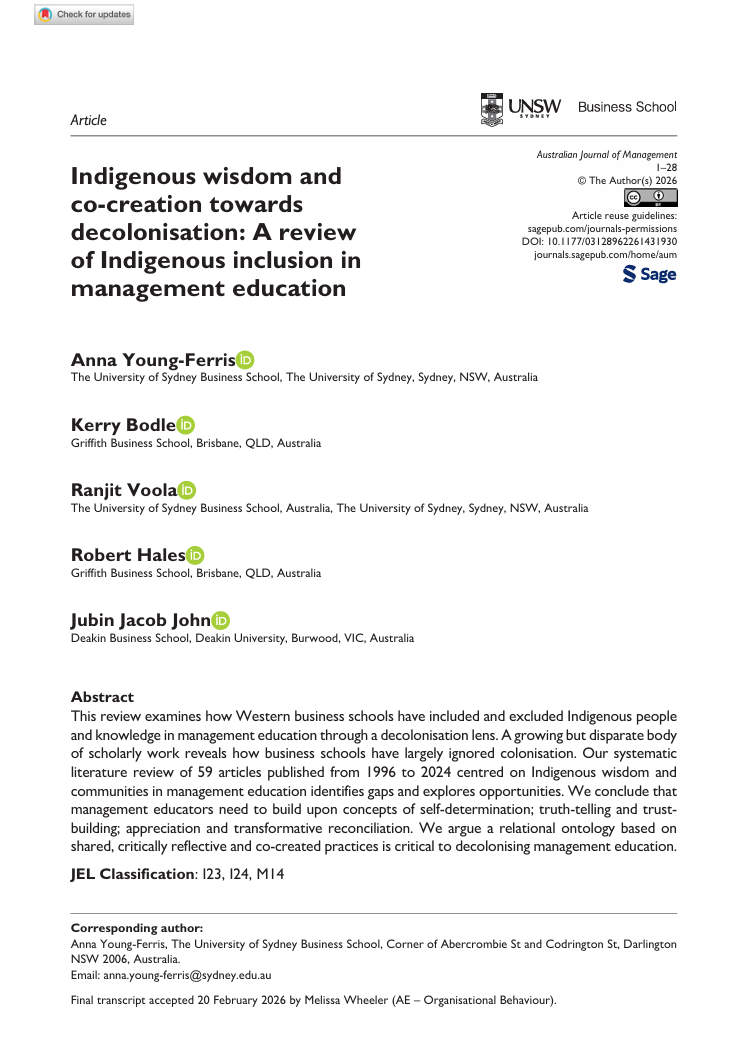
Indigenous wisdom and co-creation towards decolonisation: A review of Indigenous inclusion in management education
This review finds Western business schools have often excluded Indigenous knowledge, and argues decolonising management education requires Indigenous self-determination, truth-telling, trust-building, co-created curricula and relational pedagogies grounded in Indigenous wisdom and communities.
Please login or join for free to read more.

OVERVIEW
Introduction
This review examines Indigenous inclusion in management education, noting systemic exclusion despite Indigenous peoples representing 6.2% of the global population. It distinguishes Indigenisation from decolonisation and highlights persistent colonial structures in curricula. The study addresses gaps in how business schools integrate Indigenous knowledge and perspectives.
Methodology
A systematic literature review of 59 sources (1996–2024) was conducted using Scopus and Web of Science. Keywords related to Indigenous identity and business education filtered relevant studies. The review followed a structured multi-phase process, analysing context, pedagogy and research design to identify patterns and gaps.
Descriptive results
Publications on Indigenous topics in management education have increased, particularly post-2010. However, only 14 studies include 13 Indigenous authors, indicating limited Indigenous representation. Research spans diverse global communities, though Western academic paradigms dominate. The review acknowledges exclusion of non-traditional Indigenous knowledge sources as a limitation.
Thematic analysis
Why a decolonising framework
Decolonisation is used to critique Western dominance in management education. It challenges assumptions of universal Western knowledge and promotes inclusion of Indigenous epistemologies, encouraging alternative frameworks for understanding business and society.
Our conceptual model
The model contrasts ‘colonising ways’ and ‘ways of decolonising’. Colonising practices include dominant Western models, ignored trauma, and limited Indigenous participation. Decolonising approaches emphasise relational ontology, authentic inclusion, cultural competence, and inclusive pedagogy. Central themes include self-determination, truth-telling, co-creation and reconciliation.
Colonising ways
Western business education prioritises shareholder value and capitalist frameworks, often incompatible with Indigenous worldviews. It overlooks intergenerational trauma and marginalises Indigenous voices. Limited representation of Indigenous staff and students reinforces exclusion. While technical skills offer some benefits, these are constrained without addressing historical harms and structural inequities.
Ways of decolonising
Indigenous perspectives introduce relational and interconnected approaches to business, emphasising sustainability, reciprocity and long-term stewardship. Authentic inclusion requires Indigenous leadership and co-creation rather than tokenistic integration. Cultural competence and critical self-reflection are necessary for educators and students. Pedagogical innovations include storytelling, place-based learning and experiential methods rooted in Indigenous traditions.
Discussion, limitations and future research
The review identifies four key principles for future research and practice. Self-determination requires Indigenous leadership in curriculum design. Truth-telling and trust-building involve acknowledging historical harms and addressing institutional barriers. Appreciating and co-creating emphasises reciprocal engagement and valuing Indigenous knowledge systems. Transformative reconciliation calls for structural change rather than symbolic actions.
Limitations include reliance on English-language, peer-reviewed sources and Western methodologies, which may exclude Indigenous knowledge forms. Future research should incorporate Indigenous methodologies and context-specific approaches.
Conclusion and implications
The study highlights growing academic interest but continued underrepresentation of Indigenous voices. It argues for fundamental reform of management education through decolonisation. Business schools must integrate Indigenous knowledge authentically, address systemic inequalities, and adopt relational, co-created approaches to prepare future leaders.




