
Library | ESG issues
Systemic Risk Management
Systemic risk refers to the possibility that an event at the company level could trigger severe instability or collapse in an entire industry or economy. It extends beyond individual failures, encompassing large-scale threats such as climate change, natural disasters, inflation, geopolitical crises, and pandemics. Effective systemic risk management requires proactive monitoring, regulatory safeguards, and resilience strategies to mitigate risks and ensure financial stability in an increasingly complex and uncertain global landscape.

Refine
390 results
REFINE
SHOW: 16


Enel: Industry case studies: Electric utility
This report presents Enel’s case study on implementing CFO Principles for the SDGs. It outlines historical drivers, sustainability disruption, strategic responses, and SDG investments, highlighting decarbonisation, electrification, and financial performance assessment. The report details Enel’s renewable energy expansion, SDG alignment, and integration of sustainability outcomes with financial results.
Evidencing financial materiality of sovereign ESG risk
This report analyses the relationship between sovereign ESG risks and credit risk across 70 countries. Using FTSE Russell/Beyond Ratings data and five-year CDS spreads, it finds stronger financial materiality of ESG risks in emerging and high-yield markets, particularly for social and governance factors, with weaker results for environmental risks.
MSCI ESG ratings in global equity markets: A long-term performance review
This MSCI report reviews the long-term performance of ESG ratings in global and developed equity markets. It finds that higher-rated companies outperformed peers, driven by stronger earnings growth and dividend yields rather than valuation effects. MSCI ESG indexes also generally outperformed their benchmarks across regions and during crises.
Externalities and the common owner
This article analyses institutional investors’ incentives to internalise negative externalities across their portfolios. It focuses on climate change, showing how large asset managers influence fossil fuel companies to reduce emissions, disclose risks, and limit lobbying, reframing shareholder primacy by prioritising portfolio-wide welfare over firm-level profit maximisation.
Just transition, environment and social considerations for the aviation fuel transition: An investor guide
This guide outlines environmental, social, and just transition considerations for investors in aviation’s fuel shift. It compares biofuels and e-fuels, highlights regulatory and biodiversity risks, and provides engagement questions to assess companies’ transition strategies, ensuring alignment with climate goals while safeguarding communities and long-term financial stability.

Sizing the inevitable investment opportunity: Climate adaptation
This report estimates the climate adaptation market will grow from US\$1tn in 2024 to US\$4tn by 2050, with US\$2tn driven by global warming. Investment opportunities could reach US\$9tn, spanning emerging and established solutions, largely resilient to climate scenario differences over the next 25 years.

GRI risk viewer
The Global Resilience Index (GRI) Risk Viewer provides global‑scale risk metrics across hazard, exposure and vulnerability to assess risks to people, planet and prosperity via open, publicly available datasets.
Targeting net zero: The need to redesign bank decarbonization targets
This report examines the limitations of current bank decarbonisation targets and proposes design reforms to align with net zero. It analyses scope coverage, target types, and sector alignment, offering practical recommendations for enhancing climate credibility and effectiveness in financial institutions’ transition planning.
Starting up: Responsible investment in venture capital
This report examines how environmental, social, and governance (ESG) factors are being adopted in venture capital. It outlines current practices, challenges, and industry-specific considerations, and highlights the need for tailored guidance, collaboration, and early-stage engagement to advance responsible investment across the venture capital ecosystem.

Howden Group
Howden Insurance Brokers Australia is a global insurance intermediary offering tailored insurance and risk management solutions for businesses and individuals. With offices across Australia and access to international markets, Howden provides services in corporate risks, people risk, private clients, and alternative risk solutions. Their employee-owned model fosters a client-focused approach, delivering personalised service backed by global expertise.
Rewiring finance – a new approach to financing a sustainable economy
This report outlines three systemic shifts needed to align finance with sustainability: policy reform to drive market incentives, mindset changes to embrace long-term value, and structural financial changes to embed environmental and social risks. It highlights barriers and proposes actions to support an inclusive, sustainable economic transition.
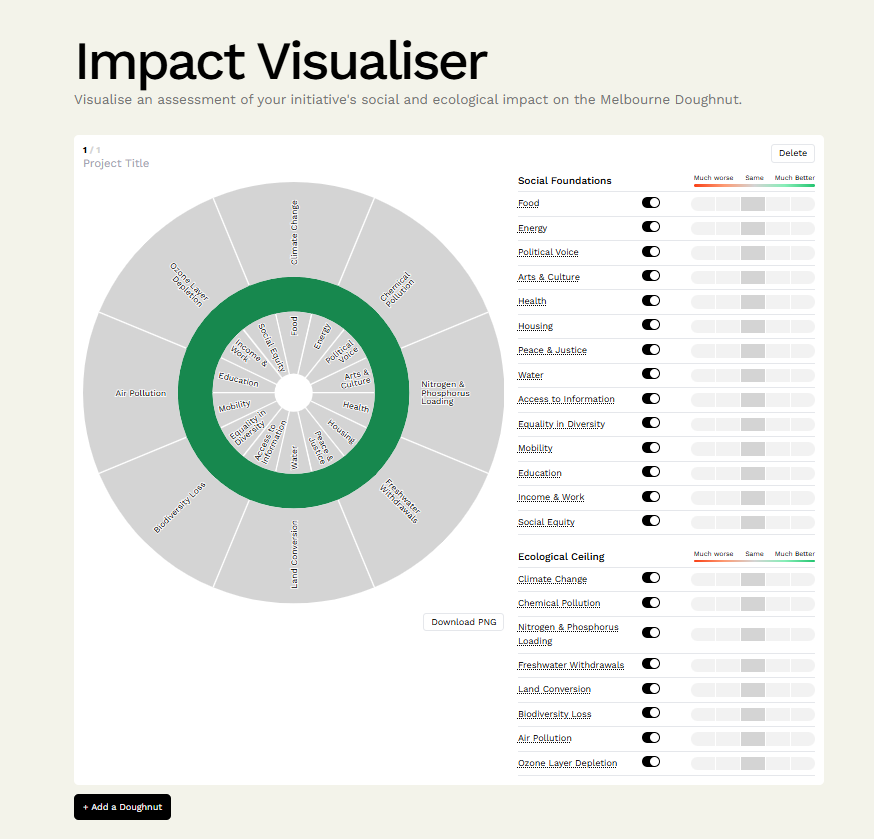
Regen Melbourne's impact visualiser tool
The Impact Visualiser enables users to qualitatively assess the social and ecological impacts of initiatives within the Melbourne Doughnut framework. It allows for rating across various dimensions, facilitating visual representation of potential effects, and supports downloading the results for sharing or further analysis.
The root cause of nature loss: Forests, why they matter, and how to assess deforestation risk in investment portfolios through nature-related data
This report outlines how deforestation, particularly in tropical forests, is a key driver of biodiversity loss and climate change. It presents the risks to institutional investors—physical, transition, and systemic—and offers a framework to assess deforestation exposure in portfolios using nature-related data and metrics across sectors and geographies..

The saliency-materiality nexus: Addressing systemic risks to people and portfolios in a turbulent world
This report introduces the saliency-materiality nexus, a framework linking severe human rights harms to financially material risks in conflict-affected areas. It highlights case studies totalling over $85 billion in losses and offers guidance for investors on due diligence, portfolio risk management, and alignment with legal and ethical responsibilities.

Heartland Initiative
Heartland Initiative is a nonprofit investor advisory organisation dedicated to advancing human rights in investment. It collaborates with institutional investors, civil society, and policymakers to address systemic risks and promote responsible investment practices. Heartland offers tailored learning services and fosters environments that integrate human rights considerations into business strategies.
Recalibrating feedback loops: Guidance for asset owners and institutional investors assessing the influence of system-level investing
This report guides asset owners in assessing how their investments affect systemic environmental and social issues. It introduces a framework to align investment practices with system-level goals and improve financial system resilience. Case studies explore climate change, income inequality, and racial inequity to illustrate practical applications.


