
Library | ESG issues
Systemic Risk Management
Systemic risk refers to the possibility that an event at the company level could trigger severe instability or collapse in an entire industry or economy. It extends beyond individual failures, encompassing large-scale threats such as climate change, natural disasters, inflation, geopolitical crises, and pandemics. Effective systemic risk management requires proactive monitoring, regulatory safeguards, and resilience strategies to mitigate risks and ensure financial stability in an increasingly complex and uncertain global landscape.

Refine
390 results
REFINE
SHOW: 16


Ethical Partners
Ethical Partners is an Australian investment management firm dedicated to responsible investing. With a focus on ethical considerations, they offer a range of investment solutions across various asset classes. Their approach integrates environmental, social, and governance (ESG) factors to achieve sustainable financial returns while making a positive impact.

200 and counting: Global financial institutions are exiting coal
Financial institutions (FI) across the world are increasingly recognising the risks and opportunities connected to coal, and many are reducing their exposure to the industry. The number of FIs withdrawing from coal is rapidly increasing, and this report catalogues the global trend towards coal withdrawal.

Road to resilience: An investor action plan for an adaptive and sustainable economy
This paper presents a strategy to manage economic and environmental stability in response to physical climate risks. This aims to bring awareness and understanding of physical climate risks and highlights the importance of innovative solutions toward a sustainable low-carbon economy.

Constructive corporate engagements: From a corporate perspective
This research focuses on constructive corporate engagement. This report analyses survey results from 100 senior company directors and interviews with ten executives to examine the drivers of successful engagements. Insights include the importance of collaborating with companies, focusing on material issues, and using standard metrics for success.
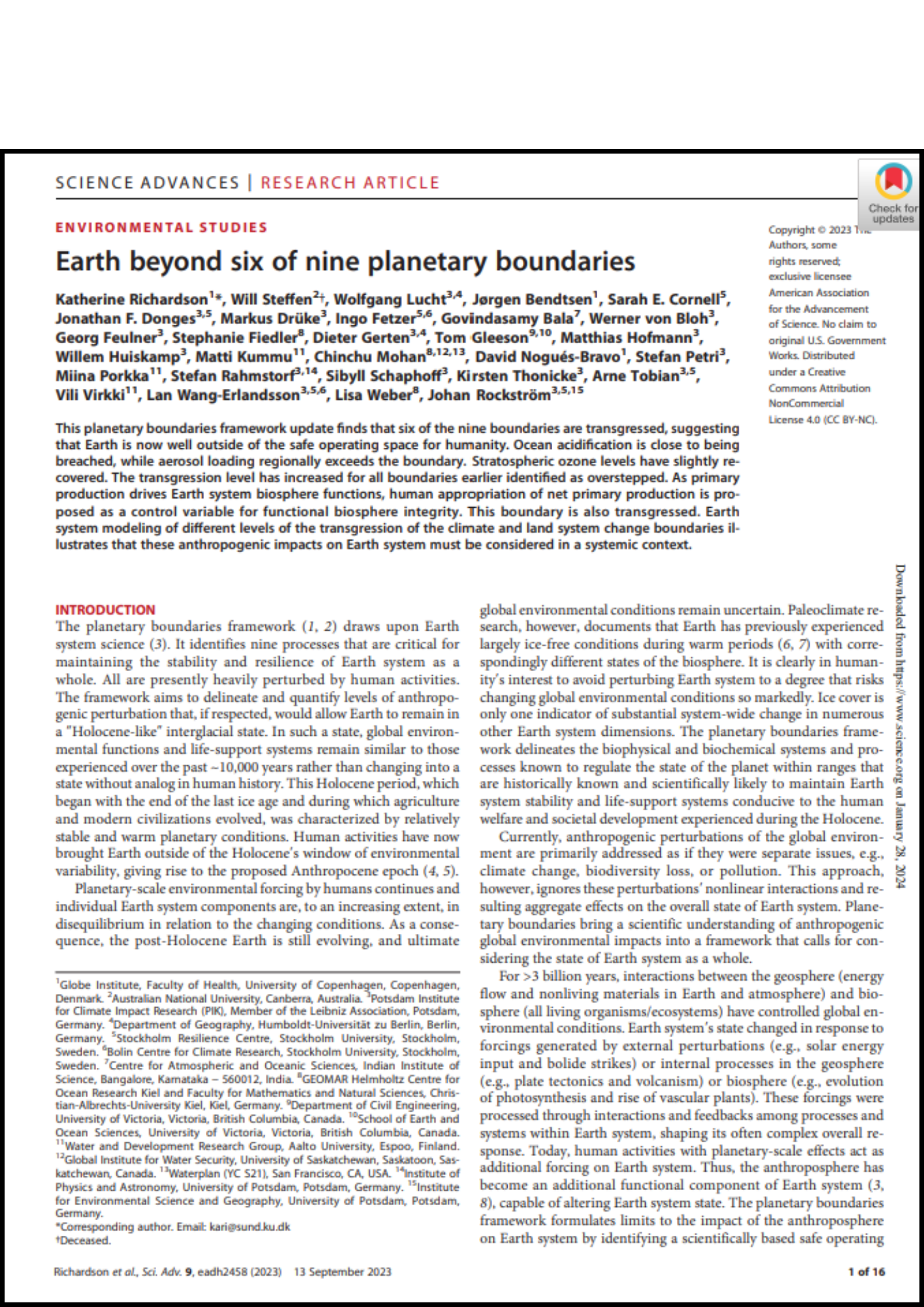
Earth beyond six of nine planetary boundaries
Six of nine planetary boundaries are exceeding safe thresholds, with ocean acidification and aerosol loading at tipping points. Maintaining functional biosphere integrity requires controlling human appropriation of net primary production. Earth system modelling illustrates the need to consider anthropogenic impacts on Earth in a systemic way.

Right direction, wrong equipment: Why transition risks do not fit into regulatory stress tests
The authors of this report explore the challenges of integrating climate-related risks into regulatory stress tests. They demonstrate that supervisory risk assessment frameworks struggle to capture long-term systemic risks, and offer recommendations for developing a 'long-term risk;' supervision 'infrastructure.'

A little less conversation, a little more action: 10 lessons learned from 10 years of helping investors to tackle climate
This report presents 10 lessons for investors on tackling climate change. Through this summary, the authors offer insights on methodologies for climate scenario analysis, the intersection of reporting and acting, an effective climate voting process, the role of regulators in transparent carbon neutral investments, among other topics.

The third, systems stage of corporate governance: Why institutional investors need to move beyond modern portfolio theory
The authors of this paper argue that institutional investors need to move beyond Modern Portfolio Theory (MPT), and consider a wider risk management strategy. The paper outlines the potential failings of MPT and suggests ways for institutional investors to better align with the needs of society and the economy.

Catalysing bank climate action: Lessons from the inside
This report shares insights from the Climate Safe Lending Fellowship, a programme for banking professionals committed to accelerating the decarbonisation of their institutions. The report offers practical approaches and tools used by climate intrapreneurs to help their banks transition toward climate-safe banking.

The TNFD nature-related risk and opportunity management and disclosure framework: Beta v0.1 release
The Taskforce on Nature-related Financial Disclosures (TNFD) has released a beta version of its Nature-related Risk and Opportunity Management and Disclosure Framework. The framework aims to deliver a risk management and disclosure framework for organisations to report and act on evolving nature-related risks and opportunities.

Investor primer to transition risk analysis
This report focuses on scenario analysis as a tool for assessing climate and energy transition risks that traditional financial analysis may not capture. It gives insight into the conceptual and methodological underpinnings of scenario analysis, drawing on models from The CO-Firm and KECH climate research.

A toolbox of sustainable crisis response measures for central banks and supervisors – second edition: Lessons from practice
This report is a toolbox of options for central banks and supervisors to align crisis response measures with climate and sustainability objectives. The second edition includes an extended analysis of sustainability-linked measures. It also highlights the importance of moving from voluntary to mandatory environmental reporting and recommends efficient disclosure to regulated financial institutions.

Connecting the dots: Energy transition scenarios and credit quality
This report explores the implications of climate transition scenarios for the credit quality of nine companies in power utilities, cement, and steel. It shows the potential credit consequences of failing to mitigate risks and grasp opportunities associated with the low-carbon transition. The study highlights the value of granular scenario analysis for investors.

Welcome to the great unravelling: Navigating the polycrisis of environmental and social breakdown
This report examines the ongoing crises of environmental and social breakdown, exploring their interconnected drivers and feedbacks. It offers pragmatic and personal solutions, challenging the myth of progress, and suggesting thoughtful change as the only hope for navigating this uncertain future.

Physical risk framework: Understanding the impacts of climate change on real estate lending and investment portfolios
This report provides lenders and investors with a four-step process to assess the physical impact of climate change on their real estate and infrastructure portfolios. The report emphasises the importance of using insurers’ extreme weather models within this framework to estimate natural catastrophe risks.

Intangible cultural heritage, diverse knowledge systems, and climate change
This paper explores the relationship between climate change, different knowledge systems, culture, and heritage. It discusses the importance of a historical perspective, defines and describes different knowledge systems, and addresses the limitations of the predominant scientific approach. It also presents a framework for collaboration among plural knowledge systems.


