
Library | Asset Class
Fixed Income & Cash
Fixed income includes government bonds, corporate bonds and asset-backed securities. Cash typically refers to money market instruments and short-term, highly liquid investments that provide capital preservation and stability.
Refine
352 results
REFINE
SHOW: 16



Sector insights: Real estate series
Sustainable Fitch Sector Insights Report Series is a series providing analytical assessments of the sustainability profiles of different sectors. It examines sustainability impacts, ESG rating trends, sustainable finance developments, sector-specific issues, and relevant sustainability-related regulations to support finance professionals’ understanding of sector performance.
The Asian international bond markets: Issuance trends and dynamics series
A benchmark series published by ICMA examining issuance trends and dynamics in Asia's international bond markets. The series covers regional issuance volumes, deal nationality, arrangement locations, currency and tenor distribution, debut issuances, and sustainable bond activity across key Asian jurisdictions.
EDHEC Climate Institute Resource Hub
EDHEC Climate Institute is a climate finance research resource that provides research, analytical tools and data on climate-related financial risks, transition pathways and climate policy. It supports finance professionals with evidence-based insights for investment analysis, risk assessment and decision-making on climate-related issues.
Widening the lens: Scaling climate adaptation and resilience through sustainable finance
This report examines climate adaptation and resilience in sustainable finance, highlighting a significant financing gap in emerging markets and limited formal allocation in labelled debt markets. It argues for a broader lens that recognises resilience outcomes already embedded in policy-driven investments, using Ecuador's sovereign housing framework as a case study.
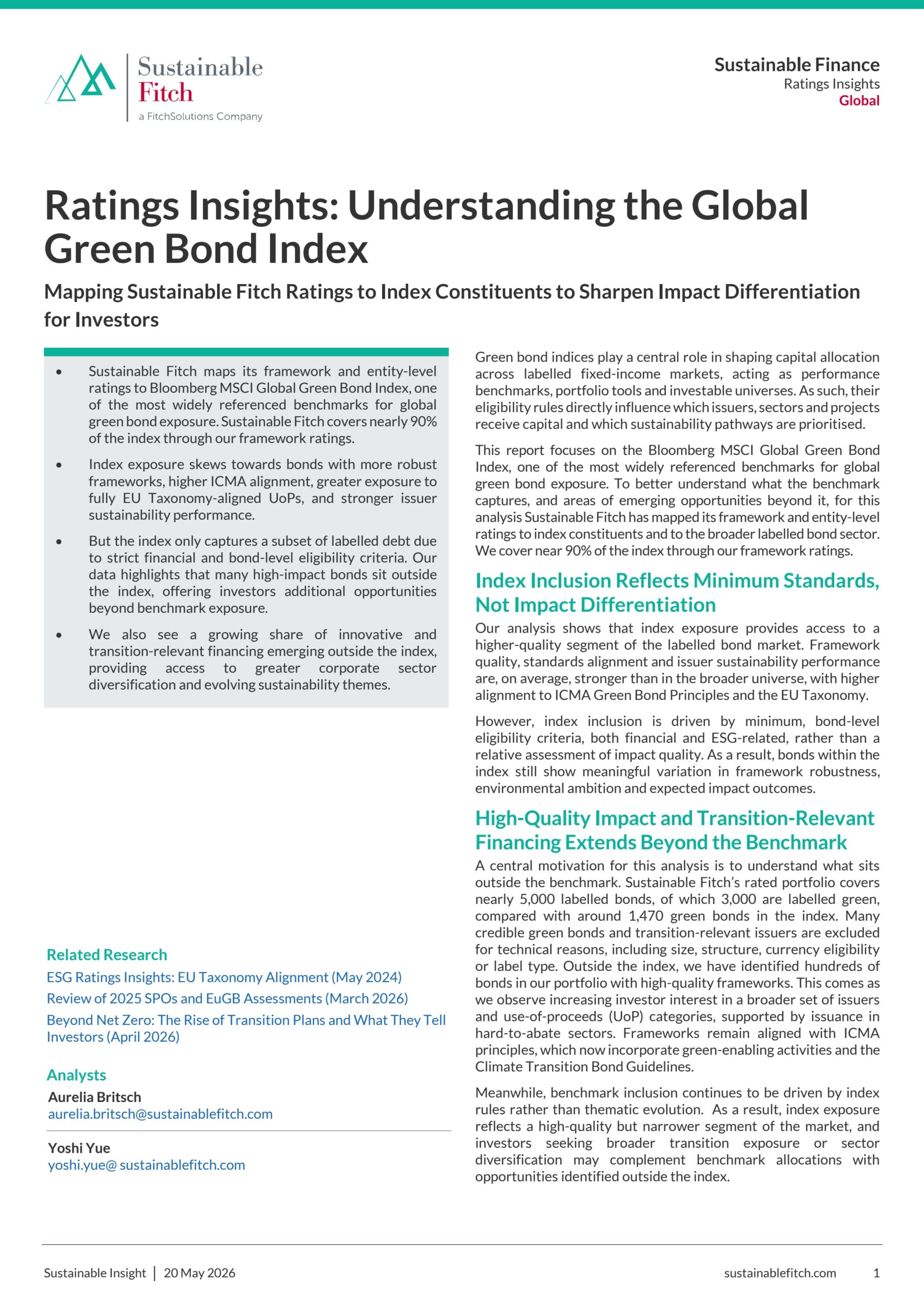
Ratings insights: Understanding the global green bond index
Sustainable Fitch maps its framework and entity-level ratings to the Bloomberg MSCI Global Green Bond Index, covering 88% of index bonds. While index constituents show stronger framework quality and ICMA alignment than the broader market, many high-quality and transition-relevant bonds sit outside the benchmark due to financial eligibility constraints.
Interest rate caps, competition, and strategic borrowing: Evidence from Kenya
This paper examines Kenya's 2016 interest rate regulation, which capped bank lending rates but exempted the digital platform M-Shwari. Using borrower-level administrative data and a structural model, the authors find that the M-Shwari carve-out preserved credit access for high-risk borrowers, while a uniform cap would have eliminated it entirely.
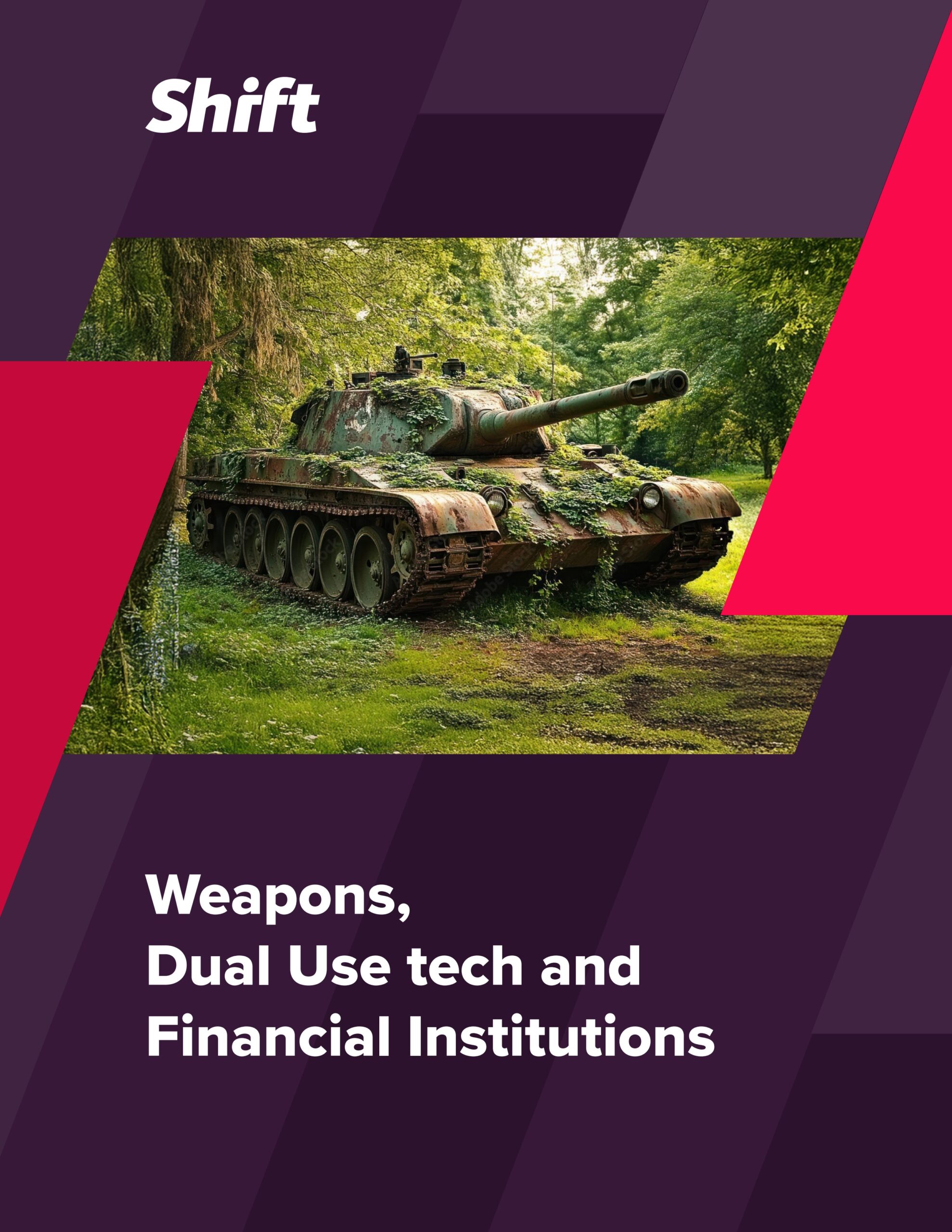
Weapons, dual use tech and financial institutions
This Shift briefing examines how financial institutions should approach human rights due diligence in relation to weapons and dual-use technologies. It identifies four key challenges, six anchors grounded in international humanitarian law, and six practical approaches to support responsible defence-related lending and investment decisions.
SIPRI Military Expenditure Database
SIPRI's open-access database providing annual military expenditure data for countries worldwide from 1949 to 2025, across multiple metrics.
APLMA: Green and Sustainable Lending Microsite
The APLMA Green and Sustainable Lending Microsite provides documentation, principles, guidelines, and market data for sustainable lending.
Biodiversity loss will decrease the future creditworthiness of nations
This study examines how biodiversity and ecosystem service loss affect sovereign creditworthiness across 23 countries. Using ecological-economic modelling, it finds that a partial ecosystem collapse could generate US$162 billion in additional annual debt servicing costs globally, highlighting that sovereign credit ratings are systematically underpricing nature-related financial risks.
Metals-as-a-Service: A strategic and investable circular business model for the wind energy industry and beyond
Metals-as-a-Service (MaaS) proposes a circular business model for the wind energy sector and beyond, in which metal ownership is retained by a Special Purpose Vehicle throughout the asset lifecycle. The model converts metal procurement from capital expenditure into a service-based structure, enabling securitisation, improved supply security, and circular value creation.
Don't mess with the ETS: Priorities for the upcoming EU emissions trading system revision
Carbon Market Watch presents a 10-point plan for improving the EU Emissions Trading System ahead of its upcoming revision. The report argues against weakening the cap, free allocation phase-out, or the Market Stability Reserve, and calls for expanded coverage of aviation, shipping, and biomass, alongside eliminating fossil fuel subsidies from ETS revenues.
Modeling ghost GDP: Macro-financial risk and diversified portfolios in the age of artificial intelligence, automation, and populism
This PDI working paper stress-tests four AI-driven labour displacement scenarios against US macro-financial data, modelling cascading losses across household debt, corporate credit, equities, pensions, insurance, and fiscal channels. Total economy-wide value at risk ranges from approximately $15–18 trillion (Light) to $62–72 trillion (Aggressive). Predistributive mechanisms are proposed as structural solutions.
Beyond the illusion of innovative climate finance at scale in Africa: A market-informed blueprint for Kenya's just and resilient climate transition
This report examines why Kenya's climate finance gap persists despite strong institutions, renewable energy leadership and financial inclusion gains. It identifies seven flawed assumptions and recommends a nationally co-ordinated country investment platform to mobilise domestic capital, align incentives and deliver a just and resilient climate transition.
Business models and investments for nature: Full report, 2nd edition
This report by the EU Business & Biodiversity Platform presents ten existing finance practices for investing in nature across sectors including forestry, regenerative agriculture, green infrastructure, and urban ecosystems. It explores how financial instruments such as green bonds, blended finance, and sustainability-linked loans can be structured, scaled, and replicated to help close the biodiversity finance gap.
DBSA: Financial instrument design for an effective carbon market in South Africa
The Development Bank of Southern Africa details two proposed financial instruments to support the domestic voluntary carbon market: a carbon credit-backed bond and a repurchase facility. These tools aim to mobilise private capital, address early-stage funding shortages, and improve liquidity for carbon reduction projects.


