
Library | Asset Class
Infrastructure
Investments in essential physical systems and facilities (transport, energy, water, communications) that support economic and social activity.
Refine
335 results
REFINE
SHOW: 16


Fossil fuel divestment strategies: Financial and carbon-related consequences
This study examines financial and carbon-related impacts of fossil fuel divestment strategies. Empirical analysis of a Canadian stock index suggests ethical divestment reduces carbon exposure and performs as well or better than the benchmark.

What is tax fairness and what does it mean for investors?
This report is a discussion paper on tax fairness and its impact on institutional investors. Six principles guide the initiatives to bring transparency and systematic approach in dealing with tax issues in the investment industry. It also outlines past legal and regulatory efforts and recommendations for future stakeholder engagement to improve tax arrangements.

Women in business leadership boost ESG performance: Existing body of evidence makes compelling case
Increase in women's representation in business leadership positions intensifies environmental, social, and governance (ESG) standards. 70 peer-reviewed papers published from 2008 to 2017 proportionally associate higher diversity with better firm performance. The compendium of available material evolves into a pressing case for more women in boards and other leadership roles.

Welcome to the great unravelling: Navigating the polycrisis of environmental and social breakdown
This report examines the ongoing crises of environmental and social breakdown, exploring their interconnected drivers and feedbacks. It offers pragmatic and personal solutions, challenging the myth of progress, and suggesting thoughtful change as the only hope for navigating this uncertain future.

Time to accelerate: Capital mobilisation for the SDGs in emerging markets
This progress report details two years of capital mobilisation for the Sustainable Development Goals (SDGs) in emerging markets. It highlights the need for government and private investors to take action if the SDG financing gap is to be closed, and outlines strategies for scaling private investment and reducing investment risks.

Australian Social Impact Investing Taskforce: A Commonwealth strategy to build a mature and self-sustaining social impact investing market that improves the lives of vulnerable Australians
The report details a strategy to support early-stage social enterprises and foster growth in social impact investment (SII) opportunities. The report explores four action areas for government and stakeholders to accelerate SII growth and improve social impact measurement.

Higher cost of finance exacerbates a climate investment trap in developing economies
This study investigates how different weighted average cost of capital (WACC) assumptions impact decarbonisation pathways for developing economies. The results demonstrate the disproportionate impact of high capital costs between regions, with green electricity production potentially 35% lower in Africa, increasing the risk of a climate investment trap.

Rate the raters 2023: ESG ratings at a crossroads
This report explores the current landscape of ESG ratings. Investors are the primary customers for ESG ratings products and drivers of their evolution. Fifty-two percent of corporates and fifty-nine percent of investors have moderate trust that ESG ratings accurately reflect ESG performance.

Water risks and financial market: Overview and analysis
This report explores water risks and opportunities in the financial sector. It provides an overview of tools and approaches to assess water risks, identifies potential actions to align with international water goals, and calls for greater integration of water considerations into financial decision-making.
Renewable energy and human rights benchmark report series
The Renewable Energy and Human Rights Benchmark series assesses how leading renewable energy companies manage and respect human rights across their operations and value chains. The series provides a consistent, comparative framework to track corporate practices and accountability in the global energy transition.

Measuring what matters most: Seven systems transformations for benchmarking companies on the SDGs
This report provides guidance on developing benchmarks to transform systems towards achieving Sustainable Development Goals (SDGs). It identifies seven critical transformations: social, agriculture and food, decarbonisation and energy, circular, digital, urban, and financial systems. These benchmarks aim to hold companies accountable and drive meaningful change across industries to support sustainable development.

Transition risk framework: Managing the impacts of the low carbon transition on infrastructure investments
This report introduces a transition risk framework aiding investors and regulators in navigating risks and seizing opportunities in the low-carbon transition. It enhances comprehension of how transition risks impact financial performance in infrastructure investments, offering a transparent, adaptable, and robust methodology for assessing the financial implications of a shift towards a low-carbon economy.
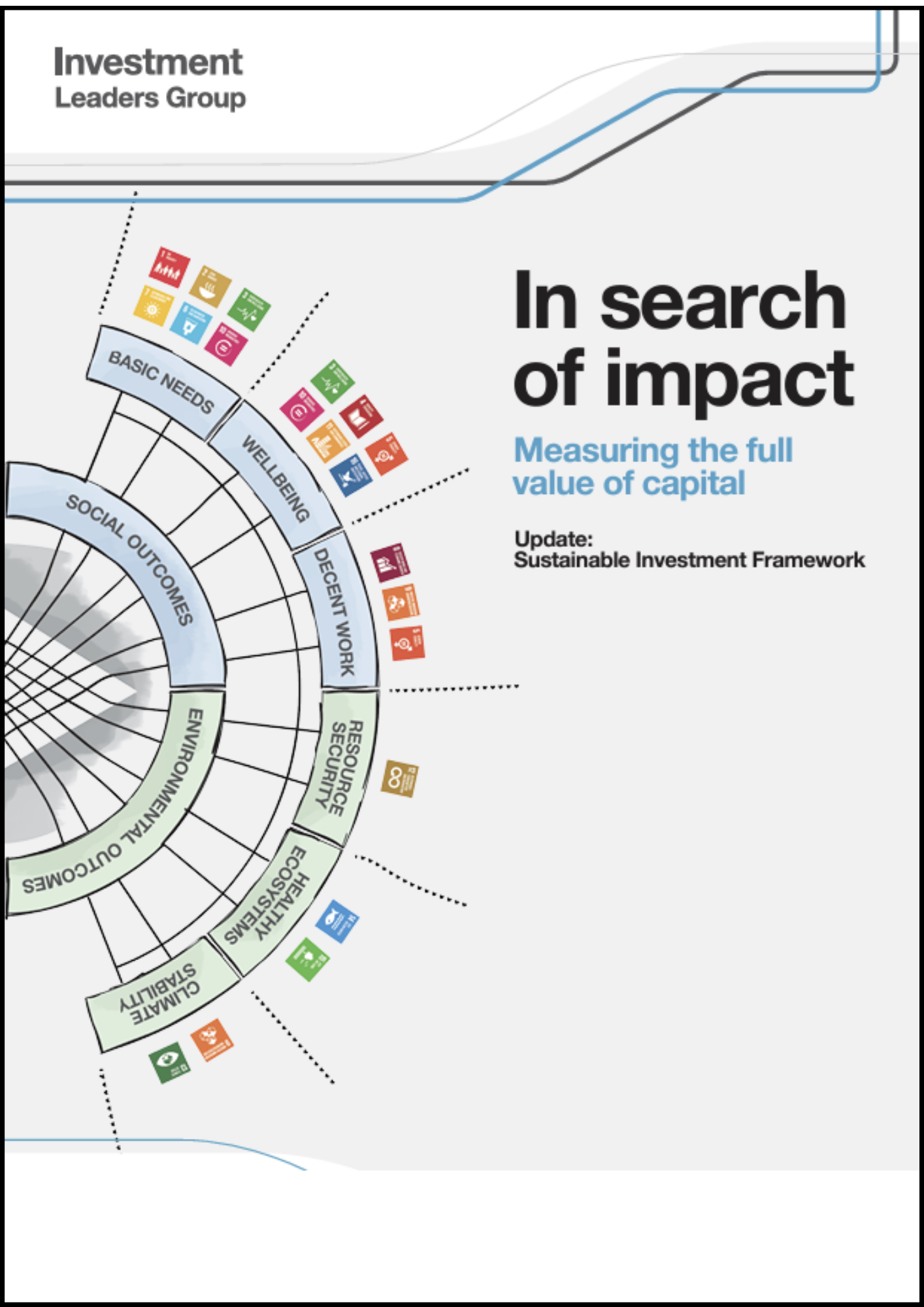
In search of impact: Measuring the full value of capital
This report outlines a sustainable investment framework, designed to empower individuals and organisations to better understand and make informed investment choices. The framework utilises six themes to communicate the impact of financial flows into the economy and contains theoretically grounded metrics that can be practically applied.

The comprehensive business case for sustainability
Sustainable businesses redefine the corporate ecosystem by creating value for all stakeholders, including employees, shareholders, supply chains, civil society, and the planet. Managing sustainability risks requires making investment decisions today for longer-term capacity building and developing adaptive strategies. Significant cost reductions can result from improving operational efficiency, and sustainable companies deliver significant positive financial performance.

SDG action manager technical guide
This guide provides businesses with a web-based impact management solution to take action on the Sustainable Development Goals (SDGs) through 2030. The guide describes the overall structure, module design, baseline module, SDG-specific modules, scoring methodology, and development process of the SDG Action Manager in a concise manner.

Physical risk framework: Understanding the impacts of climate change on real estate lending and investment portfolios
This report provides lenders and investors with a four-step process to assess the physical impact of climate change on their real estate and infrastructure portfolios. The report emphasises the importance of using insurers’ extreme weather models within this framework to estimate natural catastrophe risks.


