

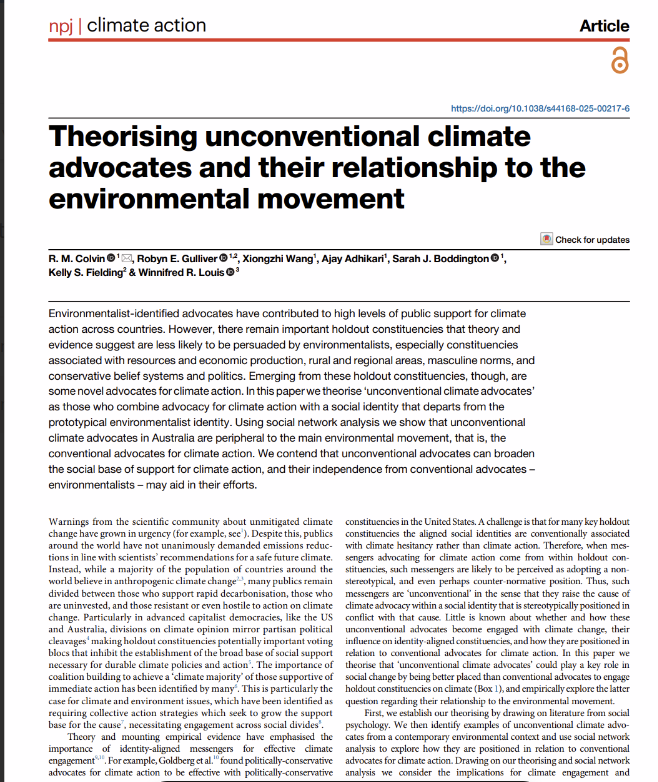
Theorising unconventional climate advocates and their relationship to the environmental movement
This study theorises “unconventional climate advocates” and analyses their position within Australia’s environmental movement using social network analysis. It finds these advocates are peripheral yet potentially effective in engaging climate-hesitant constituencies by operating independently from conventional environmentalists.
Please login or join for free to read more.

OVERVIEW
Introduction
This paper examines why significant segments of the public remain resistant to climate action despite widespread acceptance of climate science, focusing on Australia. It introduces the concept of unconventional climate advocates: individuals or groups advocating for climate action from social identities not typically associated with environmentalism. Drawing on social identity and persuasion theory, the authors argue that such advocates may be better positioned than conventional environmentalists to engage climate-hesitant or “holdout” constituencies, including political conservatives, farmers, resource industry workers, businesses, religious groups, and groups shaped by masculine norms.
Results
The study uses social network analysis to examine how unconventional climate advocates are positioned relative to the broader Australian environmental movement. The dataset includes 508 advocacy organisations and, when accounting for parent groups and subgroups, 1,551 advocacy groups, alongside 1,670 non-advocacy environmental groups. Of these, 76 groups (4.9%) are classified as role-based unconventional advocates and 12 groups (0.7%) as conflict-spanning unconventional advocates.
Quantitative network metrics show that unconventional advocates are more peripheral than conventional advocates. Conventional advocates have a higher mean degree of connectivity (1.286) compared with role-based unconventional advocates (1.159) and conflict-spanning unconventional advocates (0.939). Conventional advocates also exhibit higher modularity (0.791), indicating stronger clustering and more cohesive internal networks than either category of unconventional advocate.
Network visualisations further indicate that role-based unconventional advocates tend to be more connected than conflict-spanning advocates, though both remain less embedded than conventional environmental groups. A small number of unconventional advocates, such as the Investor Group on Climate Change and the Australian Religious Response to Climate Change, demonstrate relatively higher connectivity to conventional advocacy networks.
Discussion
The findings suggest that unconventional advocates occupy a marginal position within the environmental movement, sharing fewer public ties and occupying less central network roles. From a conventional social movement perspective, this may limit coordination, shared narratives, and resource exchange. However, the authors argue that peripheral positioning may be advantageous for engaging holdout constituencies that distrust environmentalist identities.
Maintaining distance from the environmental movement may enhance the perceived credibility of unconventional advocates by reducing assumptions of ideological bias or self-interest. The paper distinguishes between conflict-spanning advocates, who operate within identities historically in tension with environmentalism, and role-based advocates, who challenge assumptions about who can legitimately speak on climate issues. Together, these groups may expand the social base of climate support by operating in parallel to, rather than within, the established environmental movement. This challenges traditional definitions of social movements that emphasise dense internal networks.
Methods
The analysis applies social network analysis using Gephi software. Network ties were identified from publicly available information on organisational websites and Facebook pages, including formal affiliations, partnerships, memberships, and parent–subgroup relationships. Three sub-networks were constructed: conventional advocates, role-based unconventional advocates, and conflict-spanning unconventional advocates. Network statistics include mean degree, modularity, clustering, and average path length. The analysis is descriptive, reflecting the sensitivity of network measures to small changes in ties.
Data
The dataset is based on a pre-existing database of Australian environmental organisations developed over several years. It was compiled through systematic searching of the Australian Register of Environmental Organisations, supplemented by iterative snowball searches of linked organisations. Website content was manually coded to identify advocacy activity and network connections. Data collection occurred between June and September 2022.
A second round of coding was conducted on 14% of organisations to improve reliability, identifying 278 additional connections on top of 4,210 initially recorded. The final dataset includes both advocacy and non-advocacy environmental groups to reflect the broader environmental movement, recognising that some groups contribute to climate action without framing their activities as advocacy.
Analysis
Network analyses focus on how unconventional advocates relate to conventional environmental actors. Mean degree and modularity metrics are used to assess connectivity and clustering. Results are interpreted alongside social identity theory to assess implications for persuasion, legitimacy, and engagement with climate-hesitant constituencies.
Data availability
All network data and statistics are publicly available via the Open Science Framework.




