Overview
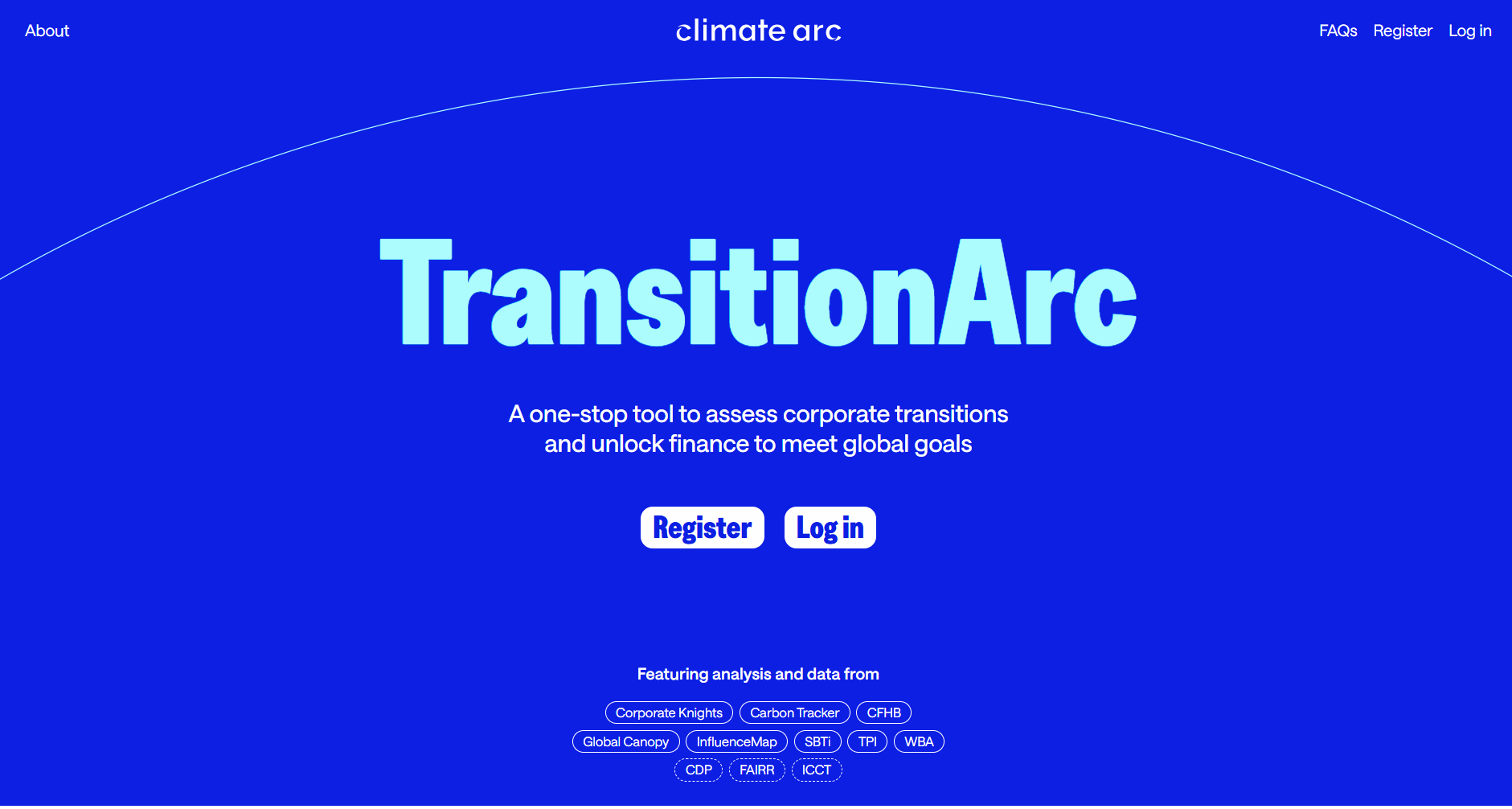
TransitionArc is an online platform that consolidates corporate climate transition data into a single, comparable view. Its main purpose is to help users assess how companies are aligning with climate transition expectations, including targets, strategies and disclosures. Finance professionals may find it relevant for evaluating transition readiness, comparability across firms, and integration into climate-related analysis.
Organisation behind the tool
TransitionArc is developed and maintained by ClimateArc, an organisation focused on improving access to decision-useful climate transition intelligence. The platform draws on data from established climate and transition assessment initiatives and presents them in a unified interface.
What the tool does
- Aggregates corporate climate transition assessments from multiple recognised sources.
- Allows users to compare companies on transition-related indicators, such as targets, governance and strategy.
- Presents high-level scores, classifications and alignment signals rather than raw emissions data.
- Enables filtering and comparison across companies and sectors.
- Provides visual summaries to support quick interpretation and benchmarking.
Target audience
The primary audience includes finance professionals such as investors, analysts and asset owners. Other relevant users include researchers, policymakers, civil society organisations and corporate stakeholders seeking an overview of transition performance.
Relevance to finance professionals
Risk assessment
- Supports identification of transition risk by highlighting companies that are misaligned with climate transition pathways.
- Enables relative risk comparison across peers and sectors.
ESG analysis
- Provides consolidated transition-related indicators that can be used alongside broader ESG analysis.
- Assists in evaluating the credibility of corporate climate commitments and strategies.
Market and sector insights
- Facilitates sector-level comparisons to identify structural transition challenges or leaders.
- Helps contextualise company performance within broader market transition trends.
Investment context
- Useful for stewardship, engagement prioritisation and screening based on transition alignment.
- Informs long-term investment decisions by highlighting potential exposure to climate transition pressures.