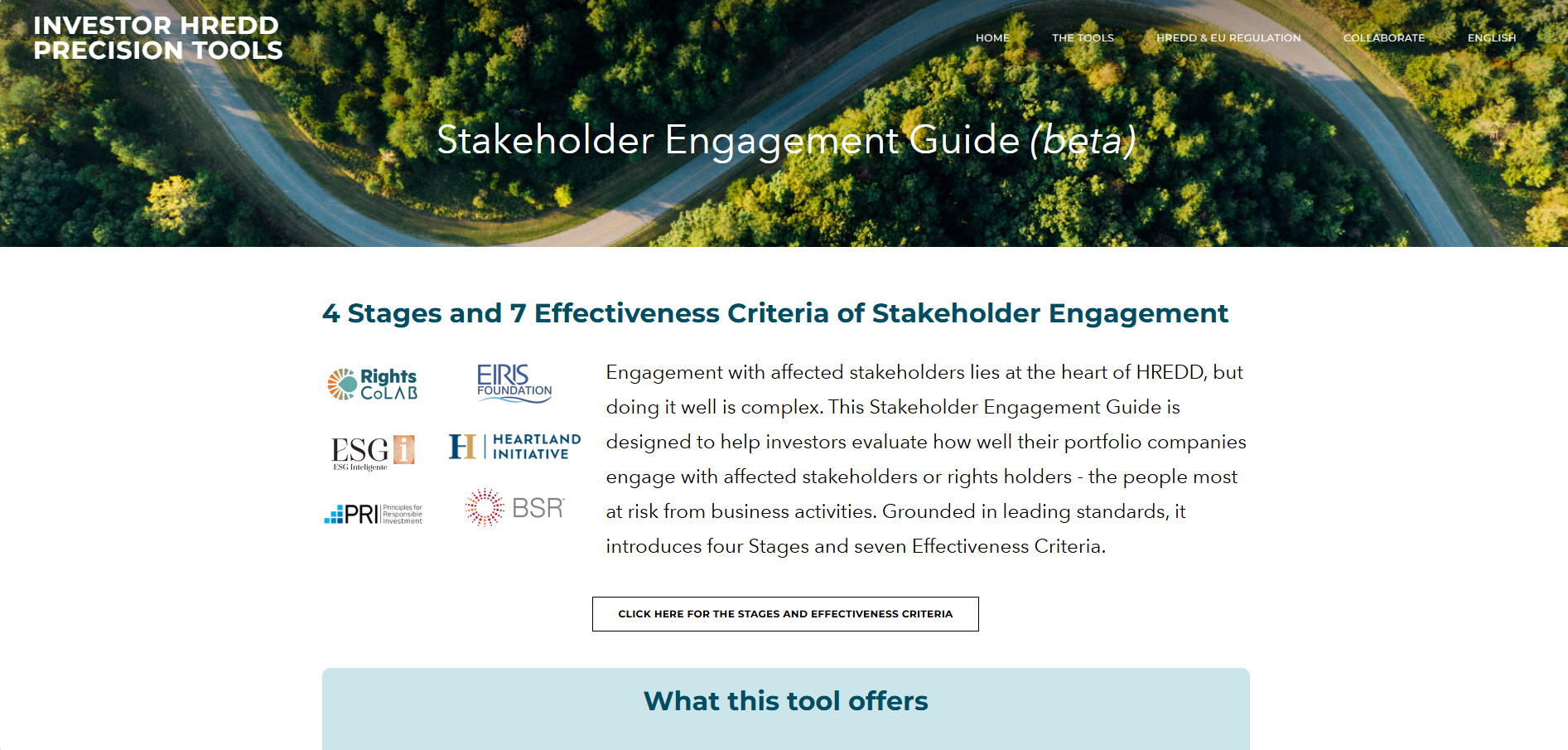
The Stakeholder Engagement Guide is an investor-focused online tool designed to assess how companies engage with affected stakeholders within human rights and environmental due diligence (HREDD). It provides a structured framework based on recognised standards. Finance professionals can use it to evaluate corporate practices, identify risks, and improve engagement quality in investment portfolios.
Organisation behind the resource
The resource is part of the Investor HREDD Precision Tools platform, maintained by Rights CoLab. It was developed through collaboration with organisations including the EIRIS Foundation, ESG Inteligente, Heartland Initiative, BSR, and the Principles for Responsible Investment (PRI).
What the resource does
- Provides a structured framework for assessing stakeholder engagement using four stages and seven effectiveness criteria.
- Explains each criterion and its role in meaningful engagement.
- Offers targeted questions investors can use when engaging with portfolio companies.
- Identifies indicators in company disclosures and communications to assess engagement quality.
- Includes real-world examples highlighting common engagement failures.
- Provides sector- and issue-specific considerations, including labour and supply chain risks.
- Gives guidance for high-risk or conflict-affected contexts requiring enhanced due diligence.
- Draws on established standards such as OECD guidance, TNFD recommendations, and IFC frameworks.
Target audience
The primary audience is institutional investors, including asset owners and asset managers, seeking to assess portfolio company practices.
Secondary users include ESG analysts, sustainability professionals, civil society organisations, and policymakers interested in corporate human rights and environmental due diligence.
Relevance to finance professionals
Risk assessment
- Identifies exposure to social and environmental risks linked to poor stakeholder engagement.
- Highlights potential legal, reputational, and operational risks arising from inadequate engagement.
ESG analysis
- Supports evaluation of social performance, particularly human rights practices and stakeholder inclusion.
- Provides qualitative indicators for assessing company disclosures and engagement processes.
Investment context
- Links stakeholder engagement quality to financial materiality, including long-term stability and risk mitigation.
- Helps investors understand how companies integrate stakeholder feedback into decision-making and governance.
Engagement and stewardship
- Offers practical questions and benchmarks to guide investor engagement with portfolio companies.
- Enables identification of gaps and opportunities for improving corporate practices.
Overall, the resource supports more informed ESG integration and active ownership by providing a structured approach to evaluating stakeholder engagement within investment analysis.