Child labour trends: Key findings
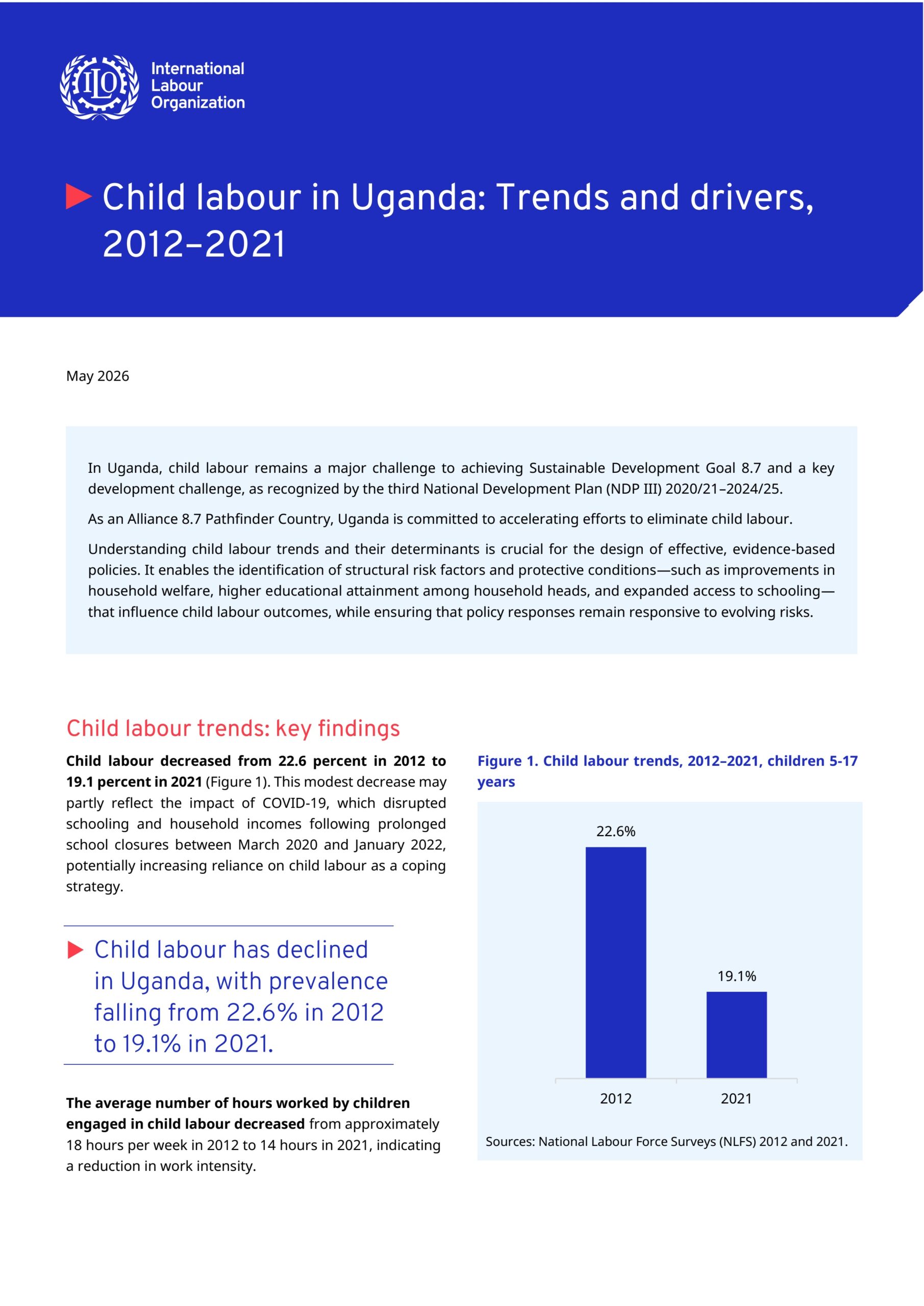
Child labour decreased from 22.6 percent in 2012 to 19.1 percent in 2021 (p. 1). The average number of hours worked by children engaged in child labour decreased from approximately 18 hours per week in 2012 to 14 hours in 2021, indicating a reduction in work intensity (p. 1). Progress against child labour has been uneven across age groups (p. 2). The reduction was significant for children aged 12–13 years (from 21.7 percent in 2012 to 15.7 percent in 2021) (p. 2) and for children aged 14–17 years (from 28 percent in 2012 to 20.2 percent in 2021) (p. 2). In contrast, for children aged 5–11 years, the drop was marginal (from 20.2 percent in 2012 to 19.4 percent in 2021) (p. 2).
Gender disparities persist and have slightly widened (p. 2). In 2021, 20.6 percent of boys were engaged in child labour compared to 17.5 percent of girls (p. 2). Child labour among orphans dropped from 30.2 percent in 2012 to 21.2 percent in 2021, compared to a decrease from 22.4 percent to 19 percent among non-orphans (p. 2). The rural-urban divide has narrowed modestly, as child labour in rural areas fell from 27.8 percent in 2012 to 21.1 percent in 2021, while urban rates increased from 10.7 percent to 13.4 percent (p. 2). In 2021, nearly 89 percent of children in child labour were engaged in agriculture, forestry, or fishing (p. 2).
Underlying drivers: Key findings
Child labour has become progressively more common among boys than girls, particularly when children grow older (p. 3). Children living in urban areas were significantly more likely to attend school and less likely to work (p. 3). Household composition and size play an important role; the presence of older siblings, aged over 17 years, reduces both the likelihood and intensity of child labour (p. 3). Household vulnerability significantly increases the risk of child labour, as children in households affected by shocks—such as illness, job loss, or crop failure—were more likely to work in 2015 and 2019 (p. 3). Household wealth is a strong protective factor, and higher educational attainment among household heads is strongly associated with lower incidence and intensity of child labour (p. 3).
Approach and data source for the analysis of child labour drivers
This analysis draws on data from the Uganda National Panel Survey waves of 2011/12, 2015/16, and 2019/20 (p. 4). The analysis employs three complementary econometric approaches: ordinary least squares regression, bivariate probit models, and a non-linear Oaxaca-Blinder decomposition (p. 4).
Policy implications
Accelerating progress requires a strengthened multisectoral approach (p. 4). Key priorities include expanding access to decent work for adults and social protection for all, addressing barriers to quality education, and tackling harmful norms (p. 4). Increased investment is needed in rural communities and in sectors where child labour is most prevalent, especially agriculture (p. 4). Gender-responsive programming is essential, with priorities including strengthening hazard regulation for boys and enforcing laws against early and forced marriage for girls (p. 4). Strengthened monitoring and enforcement of existing legislation, combined with improved data systems, are essential to ensure effective targeting, accountability, and sustained progress (p. 4).