

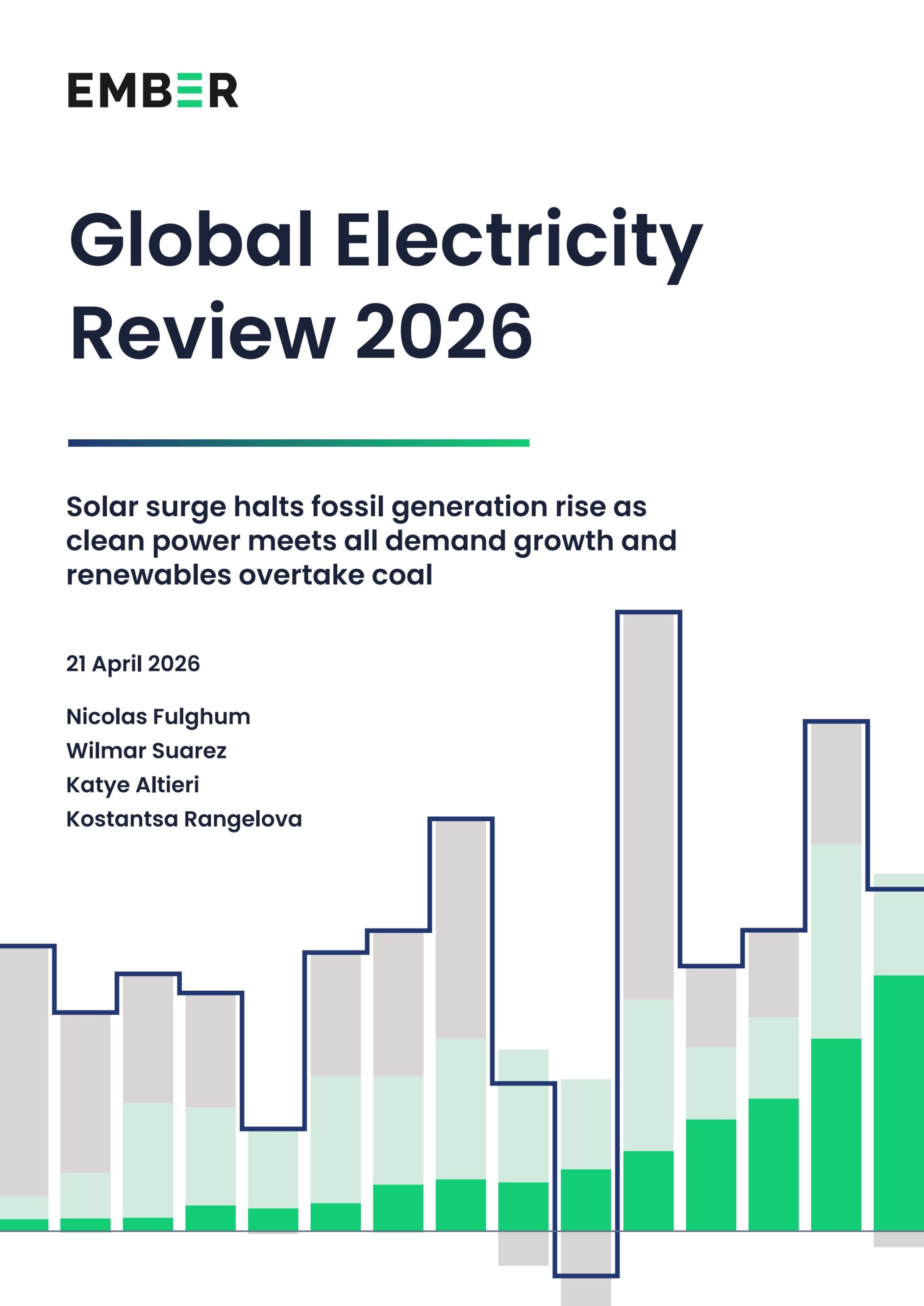
Global electricity review 2026
Ember’s 2026 Global Electricity Review reveals that solar power met 75% of global demand growth in 2025, halting fossil generation rise. Renewables reached 33.8% of the mix, overtaking coal for the first time. The report highlights falling battery costs and the decoupling of demand growth from fossil fuel consumption.
Please login or join for free to read more.

OVERVIEW
2025 in review
Record solar growth ensured that clean power sources expanded fast enough to meet all new electricity demand in 2025. This milestone prevented an increase in fossil generation, marking the first year since 2020, and only the fifth this century, without a rise in electricity generation from fossil fuels. Clean power generation increased by 887 TWh, outpacing demand growth of 849 TWh. Consequently, fossil generation recorded a small fall of 38 TWh (-0.2%). Solar power was the dominant driver of change, meeting 75% of the net rise in demand. Together with wind, these two sources met 99% of global demand growth.
In another significant milestone, renewables overtook coal power for the first time in the modern power system. Renewables contributed 33.8% (10,730 TWh) of global generation, while the share of coal fell below a third for the first time in history to 33.0% (10,476 TWh). This structural shift occurred as renewables overtook coal in every world region except Asia. The emissions intensity of global electricity also declined by 2.7% to 458 gCO2e/kWh, the largest annual percentage decline in two decades.
Global electricity insights
The global power sector is transitioning from an era of fossil-fuelled growth to an era of clean growth. Since 2015, the relationship between demand growth and fossil fuel consumption has decoupled; 81% of all wind and solar generation growth since 2000 has occurred in the last ten years. Outside of China, global fossil generation has not increased in aggregate since 2018. India is also showing signs of divergence from coal-heavy growth models, benefitting from a cost environment where providing firm power with solar and battery storage is already cheaper than new coal power.
The report highlights that battery storage is unlocking the next stage of solar expansion by turning daytime solar into “anytime solar.” Battery pack prices for stationary storage fell 45% in 2025 to a record low of USD 70/kWh. Dispatchable solar with batteries can now be delivered for approximately $76/MWh. Furthermore, the electrification of transport is directly displacing oil consumption. In 2025, the global electric vehicle (EV) fleet displaced 1.8 million barrels per day of oil demand, equivalent to 13% of United States crude oil production.
Global electricity demand and supply trends
Global electricity demand grew by a moderate 2.8% (+849 TWh) in 2025 to a record high of 31,779 TWh. China accounted for 59% of this net increase. Solar generation rose by a record 636 TWh (+30%), reaching 2,778 TWh. This represents the largest annual increase of any individual electricity source on record, excluding the post-pandemic coal rebound in 2021. Solar capacity additions also set a new record of 647 GW. Wind generation increased by 205 TWh (+8.2%), reaching a 8.5% share of the global mix.
In contrast, gas generation growth fell to a five-year low of 0.5% (+36 TWh), although it reached a record high of 6,919 TWh in absolute terms. Nuclear power rose by 1.3% to an all-time high of 2,812 TWh, driven by new reactors in China and increased output in France and Japan. Hydropower generation was essentially unchanged (+0.1%), causing its share of global generation to fall to an all-time low of 14% as it failed to keep pace with rising demand.
Analysis of major countries and regions
China remains the world’s largest power sector, accounting for one-third of global demand. Its fossil generation fell 0.9% in 2025 as clean power outpaced its 5% demand growth. Wind and solar reached 22% of China’s electricity mix. In the United States, electricity demand grew 3%, driven by data centre expansion and heating needs. Wind and solar together met 74% of this growth and surpassed nuclear generation for the first time. However, US coal generation rose 13% due to high gas prices.
In the European Union, wind and solar generation exceeded fossil generation for the first time, reaching a 30% share. EU coal generation hit a record low, though gas rose 8% to offset lower hydro output. India’s fossil generation fell 3.3% as renewable generation grew twice as fast as demand. Solar became India’s largest clean power source, overtaking hydropower. Brazil also achieved a milestone as solar generation surpassed fossil generation for the first time, with renewables providing 87% of its total electricity.
Conclusion
The year 2025 marked a turning point in the global power sector as the expansion of fossil fuel generation came to a halt outside of a major economic downturn. Solar and wind have proven to be the central technologies of this structural shift, growing fast enough to meet all global electricity demand growth. With battery costs declining rapidly, affordable storage is unlocking round-the-clock clean power. The report concludes that clean power is now positioned to deliver fossil-free growth both within and beyond the power sector.




