

Carbon Bombs
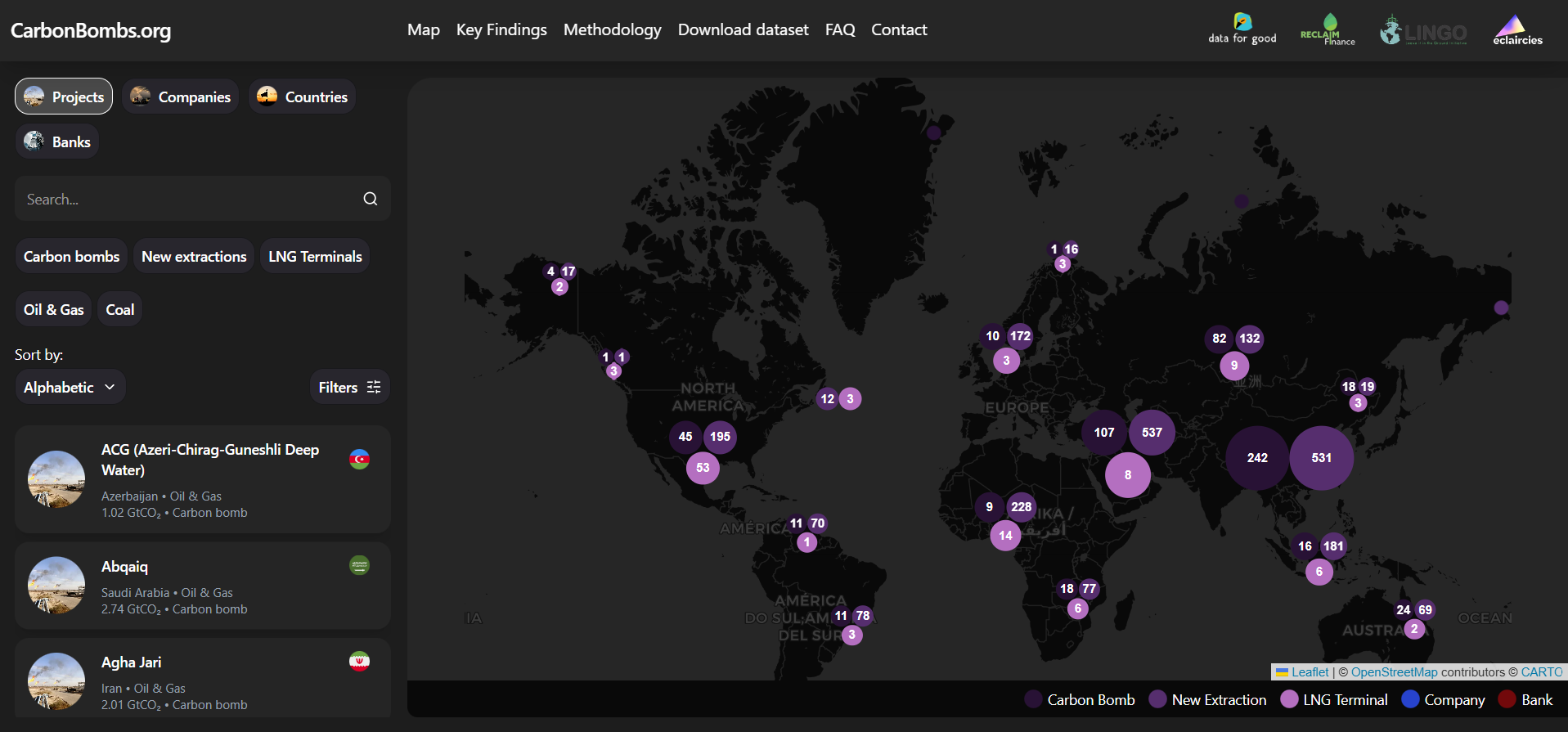
CarbonBombs.org is an open-source global database mapping large fossil fuel extraction projects (“carbon bombs”), new oil, gas and coal developments and LNG terminals, with estimated future CO₂ emissions and links to companies and banks involved. Data is consolidated from multiple research sources and regularly updated.
Please login or join for free to read more.

OVERVIEW
CarbonBombs.org is an open, interactive global database mapping large fossil fuel extraction projects (“carbon bombs”), new extraction developments and liquefied natural gas (LNG) terminals. It provides spatial and entity-level data on extraction projects, potential CO₂ emissions and links to companies and financial institutions. Finance professionals may use it to assess exposure to high-emission assets and understand fossil fuel expansion trends relevant to climate and investment risk analysis.
Organisation behind the tool
CarbonBombs.org is developed and maintained by a consortium of non-governmental researchers and campaign organisations, including LINGO, Data for Good, Reclaim Finance and Éclaircies, consolidating multiple reference datasets.
What the tool does
- Maps fossil fuel extraction projects globally that are projected to emit over 1 gigatonne of CO₂ (“carbon bombs”).
- Includes data on new oil, gas and coal extraction projects and LNG export terminals.
- Shows ownership links between projects and fossil fuel companies.
- Presents financial connections between companies and banks funding fossil fuel expansion.
- Offers searchable maps, filters by project type, company, country and bank.
- Permits users to download the underlying dataset for external analysis.
Target audience
The primary audience comprises researchers, analysts and civil society stakeholders focused on climate data and fossil fuel trends. The tool is also relevant for policymakers, journalists, and the general public interested in emissions and energy projects.
Relevance to finance professionals
- Risk assessment – Identifies large fossil fuel projects that may represent long-term carbon and regulatory risk.
- ESG analysis – Provides environmental metrics and company exposure to carbon-intensive assets for sustainability reporting.
- Market/commodity insights – Offers data on global fossil fuel project pipelines and LNG infrastructure trends.
- Investment context – Assists in evaluating how continued fossil fuel expansion may affect portfolio resilience amid climate-related policy shifts.




