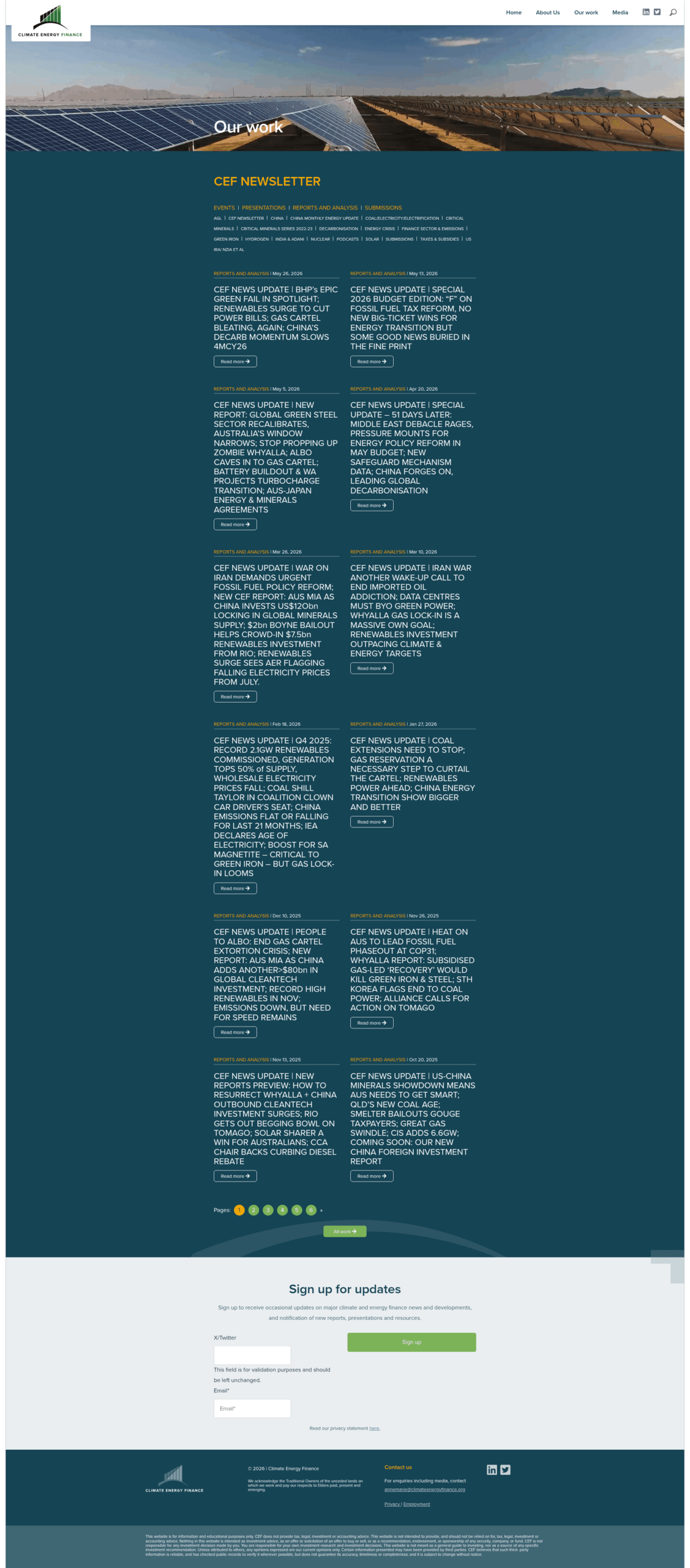
CEF Newsletter
The CEF Newsletter delivers updates and financial analysis on the global energy transition, renewable energy markets, and climate policy.
Please login or join for free to read more.

OVERVIEW
The CEF Newsletter is a regular information resource that provides updates, reports, and analyses on major climate and energy finance developments. The tool’s main purpose is to track and report on key shifts in the energy transition, renewable energy, fossil fuel policy, and global cleantech investments. Finance professionals can find it relevant as it delivers insights into market trends, decarbonisation momentum, and regulatory risks affecting the energy and finance sectors.
Organisation behind the tool
The newsletter is developed and maintained by Climate Energy Finance (CEF).
What the tool does
The tool provides users with regular updates and access to a curated archive of news, reports, and analyses. Key features and content covered by the newsletter include:
- Insights into renewable energy capacity additions, wholesale electricity prices, and transition dynamics.
- Monitoring of global cleantech investment trends, with specific focus on China’s outbound investments and minerals supply.
- Analysis of fossil fuel policy reform, subsidies, carbon pricing mechanisms, and corporate transition failures or strategies.
- Tracking of domestic and global developments in critical minerals, green iron, hydrogen, solar, and battery buildouts.
Target audience
The primary target audience includes finance professionals, policymakers, researchers, and individuals interested in the financial and strategic developments of the global and domestic energy transition.
Relevance to finance professionals
The newsletter assists finance professionals in several key practice areas:
- Market and commodity insights: Offers data on renewable energy generation, energy storage deployment, and shifting dynamics in commodities like green iron and critical minerals.
- ESG analysis and investment context: Provides perspectives on global decarbonisation progress, emissions trajectories, and corporate ESG practices.
- Risk assessment: Details regulatory shifts, policy updates, and geopolitical developments that could expose energy and resource assets to transition risks.