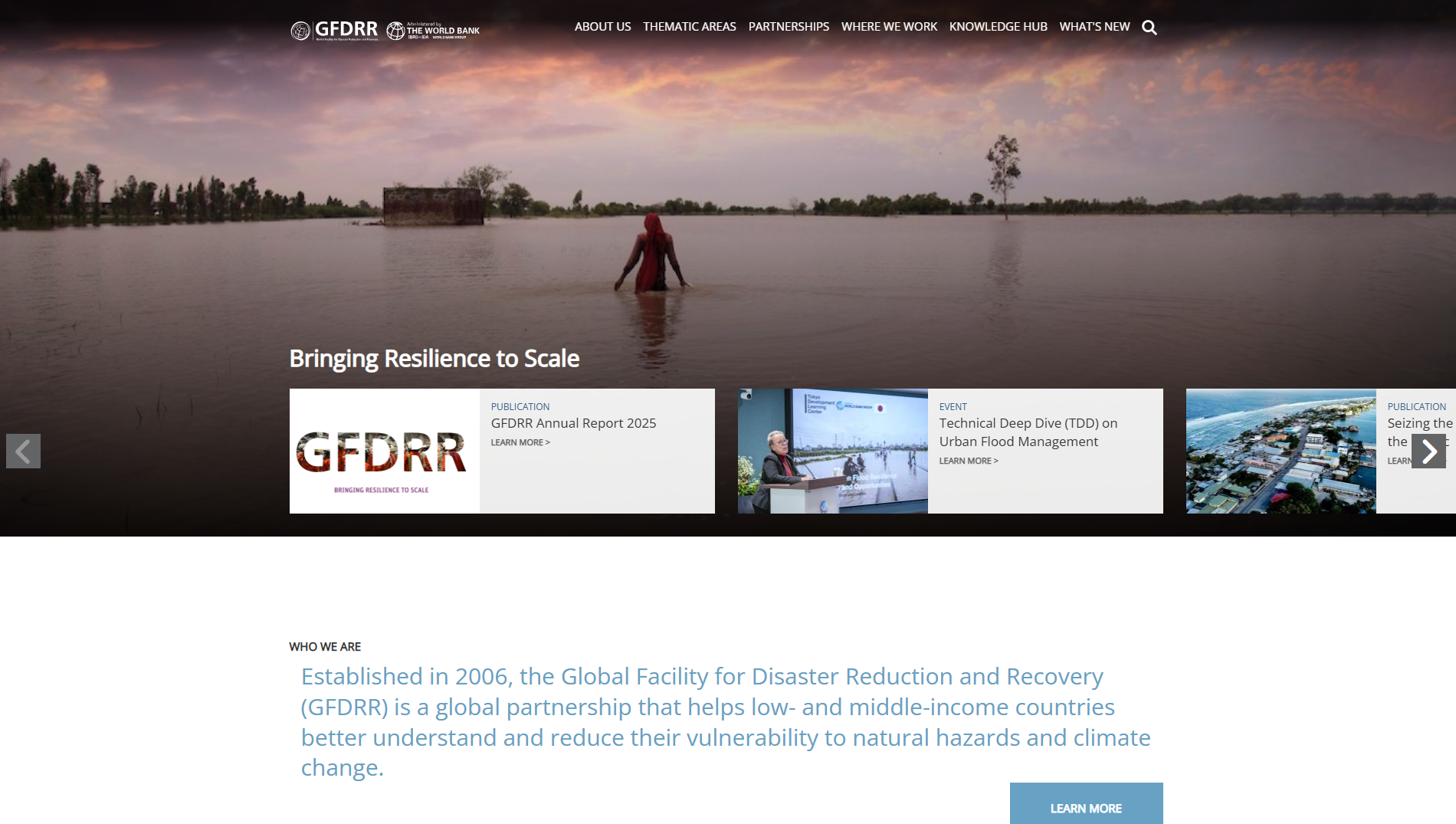
The Global Facility for Disaster Reduction and Recovery (GFDRR) is a World Bank-managed, multi-donor partnership supporting disaster risk management and climate resilience in low- and middle-income countries. It offers online tools and data resources that enable risk analysis, hazard identification and planning. Finance professionals may find these tools useful for risk assessment, resilience planning and integration of disaster risk data into financial decision-making processes.
Organisation behind the tool
GFDRR is a global partnership administered by the World Bank and supported by multiple governments and international organisations. It focuses on reducing vulnerability to natural hazards and climate change through knowledge products, analytics, technical assistance and grant support.
What the tool does
GFDRR’s online tools include:
- Climate Change Knowledge Portal – Provides global, regional and country-level climate data.
- ThinkHazard! – Identifies natural hazards in specific project areas.
- InaSAFE – Produces realistic natural hazard impact scenarios.
- GeoNode – Open source platform to deploy spatial data infrastructure.
- Code for Resilience – Supports resilience strengthening through coding frameworks.
- Risk Data Library & CCDR Tools – Enables disaster risk screening, spatial analytics and interactive risk dashboards.
- Users can analyse hazard exposure, view risk maps, combine socio-economic indicators, and download datasets for further analysis.
Target audience
Primary users include:
- Risk analysts and planners in public and private sectors.
- Government agencies and policymakers involved in disaster risk management.
- Researchers and academics analysing climate and disaster data.
- Development practitioners and NGOs working on resilience and adaptation.
Relevance to finance professionals
Risk assessment
- Evaluate exposure to natural hazards and disaster risk at national or sub-national levels.
- Identify risk-poverty hotspots through combined hazard and socio-economic data.
ESG analysis
- Incorporate environmental risk indicators into reporting and sustainability assessments.
- Use hazard and vulnerability data to inform climate resilience metrics.
Market/commodity insights
- Assess potential impacts of climate hazards on infrastructure, agriculture and water resources.
- Inform long-term planning with climate risk projections.
Investment context
- Support financial decision-making by integrating disaster risk data into cost–benefit analysis for resilient infrastructure.
- Use risk screening outputs to inform sovereign risk finance and insurance strategy discussions.