

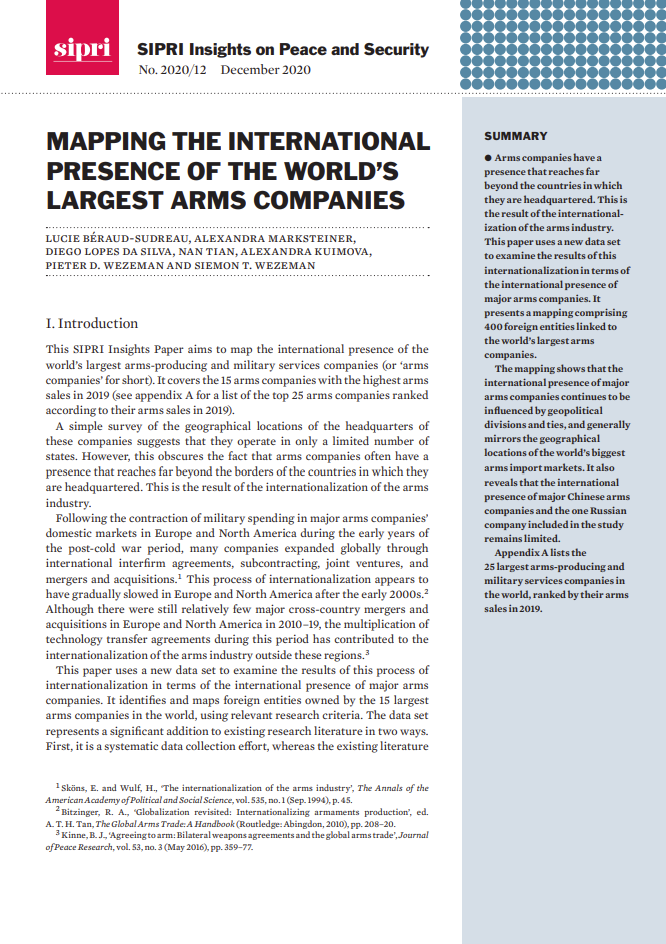
Mapping the international presence of the world's largest arms companies
SIPRI maps the global footprint of the 15 largest arms companies, identifying 400 majority-owned foreign entities. International presence aligns with geopolitical ties and major arms markets. US and European firms dominate; Chinese and Russian companies show limited overseas reach.
Please login or join for free to read more.

OVERVIEW
I. Introduction
This SIPRI study analyses the international presence of the world’s largest arms-producing and military services companies, focusing on the 15 firms with the highest arms sales in 2019. Although these companies are headquartered in a limited number of countries, the arms industry has internationalised significantly since the post–cold war period. The report introduces a new, systematic data set to map this internationalisation, addressing gaps in earlier research that relied on partial or anecdotal evidence.
2020 – Mapping the internationa…
II. Mapping the foreign entities of the world’s largest arms companies
SIPRI defines international presence as majority-owned foreign entities involved in military manufacturing, services or research and development (R&D), operating for at least six months in 2019. Applying strict criteria on ownership, activity, location and duration, the study identifies 400 qualifying foreign entities across 12 of the 15 largest arms companies.
The mapping highlights substantial variation between firms. Thales has the largest footprint, with 67 foreign entities in 24 countries, followed by Leonardo (59 entities) and Boeing (56 entities). In contrast, most Chinese companies and the single Russian company included show little or no qualifying foreign presence, largely due to limited available data and more domestically focused industrial strategies.
Geographically, the 15 companies are present in at least 49 countries, including 17 in the Global South. Europe hosts the highest number of foreign entities (167), reflecting consolidation of the European arms industry and strong transatlantic industrial ties. North American companies have a particularly strong presence in Europe, while Australia stands out as the largest military manufacturing hub outside North America and Western Europe. Overall, the distribution of entities mirrors geopolitical alliances and the location of major arms import markets.
Joint ventures account for 59 of the identified entities and are often linked to offset arrangements and technology transfer requirements in arms procurement contracts. Only 22 foreign entities qualify as military R&D facilities, established mainly by Boeing, Thales and Airbus, indicating that companies remain cautious about offshoring advanced research activities.
III. Understanding the international presence of the world’s largest arms companies
From the supply perspective, arms companies expand internationally to improve competitiveness, share development risks and access foreign markets. Rising costs of advanced weapon systems have driven mergers, acquisitions and multinational programmes such as the F-35 and A400M aircraft, which directly shape companies’ international footprints. Firms also seek foreign acquisitions to access emerging technologies, including cyber and communications capabilities.
From the demand perspective, host-country procurement and industrial policies strongly influence where companies establish foreign entities. The United States attracts subsidiaries due to its large defence market but imposes strict controls through “Buy American” provisions and national security regulations. Australia and the United Kingdom host many foreign entities due to liberal investment regimes and open procurement policies. India hosts relatively few entities despite high arms imports, reflecting historically restrictive foreign investment caps, although recent policy changes may encourage greater localisation. Saudi Arabia’s growing number of foreign entities reflects offset policies and its Vision 2030 target to localise 50 per cent of defence spending.
Chinese and Russian arms companies show limited international presence. AVIC has a small number of foreign entities, mainly linked to servicing existing customers and accessing dual-use technologies. Russian firms, including Almaz-Antey, rely more on maintenance agreements and ad hoc partnerships, constrained by state ownership, sanctions and a strong domestic focus.
IV. Conclusions
The report concludes that the international presence of the world’s largest arms companies is extensive but uneven. Western firms dominate global production and services networks, while Chinese and Russian companies remain largely domestically oriented. The new data set provides a stronger empirical basis for analysing arms industry internationalisation and highlights transparency gaps and the growing influence of localisation policies on future industry structures.




