

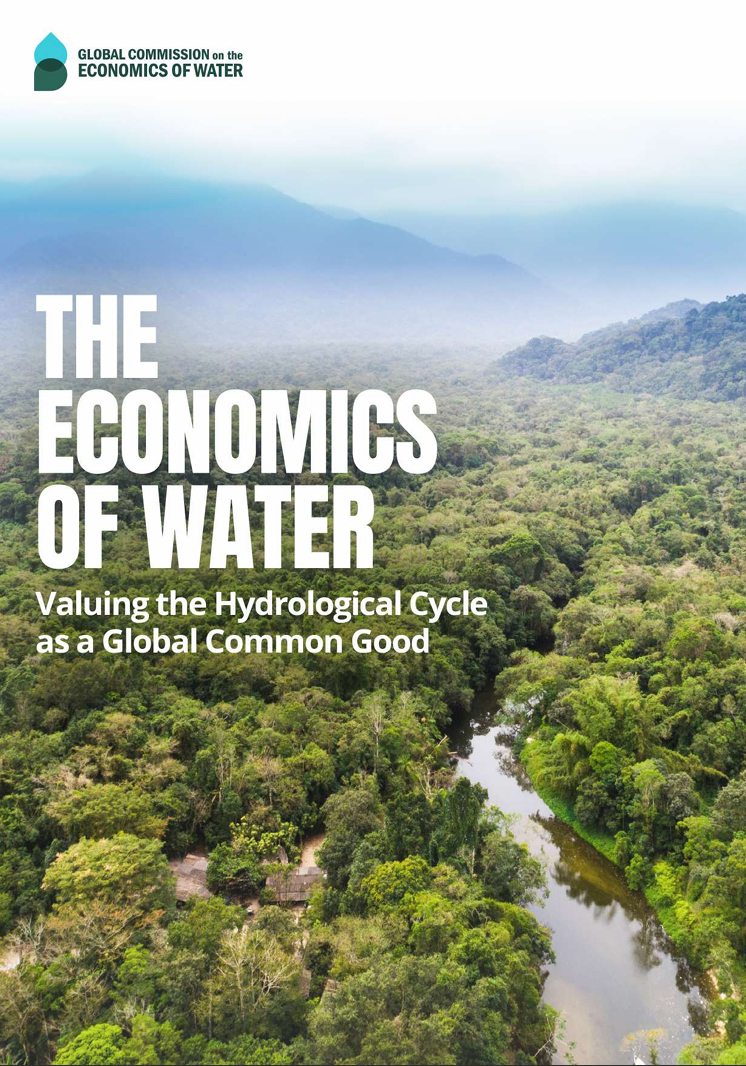
The economics of water: Valuing the hydrological cycle as a global common good
The report argues the hydrological cycle should be governed as a global common good, with water valued more accurately and managed for efficiency, equity and environmental sustainability, supported by five missions spanning food systems, ecosystems, circular water use, lower water-intensity industry, and universal safe water access. The report is produced by the Global Commission on the Economics of Water, supported by the OECD.
Please login or join for free to read more.

OVERVIEW
Introduction: Transforming the world’s understanding of the economics of water
The report argues that global water challenges stem largely from failures in economic thinking and governance rather than absolute scarcity. Around two billion people lack safely managed drinking water, and agriculture accounts for roughly 70% of global freshwater withdrawals. Climate change, land degradation and inefficient water use are destabilising the hydrological cycle. The report calls for a transformation in how water is valued and managed, recognising its central role in economic stability, food systems, ecosystems and climate resilience.
The hydrological cycle as a global common good
Water flows through interconnected atmospheric, terrestrial and ecological systems, meaning governance cannot be limited to national or sectoral boundaries. The report highlights the links between blue water (surface and groundwater), green water (soil moisture) and atmospheric moisture that influence rainfall and ecosystem stability. Deforestation, land degradation and pollution disrupt these processes, reducing water availability and increasing climate vulnerability. Treating the hydrological cycle as a global common good would enable coordinated management across sectors and borders.
Towards a new economics of water
The report argues that water is systematically undervalued in economic systems. Pricing, allocation and policy frameworks often fail to reflect water’s environmental, social and economic importance. This leads to overuse, pollution and inefficient allocation. A new economics of water would incorporate the full value of water into decision-making, integrating ecosystem services, climate impacts and social equity considerations into policies and investment decisions.
Pushing the economics: The case for shaping markets
Market mechanisms alone cannot address water scarcity and environmental degradation. The report calls for shaping markets through policies, pricing structures and regulations that reflect water’s scarcity and ecosystem value while ensuring equitable access. Governments should design incentives that promote efficient water use and reduce pollution. Financial institutions and businesses are encouraged to incorporate water risks into economic planning and investment decisions.
Innovations to tackle water’s critical mission areas
The report identifies five mission areas requiring coordinated action. These include transforming food systems to improve irrigation efficiency and water productivity, conserving and restoring ecosystems that regulate rainfall and green water, establishing a circular water economy through wastewater recycling and reuse, reducing the water intensity of energy systems and digital infrastructure, and ensuring universal access to safe and reliable water services.
Partnerships, property rights and contracts for more water justice
The report emphasises the importance of institutional reform to address inequalities in water access and management. Clear property rights, inclusive governance structures and transparent contractual arrangements can support more equitable allocation of water resources. Partnerships between governments, communities, businesses and civil society can strengthen water governance while ensuring that vulnerable populations are not excluded from access to water services.
Finance for a just and sustainable water future
Significant investment is required to improve water infrastructure, restore ecosystems and expand water services. The report highlights the role of public finance, private capital and blended finance mechanisms in supporting water security. Financial institutions are encouraged to integrate water risks into lending and investment decisions while supporting projects that improve water efficiency, resilience and equitable access.
The governance of water utilities
Water utilities play a central role in delivering safe water and sanitation services. The report emphasises the need for improved governance, accountability and operational efficiency within utilities. Strengthening regulatory frameworks and management practices can improve service reliability, reduce water losses and ensure financial sustainability while maintaining affordability for households.
Harnessing data as a foundation for action
Reliable data and monitoring systems are essential for effective water governance. The report highlights the importance of improving data collection on water flows, ecosystem conditions and water use across sectors. Advances in digital technologies, satellite monitoring and data analytics can support more informed decision-making and enable better management of water resources.
Opportunities for just global water governance
The report calls for stronger international cooperation to address water challenges that transcend national boundaries. Coordinated governance frameworks can help align climate, biodiversity and water policies while promoting equitable management of shared water resources. Global institutions and multilateral initiatives can play a role in facilitating collaboration and knowledge sharing.
Conclusions
The report concludes that stabilising the hydrological cycle requires fundamental changes in economic thinking, governance and investment. Recognising water as a global common good, reshaping markets and strengthening institutions can improve water security while supporting climate resilience, ecosystem protection and sustainable economic development.




