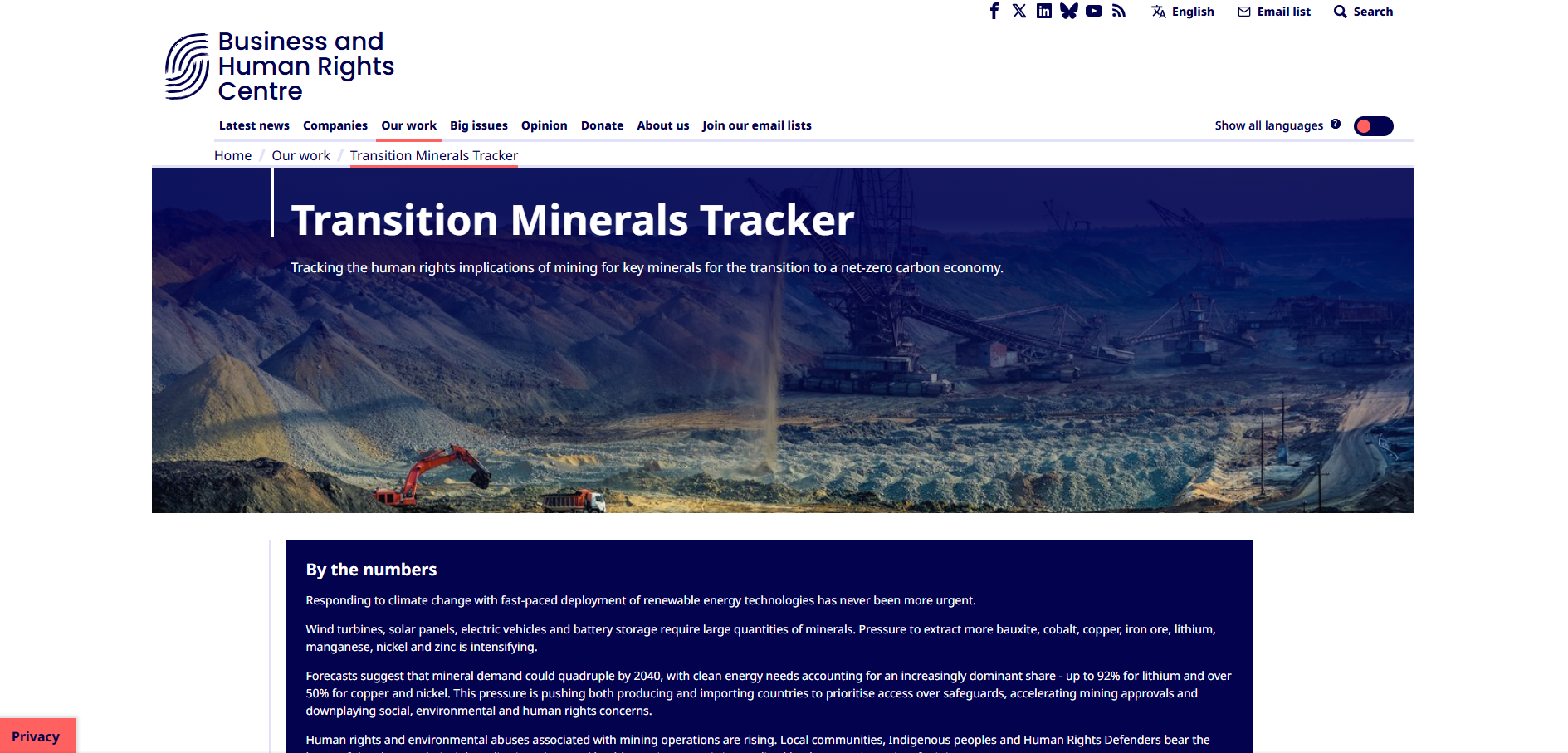
The Transition Minerals Tracker is an online database that monitors human rights risks associated with mining minerals critical to the energy transition. It compiles global data on company practices, allegations and impacts. Finance professionals may find it relevant for assessing ESG risks within mining and clean energy supply chains.
Organisation behind the tool
The tool is developed and maintained by the Business & Human Rights Resource Centre, an international non-profit organisation focused on corporate accountability. It draws on global research, media sources and civil society reporting to compile its dataset.
What the tool does
Tracks human rights allegations linked to mining of key transition minerals such as lithium, cobalt and copper.
Covers major mining companies and operations globally, including associated policies and practices.
Allows users to search by company or project to identify links to allegations or risks.
Maps geographic “hotspots” where incidents and risks are concentrated.
Provides downloadable datasets and periodic global analyses of trends over time.
Includes data on impacts affecting workers, communities, Indigenous peoples and human rights defenders.
Target audience
The primary users include investors, financial institutions, companies and civil society organisations monitoring supply chain risks. It is also relevant to policymakers, researchers and advocacy groups interested in mining, human rights and the energy transition.
Relevance to finance professionals
- Risk assessment: Identifies exposure to operational, legal and reputational risks linked to human rights abuses in mining projects.
- ESG analysis: Provides structured data on social and governance issues, including labour rights, community impacts and environmental harm.
- Market/commodity insights: Highlights supply chain risks in critical minerals essential for renewable energy and electrification technologies.
- Investment context: Supports due diligence on companies involved in the low-carbon transition, including assessment of long-term sustainability and potential conflict risks.