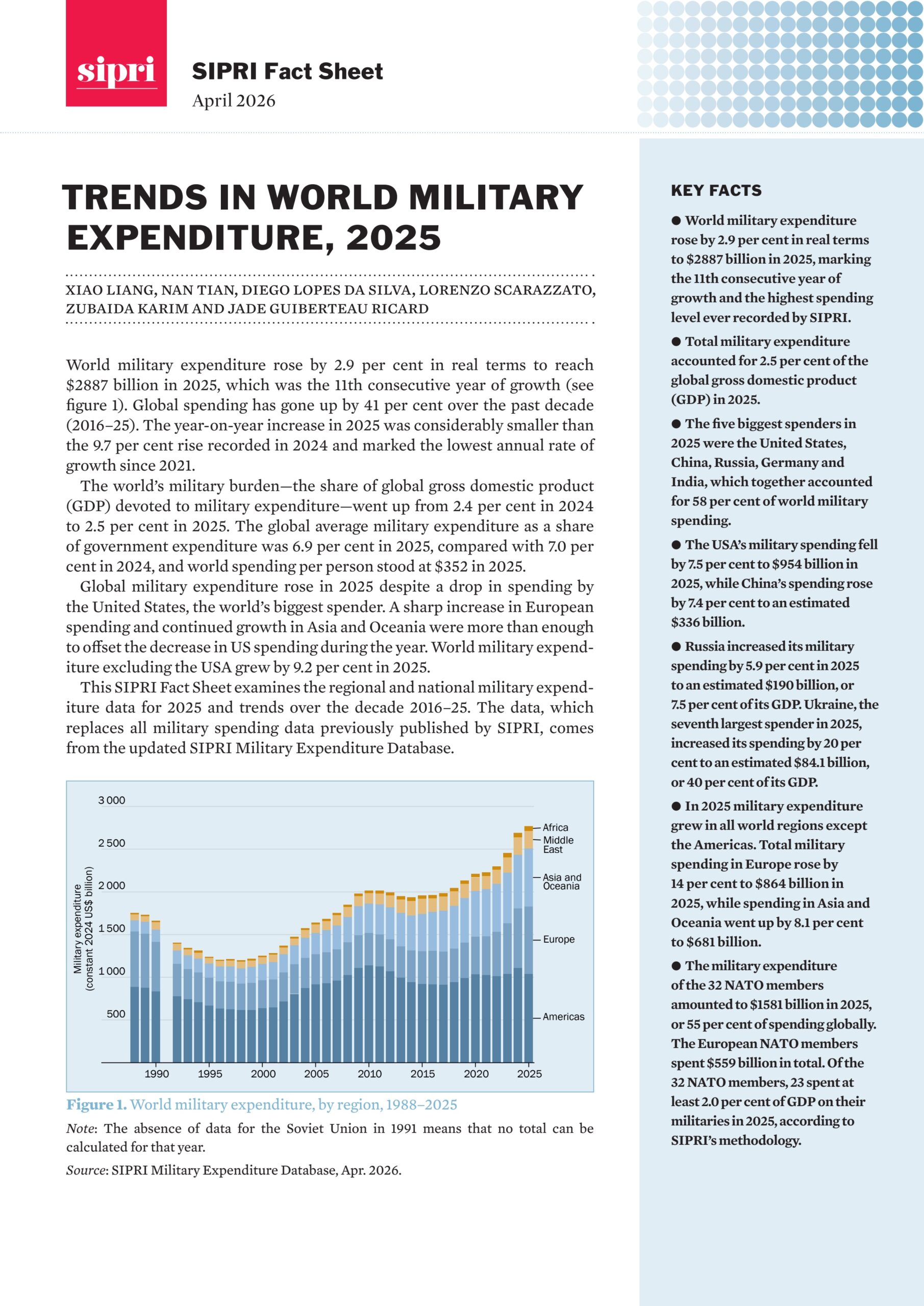
Trends in world military expenditure series
A benchmark series by SIPRI tracking annual global military expenditure across countries and regions. Published as an annual fact sheet, it provides data on spending levels, military burdens as a share of GDP, and decade-long trends to support evidence-based analysis of defence economics worldwide.
Please login or join for free to read more.

OVERVIEW
The Trends in World Military Expenditure fact sheet is an annual benchmark series published by the Stockholm International Peace Research Institute (SIPRI). It draws on the SIPRI Military Expenditure Database to provide a comprehensive, cross-country overview of defence spending patterns globally, by region, and at the national level.
What the series tracks
The series monitors military expenditure for countries across all world regions, covering current and capital spending on armed forces, defence ministries, paramilitary forces, and military space activities. Personnel costs, operations and maintenance, procurement, military research and development, and financial military aid provided by donor countries are all included where data permits.
The data is presented in multiple formats: local current prices, constant US dollars (adjusted for inflation), current US dollars, as a share of gross domestic product (GDP), on a per-capita basis, and as a share of general government expenditure. The SIPRI Military Expenditure Database extends back to 1949, making it one of the most longitudinal open-source datasets of its kind.
Methodology
SIPRI’s methodology is based exclusively on open sources, aiming to produce comprehensive and transparent estimates. This approach means that SIPRI’s figures may differ from those published by NATO or other bodies, which use different definitions and may incorporate spending categories not included in SIPRI’s framework.
Figures are expressed in both current US dollars (for the reference year) and constant US dollars (adjusted to the prior year’s prices) to enable real-terms comparisons over time. Estimates are used where official data is unavailable or incomplete, and these are clearly indicated in published tables. Civil defence, veterans’ benefits, and military involvement in non-military activities such as policing are excluded from SIPRI’s definition.
Key findings and themes from the 2025 edition
The 2025 edition reports that world military expenditure rose by 2.9 per cent in real terms to USD 2,887 billion — the 11th consecutive year of growth and the highest level ever recorded by SIPRI. Global spending has increased by 41 per cent over the decade 2016–25. The global military burden rose from 2.4 per cent of GDP in 2024 to 2.5 per cent in 2025, the highest level since 2009.
The five largest spenders — the United States, China, Russia, Germany, and India — together accounted for 58 per cent of world military spending. US military expenditure fell by 7.5 per cent to USD 954 billion, largely reflecting the cessation of supplemental appropriations for overseas financial military assistance. In contrast, European spending surged by 14 per cent to USD 864 billion, driven by geopolitical instability linked to the Russia–Ukraine War and uncertainty over US security guarantees for European NATO members.
Germany exceeded 2.0 per cent of GDP in military spending for the first time since 1990, while Poland carried the highest military burden among NATO members at 4.5 per cent of GDP. Ukraine’s military expenditure reached an estimated USD 84.1 billion, equivalent to 40 per cent of its GDP and 63 per cent of government spending — the highest shares in the world for the fourth consecutive year.
China’s military spending rose by 7.4 per cent to an estimated USD 336 billion, the largest year-on-year increase for China in the past decade and part of an uninterrupted 31-year growth streak. In Asia and Oceania, combined military expenditure grew by 8.1 per cent to USD 681 billion, continuing an unbroken upward trend since at least 1989.
A notable structural development in this edition concerns NATO’s revised spending target, agreed in June 2025, of 5.0 per cent of GDP by 2035, up from the previous 2.0 per cent target. The series highlights concerns around transparency and definitional consistency in how NATO members report spending relative to this target.
Relevance and uses for finance professionals
For finance professionals, this series provides a reliable, long-run benchmark for tracking defence expenditure as a component of government fiscal policy and sovereign budget allocation. The data is directly relevant to those involved in defence industry analysis, government bond markets, fiscal sustainability assessments, and sovereign credit analysis.
The inclusion of military spending as a share of GDP and government expenditure enables cross-country comparisons of fiscal prioritisation and budgetary trade-offs. For analysts covering countries such as Ukraine, Russia, or those undertaking rapid defence build-ups — including Germany, Poland, and Spain — the series provides granular trend data that can inform assessments of fiscal risk, debt sustainability, and industrial capacity.
The series also has relevance for infrastructure and defence procurement analysis, given its coverage of capital expenditure, arms industry investment, and off-budget financing mechanisms. As governments increasingly use borrowing, special funds, and reclassification to meet defence targets, the methodological rigour and transparency of SIPRI’s framework provides a useful independent reference point for investors and policy analysts seeking to assess actual versus reported defence capacity.
LINKS & ATTACHMENTS
-
Go to source

-
2029 - 2025 - Trends in World Military Expenditure
-
2029 - 2024 - Trends in World Military Expenditure
-
2029 - 2023 - Trends in World Military Expenditure
-
2029 - 2022 - Trends in World Military Expenditure
-
2029 - 2021 - Trends in World Military Expenditure
-
2029 - 2020 - Trends in World Military Expenditure