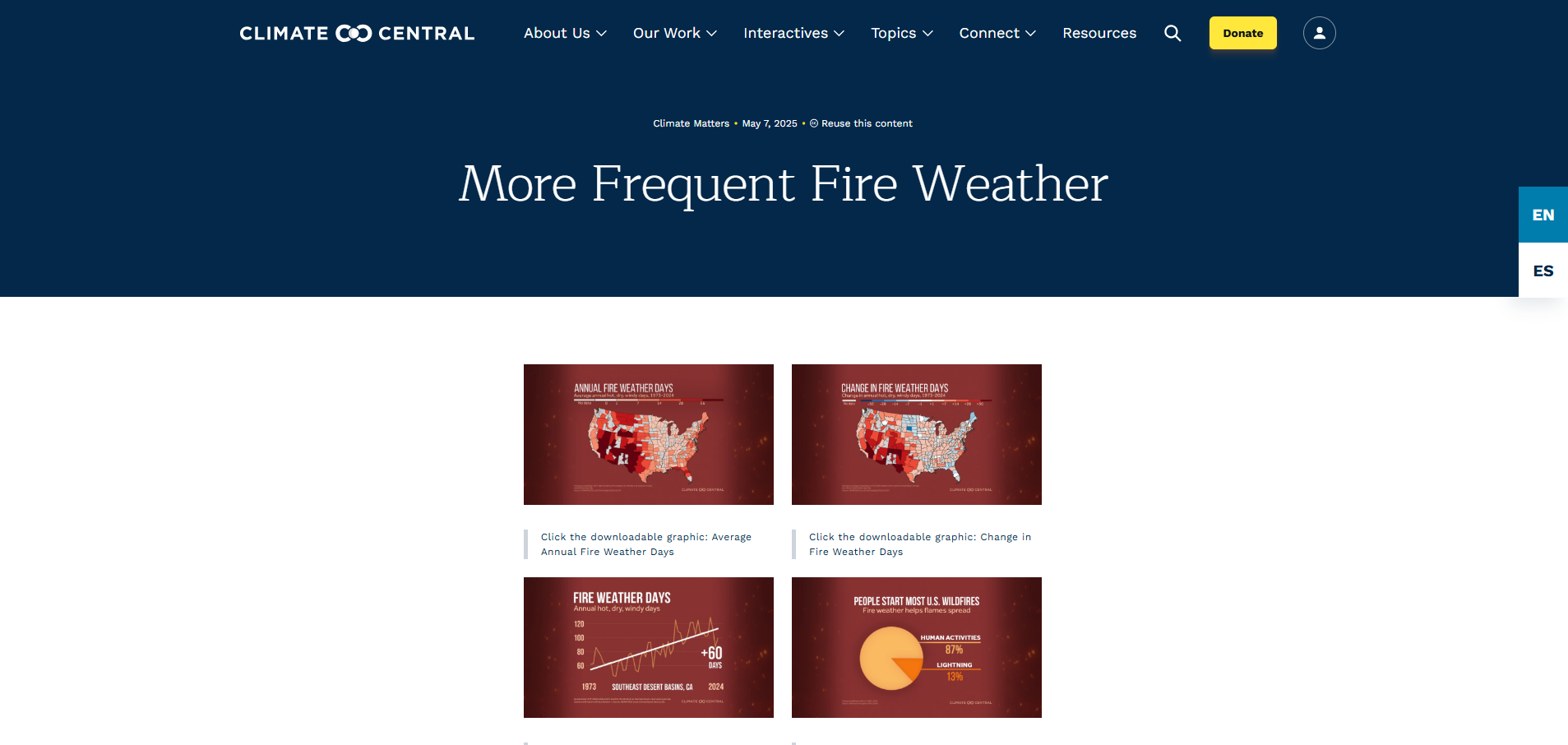
U.S. Fire Weather Historical Trends Data (1973-2025)
A dataset and analysis by Climate Central tracking fire weather trends across the U.S. from 1973 to 2025. It helps users understand the increasing frequency of high heat and low humidity conditions that drive wildfire risk.
Please login or join for free to read more.

OVERVIEW
U.S. Fire Weather Historical Trends Data (1973-2025) is a longitudinal analysis that tracks the frequency and intensity of fire weather across the contiguous United States. It monitors specific meteorological conditions—including high temperatures, low relative humidity, and strong winds—that create environments conducive to the spread of wildfires. The dataset assesses trends across 245 climate divisions using observations from 476 weather stations.
Organisation behind the tool
The tool is developed and maintained by Climate Central, an independent non-profit organisation composed of scientists and communicators who research and report on the impacts of climate change.
What the tool does
- Tracks historical trends in fire weather days from 1973 to 2025.
- Analyses data from 476 weather stations across 245 climate divisions in the contiguous United States.
- Measures changes in seasonal patterns, identifying spring as the fastest-growing fire weather season in several regions.
- Provides mapped and tabular data illustrating the increase in days per year with dangerous fire conditions.
Target audience
The primary users include meteorologists, climate researchers, journalists, and policymakers. It is also designed for emergency planners and natural resource managers who require historical context for wildfire risk.
Relevance to finance professionals
- Risk assessment – Allows insurers and asset managers to evaluate the increasing frequency of conditions that lead to catastrophic wildfire losses.
- ESG analysis – Provides factual evidence for environmental risk disclosures and physical climate risk reporting.
- Market/commodity insights – Offers context on risks to agricultural land, timber assets, and rural infrastructure.
- Investment context – Helps identify regions with accelerating long-term environmental volatility that may impact property values and municipal bonds.