
Library | Resource Types
Research
We summarise credible research and reports on sustainable finance and ESG issues. Our summaries, along with our AI ChatBot saves members time reading large reports, to focus on knowledge building and action.
Refine
1413 results
REFINE
SHOW: 16


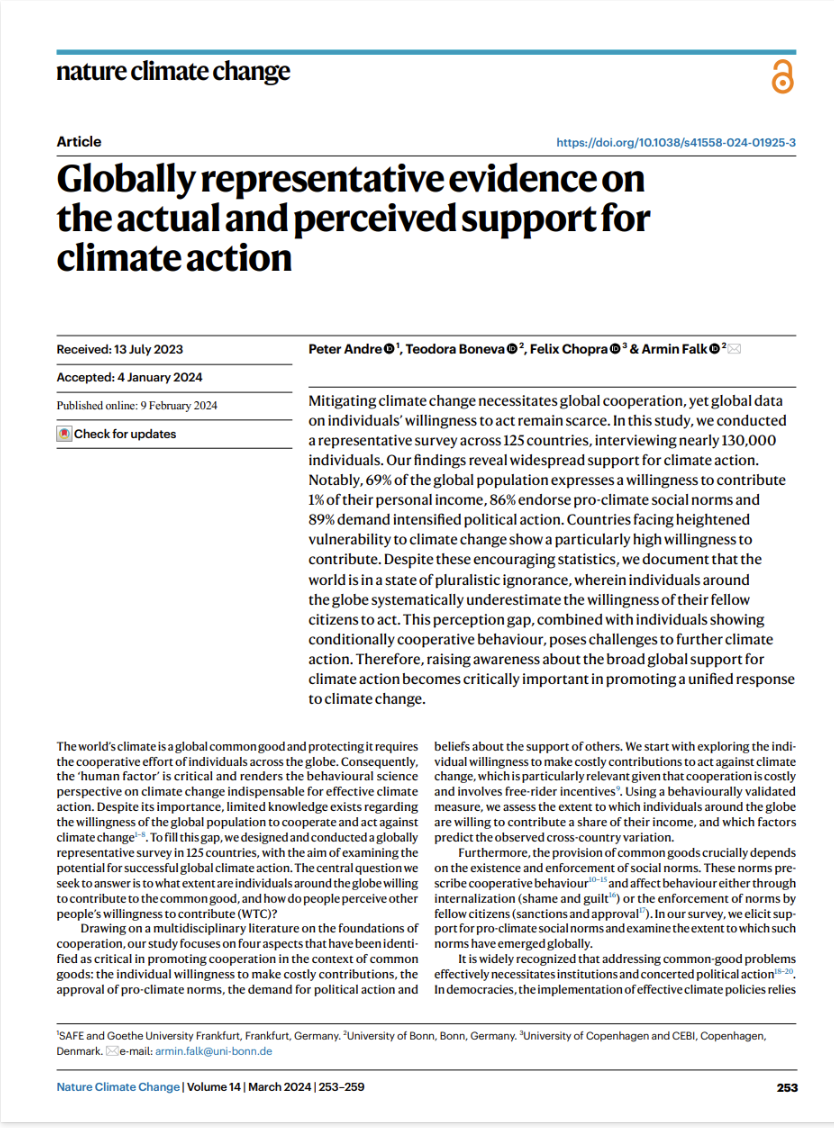
Globally representative evidence on the actual and perceived support for climate action
Using a survey of 130,000 people across 125 countries, the study finds strong global support for climate action, but widespread underestimation of others’ willingness to act. This perception gap may hinder cooperation; correcting it could materially strengthen climate action.
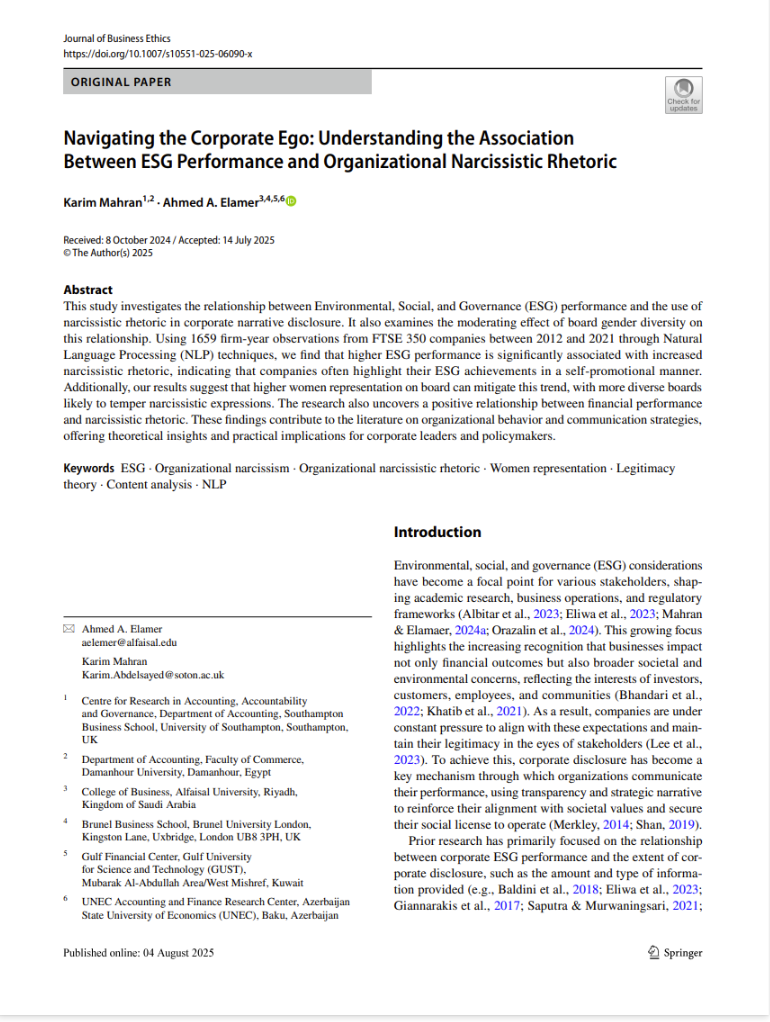
Navigating the corporate ego: Understanding the association between ESG performance and organizational narcissistic rhetoric
This study analyses 1,659 FTSE 350 observations to explore the link between ESG performance and organisational narcissistic rhetoric. Findings indicate that high ESG performance correlates with increased self-promoting language, though greater board gender diversity mitigates this effect. Additionally, strong financial results are positively associated with narcissistic corporate narratives.
Leveraging physical climate risk data
The report outlines data requirements for assessing physical climate risks, highlighting gaps in hazard, exposure, vulnerability, and adaptation information. It reviews emerging tools, stresses limitations in insurance and asset-level data, and recommends capacity building, collaboration, and improved data systems to enhance financial sector climate-risk analysis.
A just transition for the Amazon: A mission-oriented framework
A mission-oriented framework is proposed to drive a just transition in the Amazon by ending deforestation, restoring degraded land, and aligning green industrial strategies with local and Indigenous knowledge. It emphasises co-creation, redesigned public institutions, and partnerships that distribute benefits fairly while supporting sustainable, biodiversity-based development.
A bibliometric analysis of four decades of shareholder activism research
This bibliometric review of 1,055 works (1983–2021) charts the evolution of shareholder activism research. It highlights a shift from financial drivers to sustainability-oriented goals. While interdisciplinarity is increasing, disciplinary silos remain. The authors advocate for holistic approaches evaluating non-financial impacts alongside traditional metrics.
Private capital, public good: Building shared prosperity to create a resilient and inclusive economy
The report outlines bipartisan US federal policy recommendations to mobilise private capital for shared prosperity. It focuses on strengthening economic competitiveness, scaling community investing, and improving impact transparency to support inclusive growth, underinvested communities, and long-term economic resilience.
Artificial intelligence and human capital: Challenges for central banks
The report outlines how AI copilots and agents could reshape central bank roles, requiring extensive upskilling, revised workforce strategies and stronger governance. Talent shortages, regulatory constraints and cultural adaptation present key challenges as institutions transition to more AI-intensive operations.
The cost of capital: Lowering the cost of capital for climate and SDG finance in emerging markets and developing economies
The report finds EMDEs face systematically inflated capital costs due to biased credit ratings and structural financing constraints, hindering climate and SDG investment. It outlines ten reforms, including revised rating methodologies, longer maturities, expanded guarantees, and enhanced MDB and blended finance, to lower financing costs and unlock growth.
Blueprint for intelligent economies: AI competitiveness through regional collaboration
The report outlines a framework for building intelligent economies through sustainable AI infrastructure, diverse datasets and ethical guardrails. It highlights collaboration across sectors and regions to support inclusive AI adoption, guide investment, strengthen governance and enable responsible technological development.

Preparing for next-generation information warfare with generative AI
The report analyses how generative AI reshapes information warfare by enabling scalable manipulation, behavioural influence and dual-use knowledge diffusion. It highlights heightened risks to civilians, military operations and international law, stressing gaps in protection and the need for anticipatory, whole-of-society resilience strategies.

Sustainability-related risks and opportunities and the disclosure of material information
This educational material explains how entities identify and disclose material sustainability-related risks and opportunities under IFRS S1 and S2, focusing on impacts on cash flows, access to finance and cost of capital, and applying consistent, entity-specific materiality judgements.
International round table: Financing climate action at city level
This report synthesises discussions from an international round table on financing city-level climate action, highlighting how local governments overcome fiscal constraints through tailored funding scales, partnerships, innovative revenue mechanisms, and long-term approaches to deliver major decarbonisation programmes across Europe and North America.
Good practice case studies in scope 3 data collection
The report presents practical case studies on Scope 3 data collection, covering supplier, upstream, downstream and employee engagement. It outlines hybrid methodologies, use of primary and spend-based data, and emphasises collaboration, pragmatism and incremental improvement to support credible emissions measurement and reduction.
Escalation: The destructive force of Australia's fossil fuel exports on our climate
The report finds Australia’s fossil fuel exports significantly escalate global warming and domestic climate risks. It highlights missing policy restrictions, growing harms to people and systems, and urges an orderly, cooperative and just phase-out with regulatory reforms and international engagement.
Competing in the age of disruption: A business briefing by the University of Cambridge Institute for Sustainability Leadership
The report argues that global industrial transition is inevitable and accelerating, creating material risks and opportunities. It urges businesses to pursue innovation, reshape market rules and influence policy to secure competitiveness, manage systemic threats and drive sustainable market transformation.
Long-term impact and biological recovery in a deep-sea mining track
The study finds that deep-sea mining disturbance leaves long-lasting physical impacts, with partial biological recovery after 44 years. Some mobile and sessile fauna have re-established, but communities remain altered. Plume effects are limited, yet track disturbance persists, indicating slow ecosystem recovery and informing future management.


