
Library | Resource Types
Research
We summarise credible research and reports on sustainable finance and ESG issues. Our summaries, along with our AI ChatBot saves members time reading large reports, to focus on knowledge building and action.
Refine
2421 results
REFINE
SHOW: 16


Circular economy: From review of theories and practices to development of implementation tools
The paper provides an overview of the literature on Circular Economy theoretical approaches, strategies and implementation cases. After analysing different Circular Economy approaches and the underlying principles, the paper then proceeds with developing tools for Circular Economy implementation. The tools discussed include a strategies database and an implementation database.

A portfolio approach to impact investment
This paper is a practical guide on how to build and analyse a portfolio of impact, which is based on a graphical assessment of impact investments along the dimensions of impact, risk and return. The framework offers insight into the construction of a target profile, mapping individual investments and aggregate portfolios, as well as risk management.

Integrating the SDGs into corporate reporting: A practical guide
This guide builds on earlier work, in particular, the SDG Compass developed by the United Nations (UN) Global Compact, Global Reporting Initiative (GRI), and the World Business Council for Sustainable Development (WBCSD), which offers a starting point for companies approaching the SDGs, including resources. This practical guide does not create a new reporting framework. Rather, it outlines a three-step process to embed the SDGs in existing business and reporting processes.
Framing the future of corporate governance: Deloitte governance framework
This report outlines the Deloitte governance framework which provides board members with an end-to-end view of corporate governance. The aim of the framework is to act as a tool for board members and executives to quickly identify potential opportunities to improve both effectiveness and efficiency within the organisation structure.
The toll from coal: An updated assessment of death and disease from America’s dirtiest energy source
Emissions from the coal-fired power plant industry in the form of fine particle pollution, global warming, ozone smog, acid rain and regional haze, cause significant negative effects on human beings. Research shows that death or disease from coal-based electricity production in the United States, can be reduced if the pollution from coal plants is addressed.
Human rights: The foundation of sustainable business
In December 2018, the world celebrated the 70th anniversary of the Universal Declaration of Human Rights (UDHR). Two of the Ten Principles of the UN Global Compact are derived directly from the Universal Declaration. The United Nations Global Compact is advocating for businesses to stand up for human rights, promoting uptake of the UN Guiding Principles on Business and Human Rights.
The value of responsible investment
The research explores the moral, financial and economic justification for responsible investment, and the academic evidence underpinning future action. It concentrates on how ESG factors materially impact investment risk and returns, clarifying the agency of investors over non-financial value creation.
The SDG investment case
Companies and institutional investors are being asked to contribute to the Sustainable Development Goals (SDGs) through their business activities, asset allocation and investment decisions. The SDG investment case tries to answer the question: Why are the SDGs relevant to institutional investors?

Implementing inclusive business models: How business can work with low-income communities
This paper makes the case for why businesses should implement inclusive business models and engage low-income populations along their value chains. It identifies common market constraints of inclusive business models and how to overcome them.
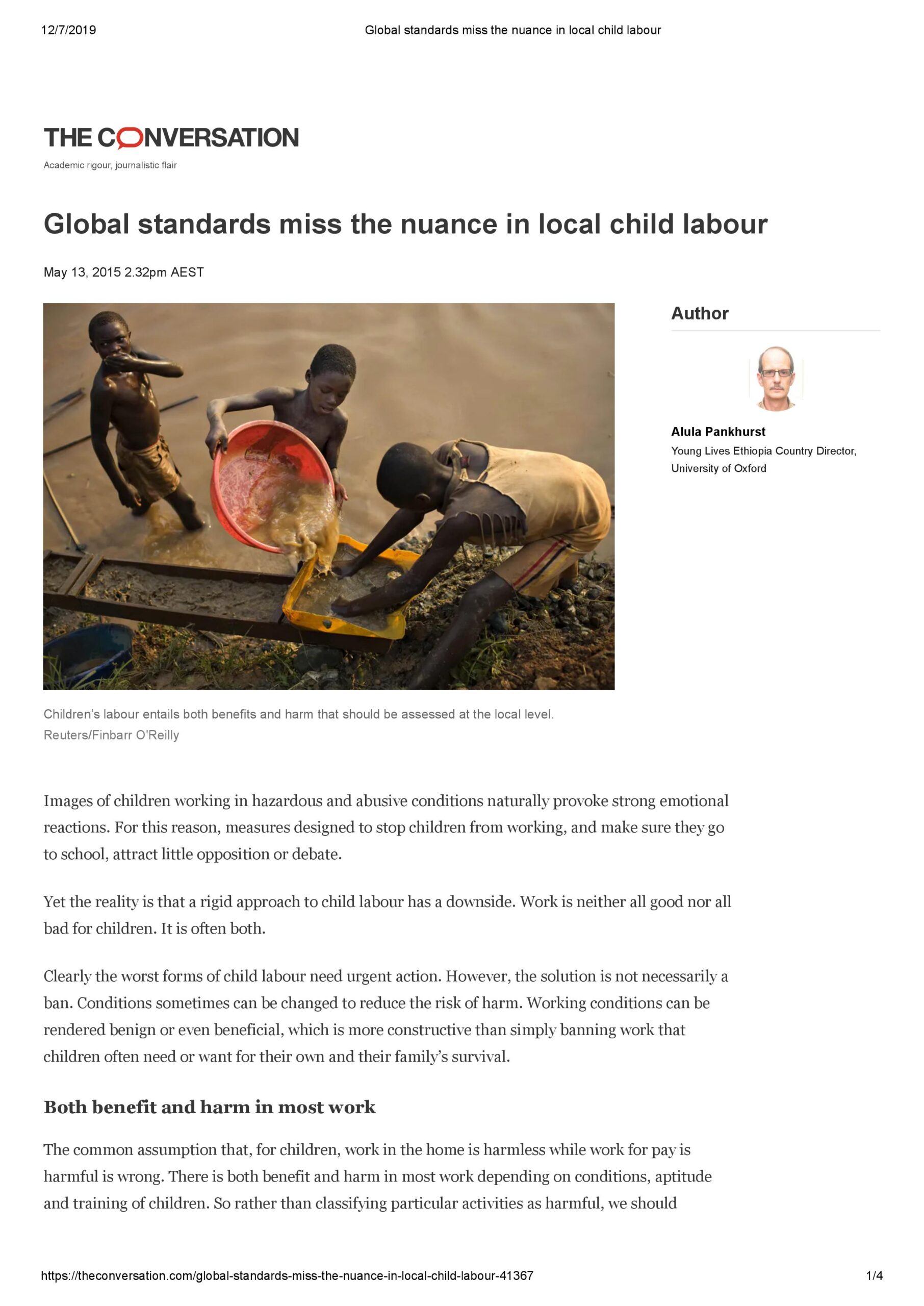
Global standards miss the nuance in local child labour
Research conducted by Young Lives on improving the current issue of child labour provided from a view that differs from the conventional approach: improving working conditions is more constructive than merely banning child labour altogether, as doing so would miss the social and economic nuances such as relationship ties, supporting families and gaining skills.

Making a splash
Nature Climate Change and Nature Geoscience jointly present 'Water in a warming world', a collection of research highlighting many of the key issues in this important area of climate change research. This article highlights some of the research on the potential impacts of climate change on the world's water resources.

How investors integrate ESG: A typology of approaches
Understanding how investors are applying the growing supply of corporate ESG information into their investment decision-making is increasingly important. This report aims to help investors navigate the rapidly changing responsible investing landscape by developing a typology that classifies approaches to environmental, social and governance (ESG) integration.

Global corporate green investment and the UN Sustainable Development Goals: How green bonds can help close the funding gap
This research identifies the potential for increased green bond issuance to support the green investment needs of large global publicly traded companies across all sectors. Comparing companies’ business as usual (BAU) to pathways aligned to the Sustainable Development Goals (SDGs), case studies illustrate how green bonds can support transitions to low-carbon business models.
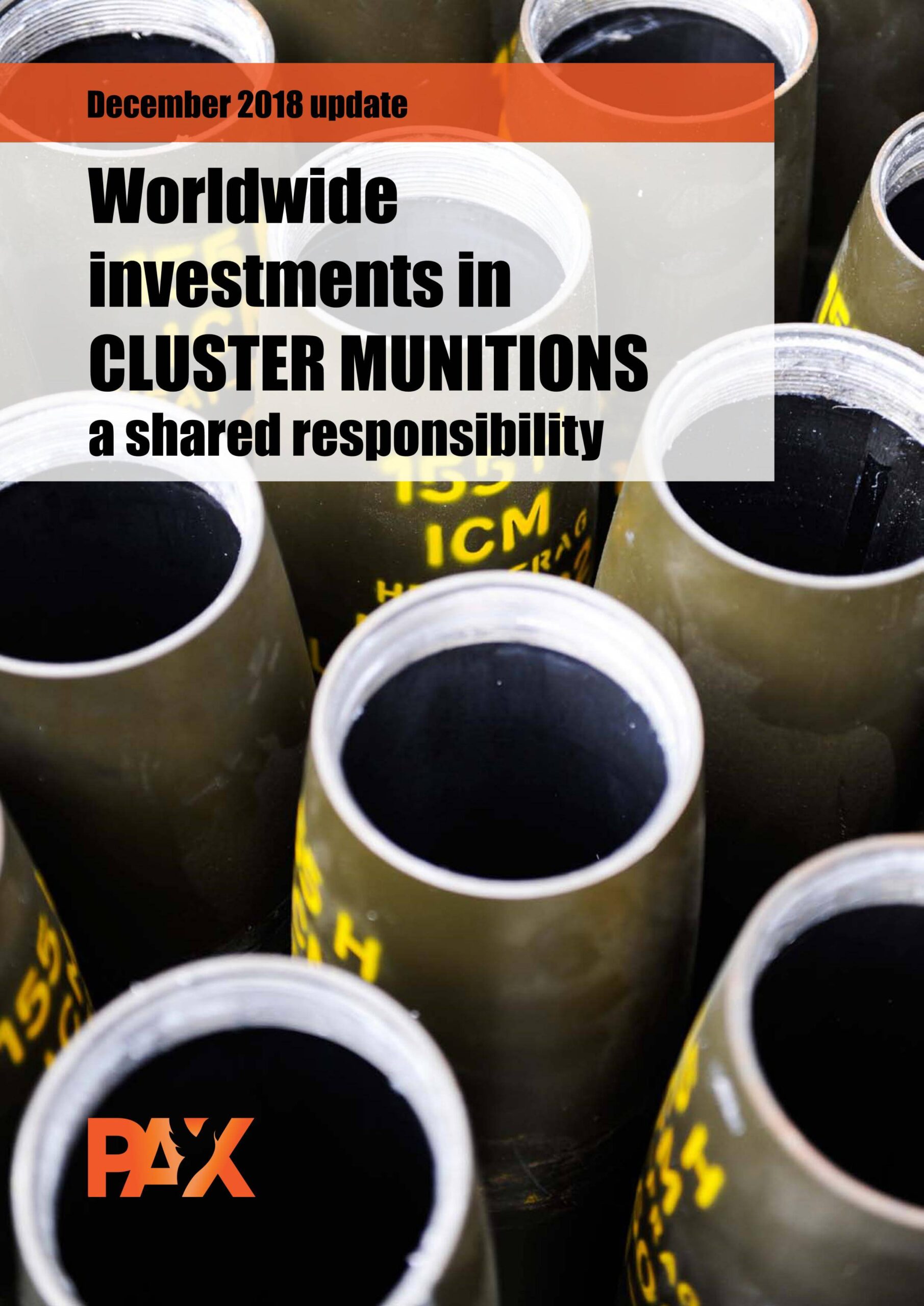
Worldwide investments in cluster munitions: A shared responsibility
A 2018 report on worldwide investments in harmful cluster munitions. Two arms manufacturers recently ended production of cluster munitions, and more financial institutions and states are acting to end money going to producers. Despite declining investment from financial institutions, there are seven companies in the report still manufacturing.

Navigating the sustainable investment landscape
This paper informs asset owners about the current state of sustainable investing for US institutional investors. Drawing on the experiences of over 100 asset owners and investment professional as well as evidence from WRI’s own endowment the paper constructs a detailed outline of sustainable investing. It highlights the underlying motives and drivers, governance structures, relevant data and standards, investment vehicles, and key barriers that shape opportunities for implementation.
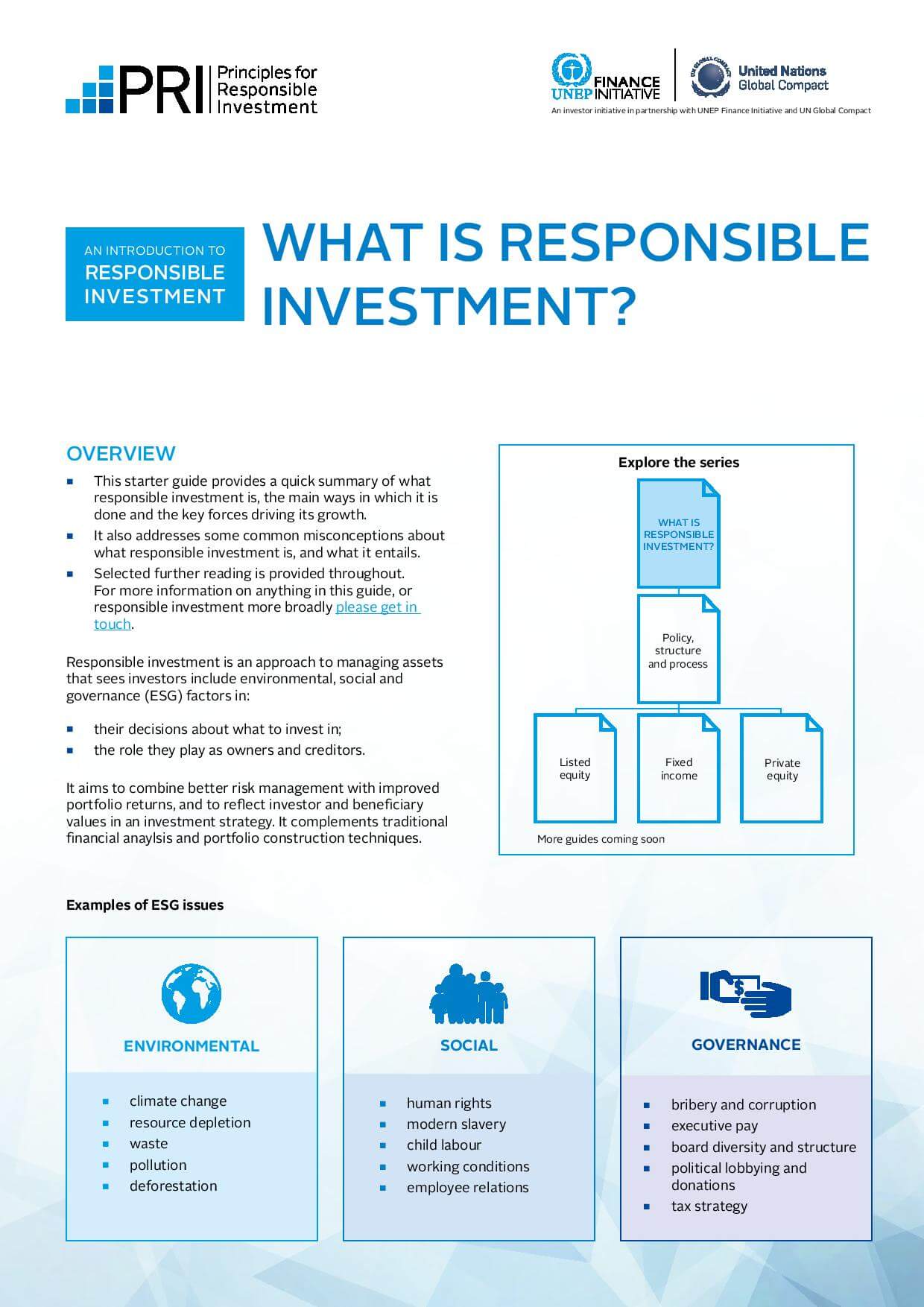
What is responsible investment?
This article defines responsible investment, highlights the ways in which it is currently applied to managing assets, and outlines the key forces driving its growth. Additionally, it discusses common misconceptions about responsible investment.


