
Library | ESG issues
Governance
The governance pillar in ESG (environmental, social, and governance) refers to the systems, policies, and practices that ensure an organisation is managed responsibly and ethically. It includes issues such as board structure, reporting & disclosures, shareholders & voting, and risk management. Strong governance reduces risks, enhances trust, and supports long-term business sustainability.
Refine
2256 results
REFINE
SHOW: 16


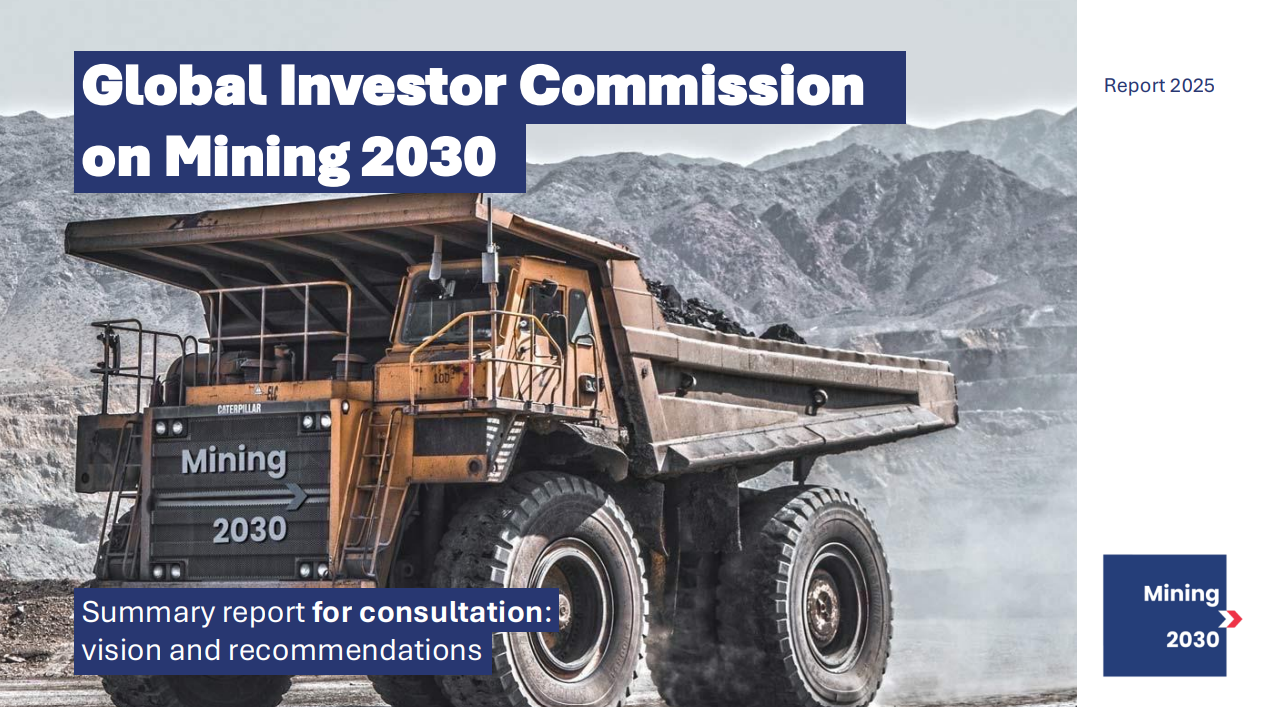
Global investor commission on mining 2030
The report outlines an investor-led 10-year vision for a responsible, resilient mining sector. It sets goals to align capital, governance and stewardship with social and environmental standards, supporting mineral supply for the low-carbon transition while managing risk and long-term value.
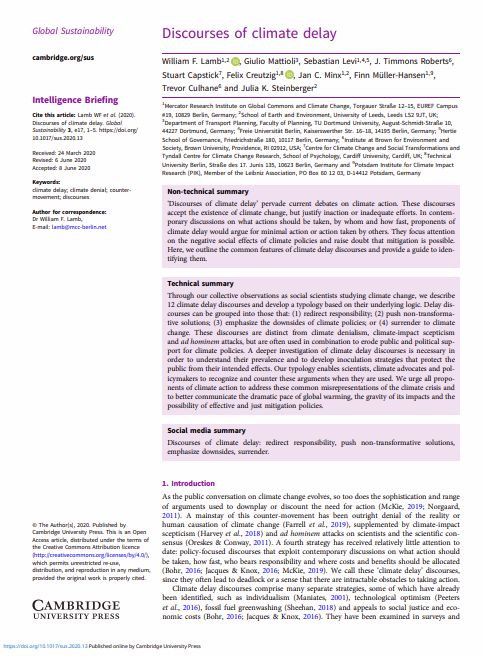
Discourses of climate delay
The report identifies twelve “climate delay” discourses that accept climate change yet justify inaction. It groups them into four strategies—redirecting responsibility, promoting non-transformative solutions, emphasising policy downsides, and surrendering to inevitability—and offers a typology to recognise and counter these arguments.
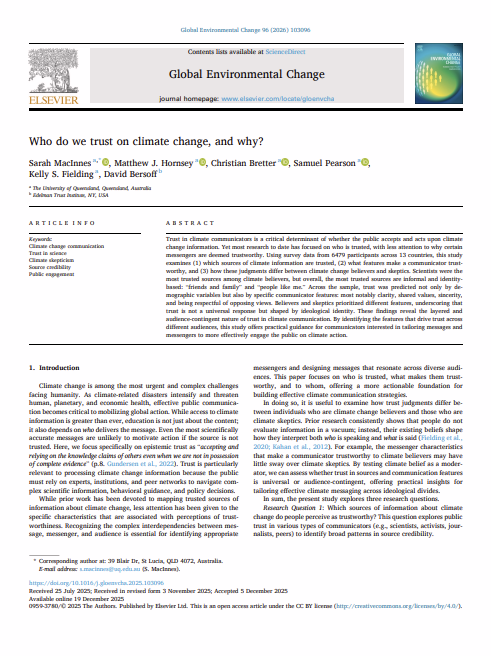
Who do we trust on climate change, and why?
Based on survey data from 6,479 respondents across 13 countries, the study finds trust in climate communication depends on source and messenger traits. Scientists rank highest among believers, while friends and family dominate overall trust. Clarity, shared values and sincerity strongly predict trust, with marked differences between believers and sceptics.
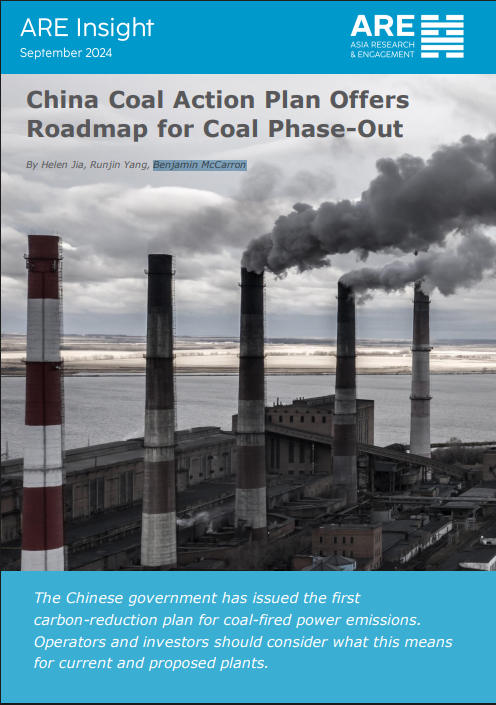
China coal action plan offers roadmap for coal phase-out
The report analyses China’s first quantitative coal power decarbonisation plan, outlining emissions-reduction targets to 2027 via co-firing and carbon capture. It finds retrofitted coal increasingly uncompetitive versus renewables with storage, raising risks for new coal investments and strengthening the case for no-new-coal commitments.

Can you be the change you’d like to see? Three US philosophers aim to offer hope
This review examines Somebody Should Do Something, a timely book arguing that individuals can spark meaningful social change by acting collectively rather than alone. It assesses the authors’ hopeful framework alongside contemporary political realities, questioning whether grassroots agency is sufficient amid concentrated power and rising authoritarianism.
Notice on the application of the sustainable finance framework and the Corporate Sustainability Due Diligence Directive to the defence sector
The European Commission clarifies that the EU sustainable finance framework and Corporate Sustainability Due Diligence Directive apply neutrally to the defence sector. Defence investments are permitted, assessed case by case, with disclosure and due diligence obligations focused on risk mitigation and exclusion limited to internationally prohibited weapons.
The impact of sustainable investing: A multidisciplinary review
This multidisciplinary review examines how sustainable investing affects environmental and social outcomes. It identifies three investor impact strategies—portfolio screening, shareholder engagement, and field building—and 15 mechanisms producing direct and indirect effects. The study argues impact emerges gradually through coordinated actions by diverse shareholders.

Arms availability and the situation of civilians in armed conflict: A study presented by the ICRC
The ICRC study finds that widespread availability of small arms intensifies civilian harm in armed conflict. Drawing on field data, case studies and staff surveys, it links unregulated arms flows to higher civilian casualties, humanitarian access constraints and weakened compliance with international humanitarian law.
Responsible business conduct in the arms sector: Ensuring business practice in line with the UN guiding principles on business and human rights
The UN Working Group reviews arms sector regulation, finding persistent exports linked to humanitarian and human rights law violations. It identifies weak political will, opaque oversight and limited human rights due diligence, and urges stronger application of the UN Guiding Principles by states and companies.
Report of the working group on the universal periodic review
The report presents Norway’s fourth Universal Periodic Review, outlining human rights commitments, recent legal reforms, and policy measures. It records peer State feedback and extensive recommendations covering equality, child welfare, Indigenous rights, migration, climate action, and business and human rights, for Norway’s consideration and follow-up.
Draft policy on cyber enabled crimes under the rome statute
The ICC Prosecutor’s draft policy explains how existing Rome Statute crimes may be committed or facilitated through cyber means, outlines jurisdictional and evidentiary approaches, and affirms commitment to prosecuting serious cyber-enabled international crimes while excluding ordinary domestic cybercrime.
Salient Issue Briefing: Artificial intelligence based technologies
This briefing examines human rights risks from AI-based technologies in the ICT sector, outlines business, legal, and financial implications, and provides investor-oriented guidance grounded in international standards to support rights-respecting AI development, deployment, and oversight.
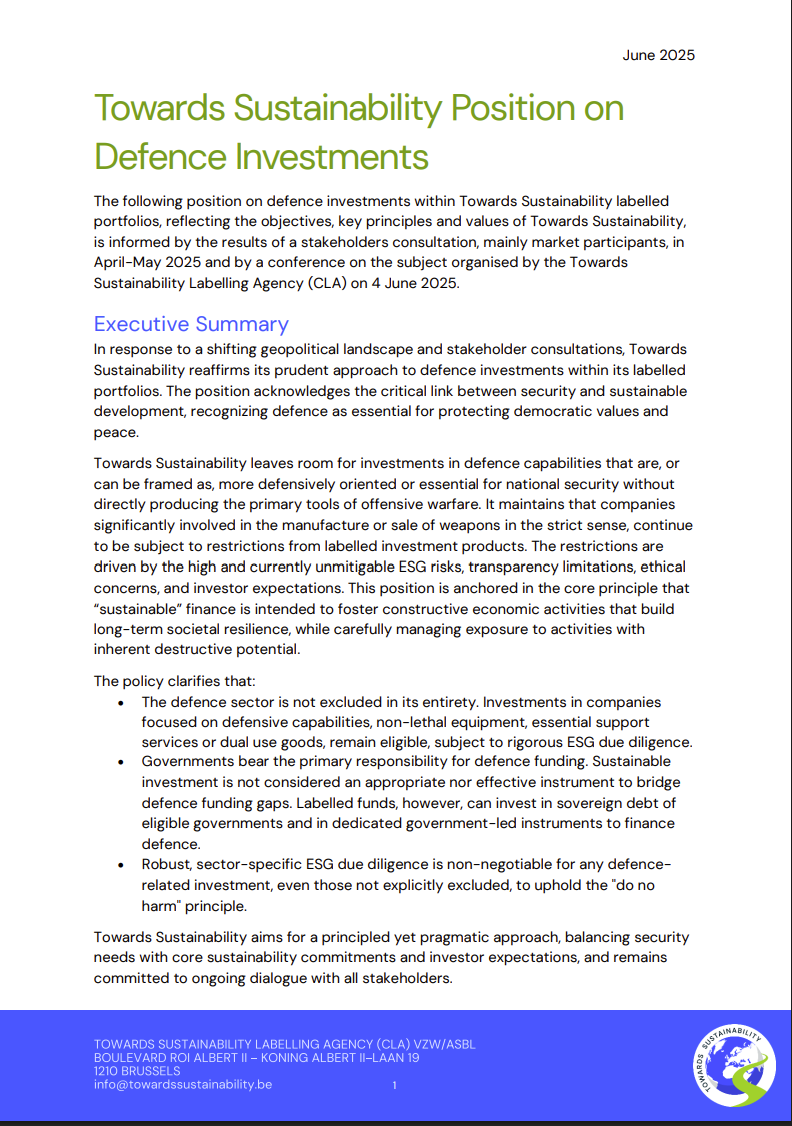
Towards sustainability position on defence investments
The report sets a pragmatic policy on defence investments for Towards Sustainability-labelled funds, permitting defensive, non-lethal and dual-use activities with strict ESG due diligence, while excluding weapons producers. It affirms defence funding as primarily a government responsibility.
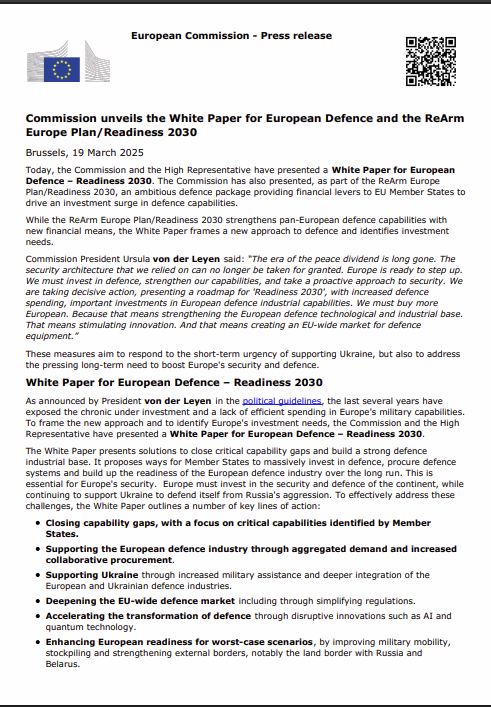
Commission unveils the white paper for european defence and the rearm europe plan readiness 2030
The report outlines the EU’s White Paper on European Defence and the ReArm Europe Plan, targeting defence readiness by 2030 through closing capability gaps, strengthening the defence industrial base, and mobilising over €800 billion via public, EU, and private funding mechanisms.
BPI France: European Defence Bond Framework
Bpifrance’s European Defence Bond Framework defines principles for issuing use-of-proceeds bonds financing eligible defence-sector projects, mainly SMEs, to support European sovereignty. It details eligibility criteria, exclusions, ESG safeguards, governance, reporting, and proceeds management, while stating the bonds are not ICMA-aligned sustainable instruments.
Mapping the international presence of the world's largest arms companies
SIPRI maps the global footprint of the 15 largest arms companies, identifying 400 majority-owned foreign entities. International presence aligns with geopolitical ties and major arms markets. US and European firms dominate; Chinese and Russian companies show limited overseas reach.


