
Library | ESG issues
Governance
The governance pillar in ESG (environmental, social, and governance) refers to the systems, policies, and practices that ensure an organisation is managed responsibly and ethically. It includes issues such as board structure, reporting & disclosures, shareholders & voting, and risk management. Strong governance reduces risks, enhances trust, and supports long-term business sustainability.
Refine
2256 results
REFINE
SHOW: 16


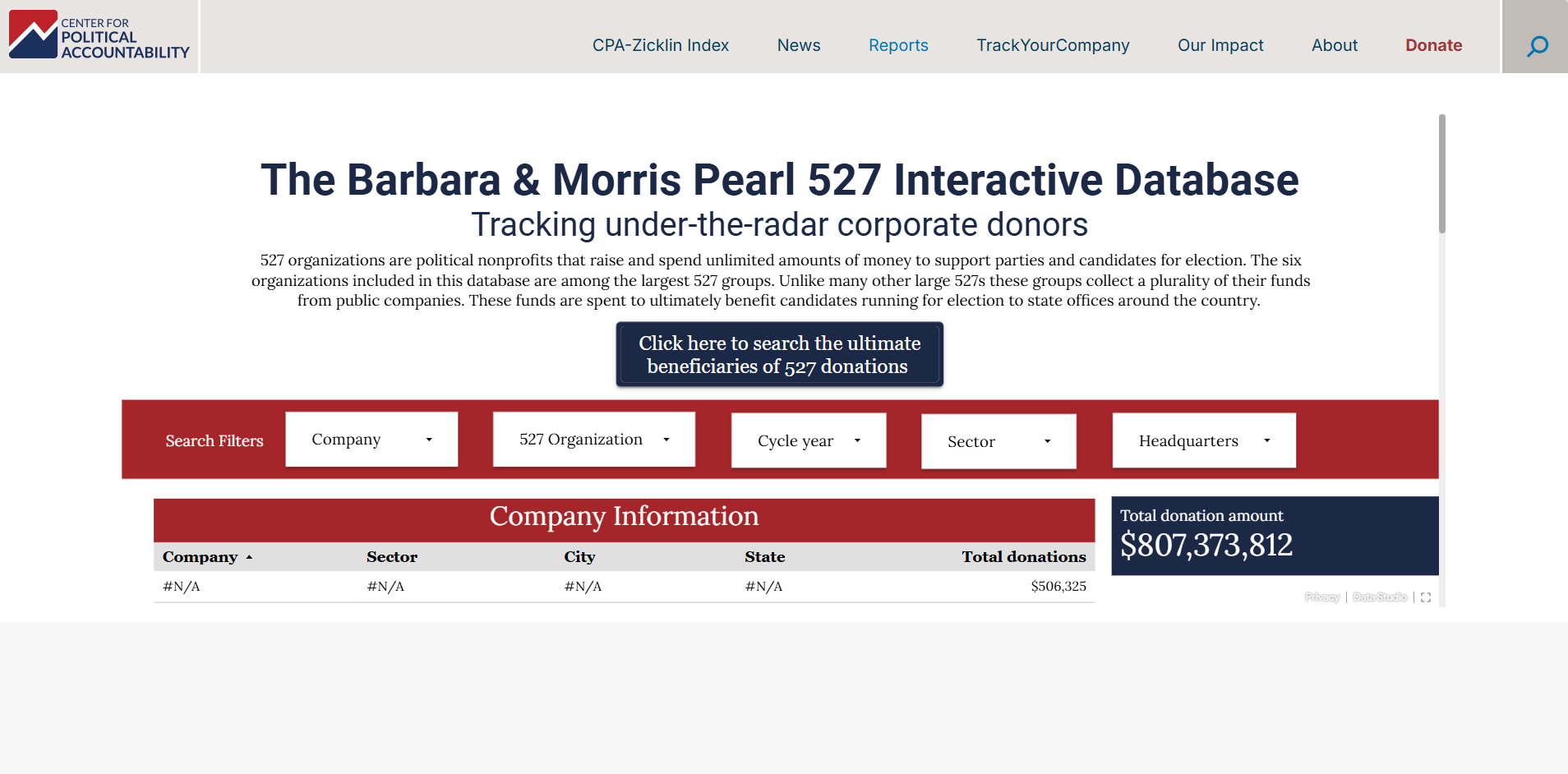
The Barbara and Morris Pearl 527 Interactive Database
The Barbara and Morris Pearl 527 Interactive Database tracks political donations from publicly traded US companies to 527 committees. Developed by the Center for Political Accountability, it helps finance professionals assess corporate governance and reputational risks related to political spending.
CPA-Zicklin Index of Corporate Political Disclosure and Accountability
This benchmark series evaluates corporate political disclosure and accountability practices among major US companies. It provides a structured analysis of transparency, board oversight, and spending policies for the S&P 500 and Russell 1000, enabling stakeholders to assess political risk and governance standards across different industries.
ASEAN sustainable finance state of the market series
This series by the Climate Bonds Initiative examines the development of sustainable finance markets across ASEAN. It covers green, social, sustainability and sustainability-linked debt instruments, alongside market structures, taxonomies, transition finance and policy developments supporting sustainable capital markets across the region.
Business-led blended finance: A practical playbook
This report examines business-led blended finance, which grew to US$24 billion in 2024. It provides a practical playbook for companies to move from passive recipients to active deal architects, addressing the US$4 trillion SDG financing gap through risk management toolkits, sector analyses, and eight global case studies.
Climate-related disclosures: Insights from our reviews 2026
This Financial Markets Authority report reviews 62 climate statements from the second reporting period in Aotearoa New Zealand. It identifies improvements in reporting structures but highlights gaps in physical risk analysis and assurance compliance. Future monitoring will focus on education to improve data substantiation and risk disclosure quality.

The climate premium on commercial real estate insurance
This report analyses rising insurance costs in the United States commercial real estate sector. It finds that premiums have surged 154% since 2017, driven by climate risk and reinsurance trends. High-risk markets face significant valuation erosion, with multi-family properties particularly impacted by increased financial burdens and pricing volatility.
Why shareholder-driven corporate social responsibility failed
This report analyses why shareholder-led corporate social responsibility failed in the early 2020s. It argues that political forces blocking government regulation also dismantle private CSR initiatives. Using the BlackRock-Texas conflict as evidence, it concludes that direct political action is the only viable path for systemic change.
A novel multilevel conceptual framework for flood risk governance
This research introduces a multilevel framework integrating flood hazard modelling, social vulnerability assessments, and risk communication. Designed for data-scarce environments, it addresses analytical silos by treating communication as a coequal component. The framework supports equitable decision-making through consequence-oriented risk surfaces and transparent uncertainty representation for municipal planning.
Templates in the EU Inc. regulation proposal
This research evaluates the European Commission’s Proposal for an optional 28th corporate law regime. It argues that proposed model articles of association fail to support venture capital-backed firms. The authors identify four shortcomings regarding scope, process, logic, and safe-harbour effects, suggesting a dedicated drafting track and broader coverage.
Harmonized calculations methods for product carbon footprints and life cycle assessments in the mining and metals industry
This research presents methodological recommendations for harmonising product carbon footprint and life cycle assessment calculations across the mining and metals industry. Developed with the International Council on Mining and Metals, it establishes consistent guidelines for 17 aspects, including system boundaries, electricity modelling, and multi-output allocation procedures.
Stakeholder governance and corporate purpose in certified B Corps: Minimizing conflict and fostering collaboration
This research examines how Australian and New Zealand B Corporations implement stakeholder governance through corporate purpose. Based on 20 interviews, it identifies six roles for purpose in decision-making and signalling. The findings suggest that purpose-led models help attract supportive stakeholders and foster collaboration beyond mere conflict resolution.
An engaged market: The 2026 state of stewardship report, prepared by the Aotearoa New Zealand stewardship code
This report examines stewardship reporting across New Zealand's investment market for 2025. Representing 20 signatories with $3.8 trillion in assets, it highlights maturing practices in collaborative engagement, escalation, and voting transparency. The document notes increased integration of te ao Māori and provides guidance on strengthening stewardship and voting policies.
Global employment trends for youth 2026: Back to the future
The Global Employment Trends for Youth 2026 report highlights a stalled post-pandemic recovery, with global youth unemployment reaching 12.4 per cent. It examines rising NEET rates, artificial intelligence impacts, and job experience inflation, while advocating for bold, adaptive policies to ensure secure, decent work pathways for young people.
Artificial intelligence and sustainability transitions: Emergent opportunities, risks, and governance
This report examines the intersection of artificial intelligence and sustainability transitions, detailing opportunities and risks across environment, energy, labour, finance, and democracy. It proposes a three-layered governance framework and a phased roadmap for global scientific alignment, interim safety measures, and a binding international framework convention to ensure societal well-being.
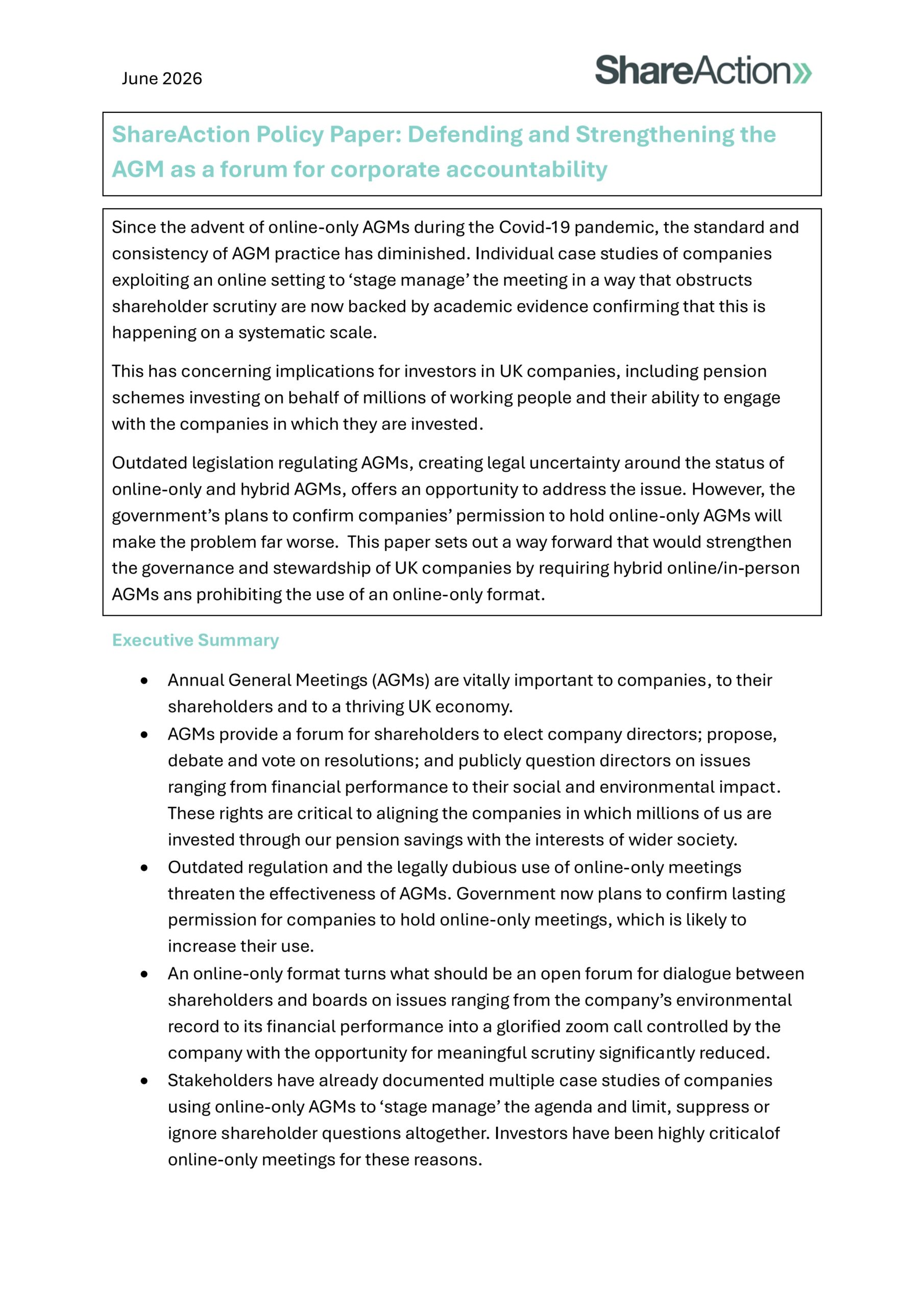
ShareAction policy paper: Defending and strengthening the AGM as a forum for corporate accountability
This ShareAction report advocates for mandatory hybrid AGMs to ensure corporate accountability. It argues that online-only formats diminish shareholder scrutiny and enable management to stage-manage proceedings. The document recommends amending the 2006 Companies Act and provides case studies of poor virtual AGM practices across several major companies.
Fragmentation of shareholder power
This research examines how fund proliferation and stewardship decentralisation affect corporate governance. It finds that supply-driven growth weakens oversight, while demand-driven expansion by incumbents can strengthen it. Competitive adoption of pass-through voting improves investor preference alignment but often reduces monitoring incentives and firm value.


