
Library | ESG issues
Human Rights
Human rights are the basic freedoms and protections every person holds regardless of nationality, status or circumstance. For financial institutions the central reference is the UN Guiding Principles on Business and Human Rights, which set out a responsibility to respect those rights through due diligence across operations, supply chains and investment portfolios. Adverse impacts such as forced labour, displacement of communities and unsafe working conditions carry legal, reputational and financial consequences, and increasingly fall within mandatory due diligence law.
Team Altiorem recommends



Refine
382 results
REFINE
SHOW: 16



Global investor commission on mining 2030
The report outlines an investor-led 10-year vision for a responsible, resilient mining sector. It sets goals to align capital, governance and stewardship with social and environmental standards, supporting mineral supply for the low-carbon transition while managing risk and long-term value.

Germanwatch
Germanwatch is an independent development, environmental and human rights non-governmental organisation advocating sustainable global development based on social equity, ecological protection and economic stability. It influences climate, trade and corporate policy, produces research and indices like the Climate Change Performance Index, and promotes fair, equitable climate action globally.

Can you be the change you’d like to see? Three US philosophers aim to offer hope
This review examines Somebody Should Do Something, a timely book arguing that individuals can spark meaningful social change by acting collectively rather than alone. It assesses the authors’ hopeful framework alongside contemporary political realities, questioning whether grassroots agency is sufficient amid concentrated power and rising authoritarianism.
Notice on the application of the sustainable finance framework and the Corporate Sustainability Due Diligence Directive to the defence sector
The European Commission clarifies that the EU sustainable finance framework and Corporate Sustainability Due Diligence Directive apply neutrally to the defence sector. Defence investments are permitted, assessed case by case, with disclosure and due diligence obligations focused on risk mitigation and exclusion limited to internationally prohibited weapons.

Arms availability and the situation of civilians in armed conflict: A study presented by the ICRC
The ICRC study finds that widespread availability of small arms intensifies civilian harm in armed conflict. Drawing on field data, case studies and staff surveys, it links unregulated arms flows to higher civilian casualties, humanitarian access constraints and weakened compliance with international humanitarian law.
Responsible business conduct in the arms sector: Ensuring business practice in line with the UN guiding principles on business and human rights
The UN Working Group reviews arms sector regulation, finding persistent exports linked to humanitarian and human rights law violations. It identifies weak political will, opaque oversight and limited human rights due diligence, and urges stronger application of the UN Guiding Principles by states and companies.
Report of the working group on the universal periodic review
The report presents Norway’s fourth Universal Periodic Review, outlining human rights commitments, recent legal reforms, and policy measures. It records peer State feedback and extensive recommendations covering equality, child welfare, Indigenous rights, migration, climate action, and business and human rights, for Norway’s consideration and follow-up.
Draft policy on cyber enabled crimes under the rome statute
The ICC Prosecutor’s draft policy explains how existing Rome Statute crimes may be committed or facilitated through cyber means, outlines jurisdictional and evidentiary approaches, and affirms commitment to prosecuting serious cyber-enabled international crimes while excluding ordinary domestic cybercrime.
Salient Issue Briefing: Artificial intelligence based technologies
This briefing examines human rights risks from AI-based technologies in the ICT sector, outlines business, legal, and financial implications, and provides investor-oriented guidance grounded in international standards to support rights-respecting AI development, deployment, and oversight.
BPI France: European Defence Bond Framework
Bpifrance’s European Defence Bond Framework defines principles for issuing use-of-proceeds bonds financing eligible defence-sector projects, mainly SMEs, to support European sovereignty. It details eligibility criteria, exclusions, ESG safeguards, governance, reporting, and proceeds management, while stating the bonds are not ICMA-aligned sustainable instruments.
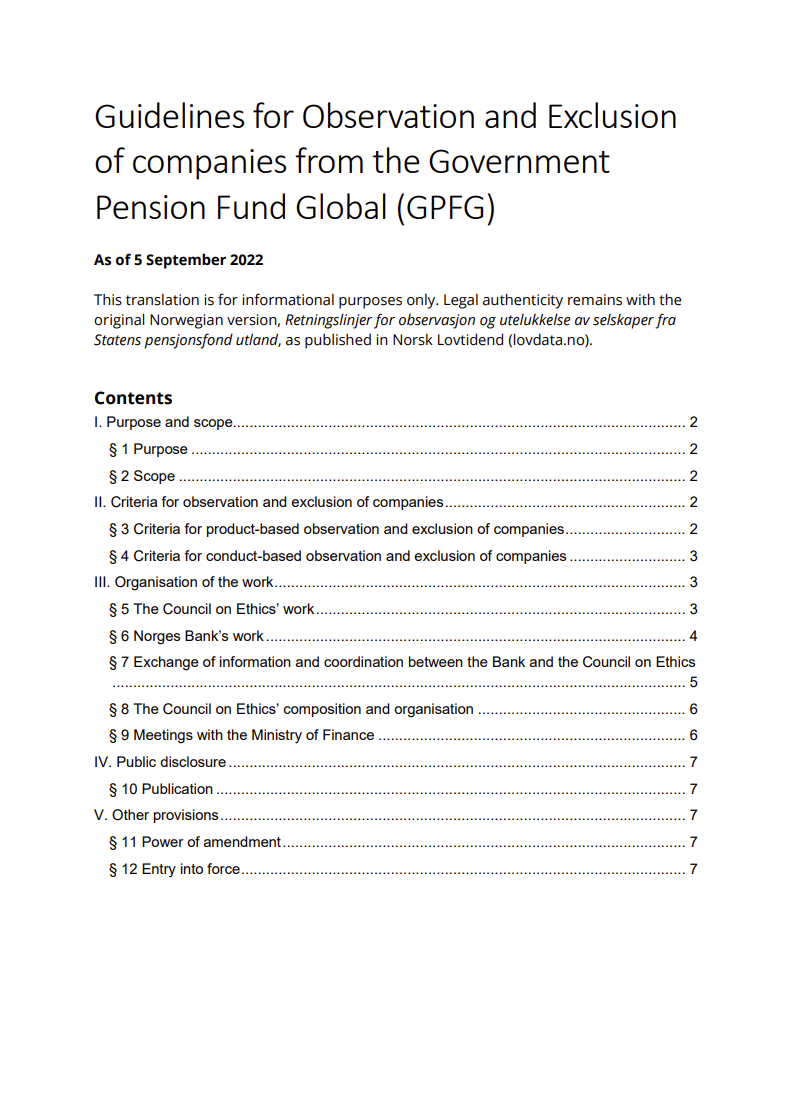
Guidelines for observation and exclusion of companies from the government pension fund global (GPFG)
The guidelines define ethical criteria for observing or excluding companies from Norway’s Government Pension Fund Global. They cover prohibited products, unacceptable conduct, coal thresholds, governance roles of the Council on Ethics and Norges Bank, and transparency requirements for decisions and reviews.
Agreement on international responsible investment in the insurance sector: ESG investment framework for the theme: Controversial weapons and the trade in weapons with high-risk countries
The framework guides insurers in managing ESG risks from controversial weapons and weapons trade with high-risk countries. It outlines international standards, investment screening criteria and due diligence processes, including risk assessment, voting, engagement and exclusion. It also provides guidance on monitoring, accountability and public reporting.
Council on ethics for the norwegian government pension fund global
The report outlines the Council on Ethics’ 2018 work advising Norges Bank on exclusions and observation under ethical guidelines. It covers assessments of human rights, environment, climate, corruption and weapons sales, resulting in multiple company exclusions, observations and revocations, alongside ongoing sectoral investigations.
Finance for war: Finance for peace: How values based banks foster peace in a world of increasing conflict
The report analyses global financial links to arms production, showing significant funding for weapons despite rising conflict. It contrasts this with values-based banks, particularly GABV members, which largely exclude arms financing, arguing divestment supports peace, reduces risk, and aligns finance with social and environmental objectives.
Stakeholder engagement and science-based targets for nature
This report provides guidance for companies on integrating affected stakeholder perspectives into science-based targets for nature, emphasising Indigenous rights, equity, and due diligence. It outlines who to engage, how to engage, and how to evaluate engagement across the SBTN five-step process.
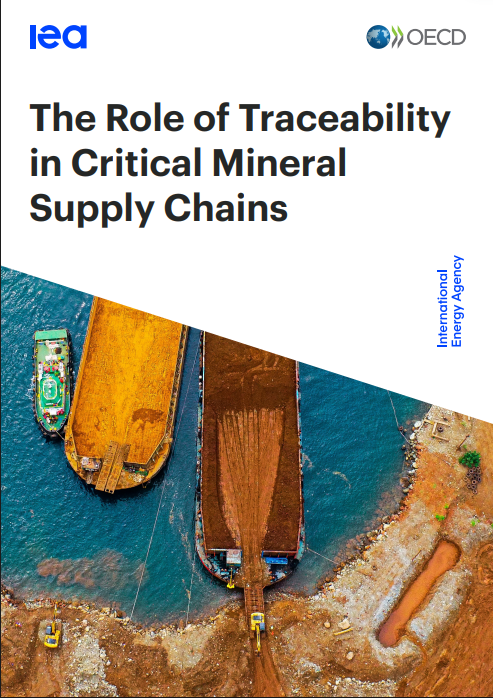
The role of traceability in critical mineral supply chains
The report examines how traceability can support responsible critical mineral supply chains. It outlines policy drivers, system components, costs and limitations, and mineral-specific challenges, concluding that well-designed traceability can enhance due diligence, transparency and supply security when proportionate and risk-based.


