
Library | ESG issues
Materials Sourcing & Efficiency
Materials Sourcing & Efficiency focuses on reducing raw material use and integrating social, ethical, and environmental considerations into sourcing decisions. By enhancing supply chain transparency and promoting circularity, it mitigates risks and fosters long-term value creation.


Refine
80 results
REFINE
SHOW: 16


The Hotspot Analysis Tool for Sustainable Consumption and Production (SCP-HAT)
SCP-HAT (Sustainable Consumption and Production Hotspots Analysis Tool) is an online tool that maps national and sector-level “hotspots” of unsustainable production and consumption using input-output and lifecycle methodologies.

International Resource Panel
International Resource Panel (IRP) is a science-policy platform established by United Nations Environment Programme in 2007. It produces peer-reviewed assessments and data such as the Global Material Flows Database to guide governments, industry and civil society on resource efficiency, sustainable use, circular economy and environmental impact.

Life Cycle Initiative
Life Cycle Initiative stewards global standards, tools and training for life-cycle assessment (LCA) and life-cycle thinking. It supports practitioners, policymakers and industry in applying LCA across plastics, textiles, tourism and construction. The initiative develops data networks, e-learning modules and hotspot analysis frameworks to advance sustainable decision making.
Deutsche Rohstoffagentur (DERA)
German Mineral Resources Agency (DERA) is Germany’s national information and consultancy platform on mineral raw materials, hosted within the Federal Institute for Geosciences and Natural Resources (BGR).
DERA analyses global commodity markets, assesses supply-chain risks, and advises industry and government on raw material strategy and sustainable sourcing.
DERA analyses global commodity markets, assesses supply-chain risks, and advises industry and government on raw material strategy and sustainable sourcing.
Rohstoffinformationssystem (ROSYS)
ROSYS is a free, interactive raw-materials information system from the German Mineral Resources Agency (DERA). It offers data on around 80 mineral and energy commodities, supported by maps and charts, enabling users to monitor global and German production, consumption, reserves, trade partners and market trends.
Federal Institute for Geosciences and Natural Resources (BGR)
Federal Institute for Geosciences and Natural Resources (BGR) is Germany’s national geological survey, advising the federal government on geoscience and raw materials. It undertakes research in earth sciences, resource management, geodata systems and sustainability. Located in Hannover, BGR coordinates national geoscientific data infrastructure and policy.

Tobacco tactics
Tobacco Tactics is a knowledge-exchange platform from the University of Bath’s Tobacco Control Research Group. It compiles rigorous academic research and monitoring on the global tobacco industry—its products, influences, themes and companies—in an accessible format.

DBS Bank
DBS Bank India is a digital-led universal bank offering personal, SME, corporate and wealth management services. Features include resident and non-resident (NRI) savings and fixed deposit accounts, remittance, loans, digital payments and credit/debit card solutions. Positions as Asia’s safest bank with a wide India branch network.

Product life cycle accounting and reporting standard
The GHG Protocol Product Life Cycle Accounting and Reporting Standard provides a globally consistent framework for companies to quantify and publicly report greenhouse gas emissions and removals associated with individual products across their life cycle. It enables informed emissions reduction strategies and supports performance tracking, supplier engagement, and product differentiation.
Critical mineral series: Sustainability considerations for investors in copper mining
This report examines copper’s role in the energy transition, highlighting growing demand, environmental and human rights risks, and evolving global regulations. It evaluates mining companies’ sustainability performance using biodiversity, governance, and modern slavery metrics, offering insights for responsible investment aligned with international standards and long-term ESG considerations.
Fossil to Clean — business action checklists
The Fossil to Clean Business Action Checklists provide sector-specific guidance for companies to transition from fossil fuels to clean energy. Developed by the We Mean Business Coalition, the tool outlines key actions aligned with science-based targets and global climate goals. It supports practical implementation of climate commitments.
Addressing biodiversity risk and opportunity at PensionDanmark
PensionDanmark developed a biodiversity strategy targeting its real estate and infrastructure assets to mitigate nature loss. It employs data-led initiatives, stakeholder engagement, and nature-based solutions to protect and restore biodiversity, aligning with EU taxonomy and Science Based Targets for Nature. Implementation includes construction screening, sustainable sourcing, and performance monitoring.

Green metal statecraft: Forging Australia’s green iron industry
Australia’s "Green Metal Statecraft" outlines a transformative agenda for advancing its green iron industry. The report advocates leveraging renewables-powered iron ore processing, supported by $10-30 billion in strategic public investment. Emphasising economic, environmental, and energy security, the plan aligns national policy with decarbonisation to secure Australia’s leadership in sustainable steelmaking and green exports.

SBTN sector materiality tool
The aim of the Sectoral Materiality Tool is to help users carry out a first screening of what types of environmental impact are potentially materially relevant to their sector and their company's activities, as part of Step 1a of the SBTN guidance.

The real effects of supply chain transparency regulation – Evidence from Section 1502 of the Dodd-Frank Act
Section 1502 of the Dodd-Frank Act requires firms to disclose if they source conflict minerals from the Democratic Republic of Congo (DRC). The report shows that increased public attention leads to responsible sourcing, which mitigates conflicts in mining regions. Certified smelters play a key role in these efforts.
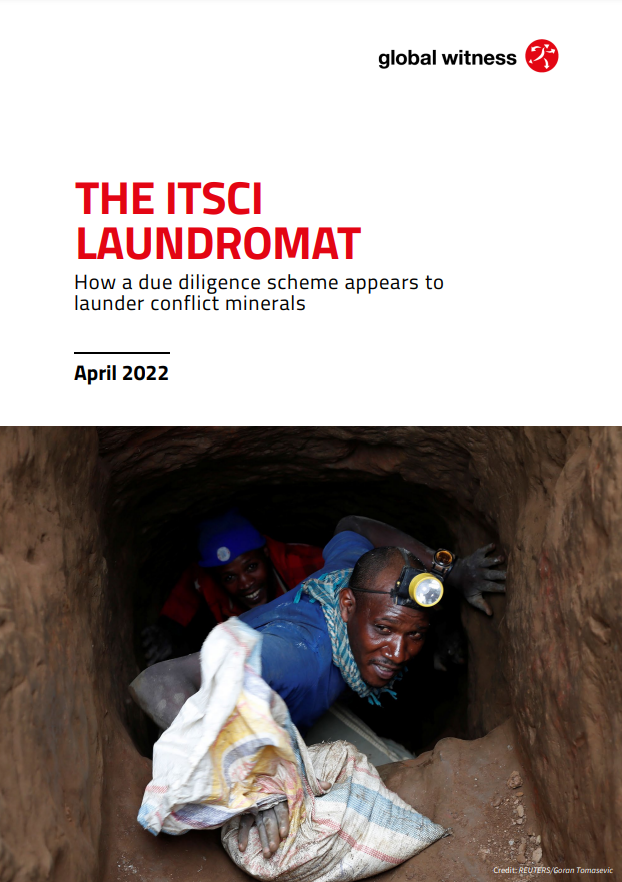
The ITSCI laundromat: How a due diligence scheme appears to launder conflict minerals
This report investigates how the International Tin Supply Chain Initiative (ITSCI) allegedly launders conflict minerals from mines in the Democratic Republic of Congo. It highlights serious failings in the traceability system, enabling smuggling, militia involvement, and child labour in the mineral trade. Recommendations include structural reforms and stricter enforcement by governments and companies.


