
Library | SDGs
GOAL 15: Life on Land
Refine
343 results
REFINE
SHOW: 16


Southeast Asia nature risk toolkit: A resource for financial institutions
A resource-hub and workbook designed by ENCORE partners to help financial institutions assess nature-related risks in Indonesia, Malaysia, Thailand, and Viet Nam. It provides over 120 curated tools and datasets to support TNFD-aligned risk management and investment decisions.

Tropical deforestation outlook: How market trends could impact the Amazon, the Congo Basin, and Southeast Asia-Oceania
This report evaluates market drivers of tropical deforestation across the Amazon, Congo Basin, and Southeast Asia. It analyses impacts from transition minerals, food systems, and fast-turnover products. The document outlines transition pathways and provides policy recommendations to address global trade and consumer demand trends through 2035.
Regenerative agriculture: Moving from ambition to credibility
This report evaluates regenerative agriculture commitments across 78 global agri-food companies. While disclosures have increased, quantified targets have declined to 28%. Significant gaps remain in financial support for farmers and pesticide reduction targets, with the pork and poultry sectors largely overlooked in transition planning.
Just Nature: How finance can support a just transition at the interface of action on climate and biodiversity
This report examines how the financial sector can facilitate a just transition within nature-based systems. It outlines priorities for sustainable agriculture, deforestation, nature-based solutions, and ocean restoration. The authors provide strategic recommendations for integrating human rights and social inclusion into climate and biodiversity actions to achieve a net-zero economy.
Gaining ground: State of private investment in nature 2026
This report analyses the growth of private investment in nature between 2016 and 2025, documenting a fivefold increase in annual capital deployment to $14 billion. It highlights the shift towards institutional-grade natural capital and recommends clearer policy drivers and standardised metrics to unlock investment and bridge the $700 billion finance gap.
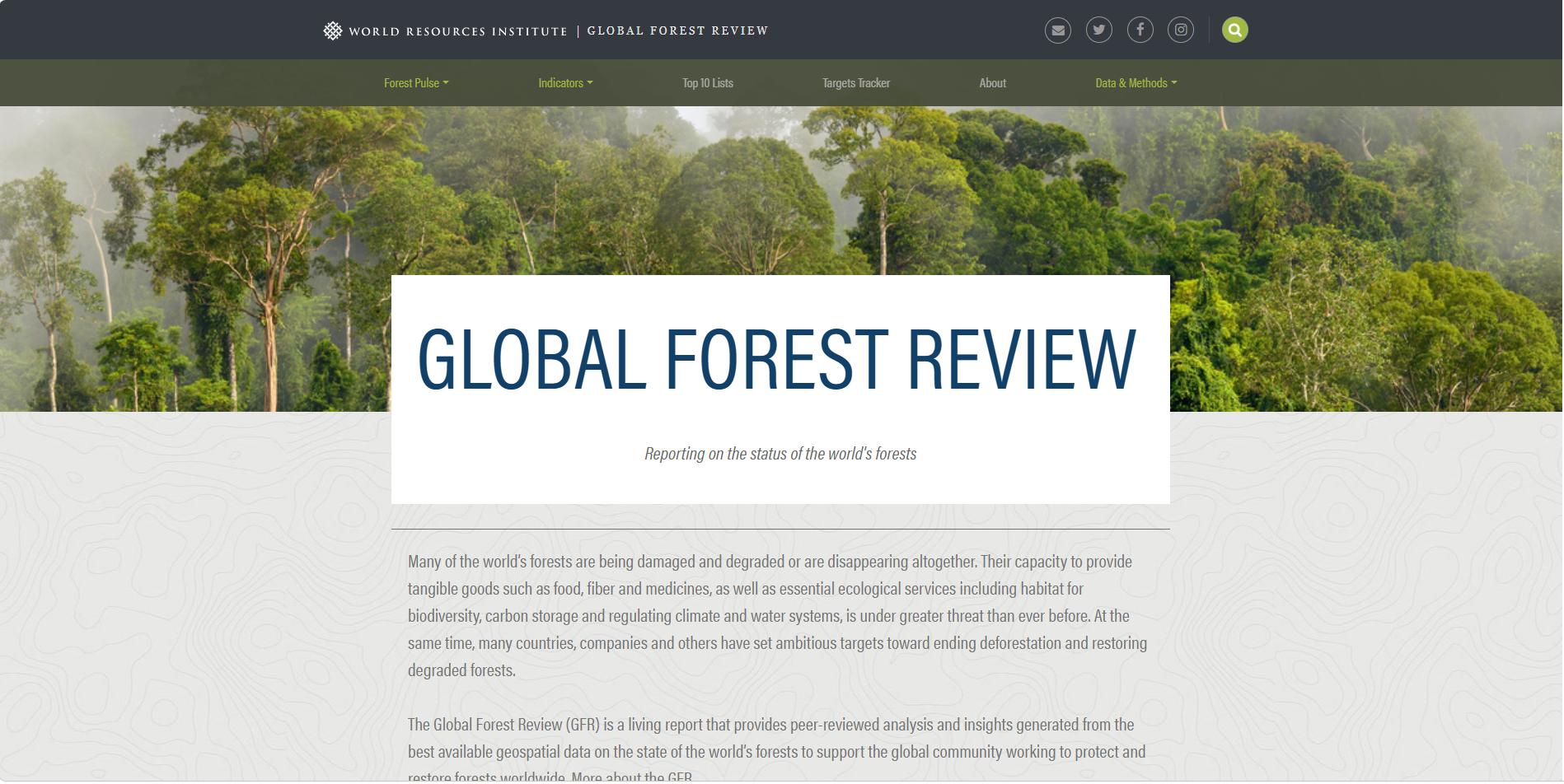
Global Forest Review
The Global Forest Review is an online resource by the World Resources Institute providing annual data on global forest loss, deforestation drivers, and carbon stocks. It helps finance professionals assess environmental risks and track supply chain exposure to deforestation-linked commodities.
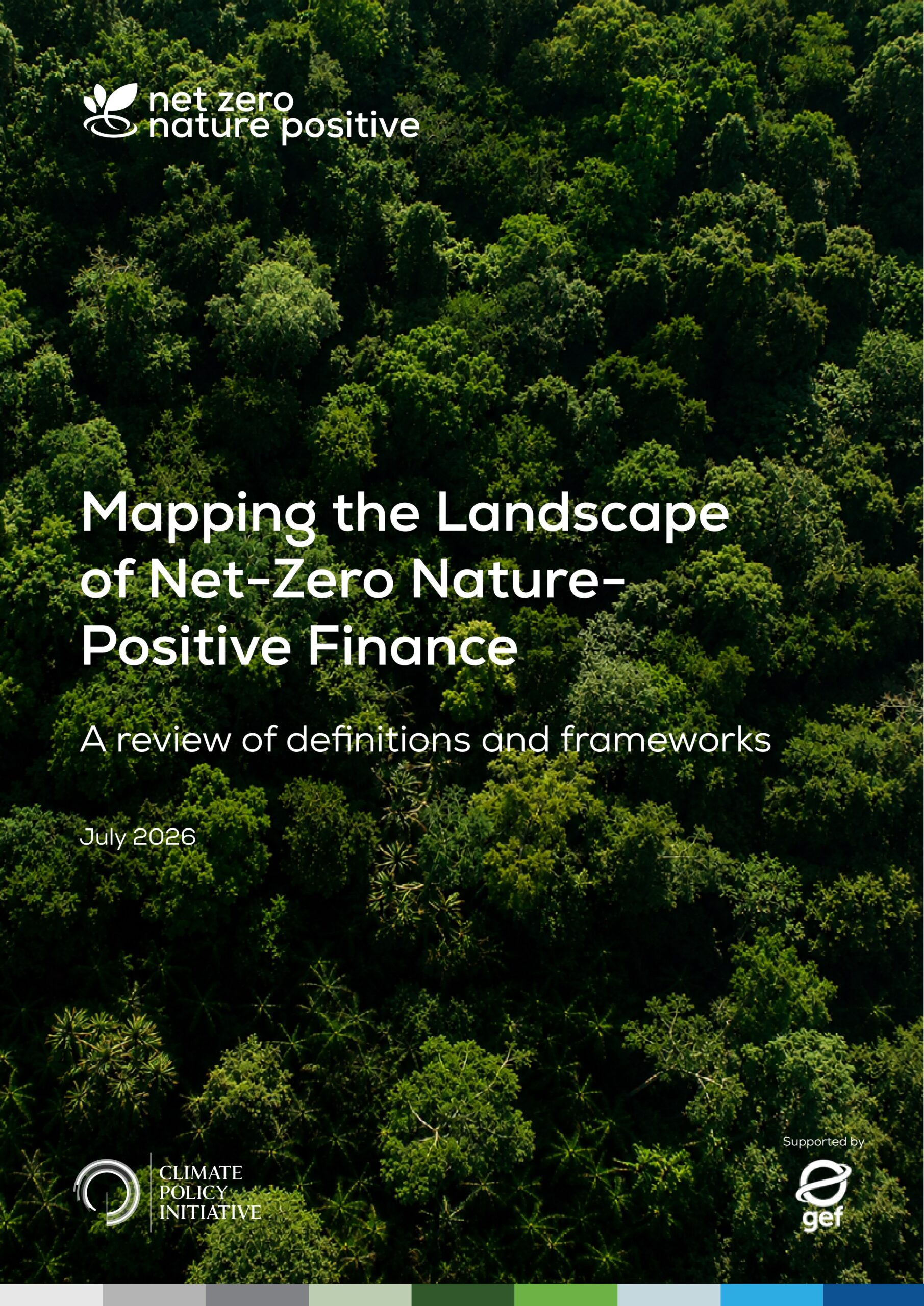
Mapping the landscape of net-zero nature-positive finance: A review of definitions and frameworks
This report provides a comprehensive review of definitions and frameworks for net-zero, nature-positive, and climate-nature finance. It identifies alignment areas and implementation gaps, advocating for integrated risk and investment approaches to achieve global sustainability goals under the Paris Agreement and the Kunming-Montreal Global Biodiversity Framework.
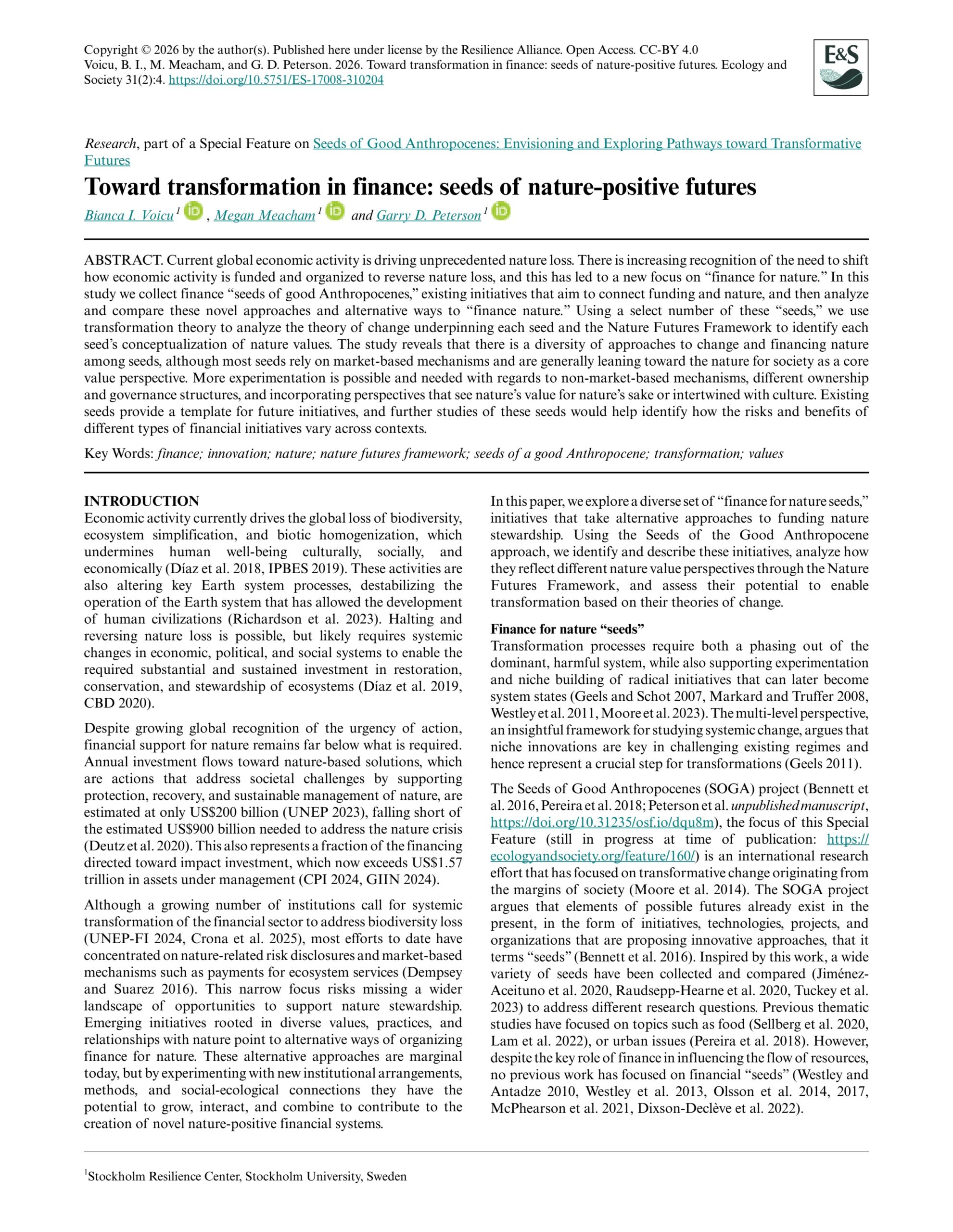
Toward transformation in finance: Seeds of nature-positive futures
This research examines "finance for nature seeds" — innovative initiatives aimed at transforming the financial sector to reverse nature loss. By analysing 92 global projects, the study identifies diverse approaches to funding nature stewardship, highlighting current reliance on market-based mechanisms and the potential for inclusive, value-pluralistic financial systems.
The emancipatory potential of biodiversity reporting: Evidence from the United Kingdom and South Africa
This research evaluates the emancipatory potential of biodiversity reporting within the United Kingdom and South Africa. Analysing disclosures from 2018 to 2022, it finds significant increases in reporting intensity. The study presents a principles-based framework to distinguish between compliance-oriented disclosures and transformative, action-oriented environmental reporting.
Tropical rainforest loss slowed in 2025, but fire is a growing threat to forests worldwide
Global tropical primary forest loss decreased 36% in 2025, though 4.3 million hectares were destroyed. Significant policy-driven reductions occurred in Brazil, but global deforestation remains 70% above levels required for 2030 targets. Fires drove 42% of global tree cover loss, with severe impacts in Canada and Europe.
Guidance on integrating deforestation into net zero strategies
This IIGCC guidance supports institutional investors in integrating deforestation, land conversion, and associated human rights risks into net zero strategies. Aligned with the Net Zero Investment Framework 2.0, it provides practical, asset class-specific action points across listed equity, sovereign bonds, real estate, and private equity and debt.
Looking beyond greenhouse gas emissions: Interlinkages between the commercial vehicle industry and nature
Published by WWF Sweden in collaboration with TRATON GROUP, this report examines the commercial vehicles sector's interlinkages with nature across its full value chain. It analyses six key commodities and value chain stages, identifies nature-related risks for businesses, and calls for sector-wide collaborative action towards a nature-positive future.
Potential business cases in measuring biodiversity state and impact in agriculture
A joint Mistra FinBio and Svensk Kolinlagring report identifying three business cases linking biodiversity data to agricultural finance: baseline databanks for bank and insurance risk assessment, and an MRV system for biodiversity claims. It highlights the financing gap in regenerative agriculture and outlines potential biodiversity-linked financial products.
Applying planetary boundaries: Effective risk management and value creation
This report examines how the Planetary Boundaries Framework translates nine critical global processes into material risks and value creation opportunities for investors and corporates. Seven of nine boundaries have already been breached. Tools, frameworks, and an investor engagement plan are outlined to support Earth-system-aligned capital allocation and long-term value creation.
Community engagement, nature and financial materiality: An evidence review on the financial effects of engagement with indigenous peoples and local communities on nature-related issues
This Shift report reviews the financial effects of corporate engagement with Indigenous Peoples and local communities on nature-related issues. Drawing on over 1,200 cases and approximately 40 publications, it finds that engagement quality is financially material, with poor engagement linked to significant operational, legal, and reputational costs.
Navigating nature-related data: Metrics, sources and uses
This NGFS information note examines available nature-related data resources and methods for integrating them into financial risk assessment. It reviews metrics and indicators against five key criteria, presents four case studies, and identifies data quality, availability, and standardisation challenges. Public-private collaboration and targeted investment are recommended to address data gaps.


