
Library | SASB Sustainability Sector
All industries
Refine
624 results
REFINE
SHOW: 16


Beyond compliance: Effective reporting under the Modern Slavery Act
This report provides practical guidance from non-governmental organisations with expertise in modern slavery for commercial organisations reporting under the UK Modern Slavery Act. It provides a business case for business action on modern slavery in supply chains that goes beyond minimum compliance to achieving positive change on slavery and forced labour.

Climate transparency report 2021: Comparing G20 climate action towards net zero
The Climate transparency report 2021 summarises the climate actions of G20 countries using the latest emissions data. It covers 100 indicators on decarbonisation, climate policies, finance, and vulnerability to the impacts of climate change. Providing country ratings, it identifies leaders and laggards in transition to a net zero-emission economy.

Handbook for nature-related financial risks: key concepts and a framework for identification
The Cambridge Institute for Sustainability Leadership (CISL) has created this handbook and a framework for the identification of nature-related financial risks. It builds on the Dasgupta Review of the economics of biodiversity, enabling financial institutions to begin embedding nature into mainstream financial models, risk frameworks, and portfolio strategies.

The return on purpose: Before and during a crisis
This paper demonstrates that investment in corporate purpose can improve company performance. To study the impact of purpose on performance, the authors conducted analysis on how corporate purpose relates to company financial performance, market valuation and shareholder value creation.
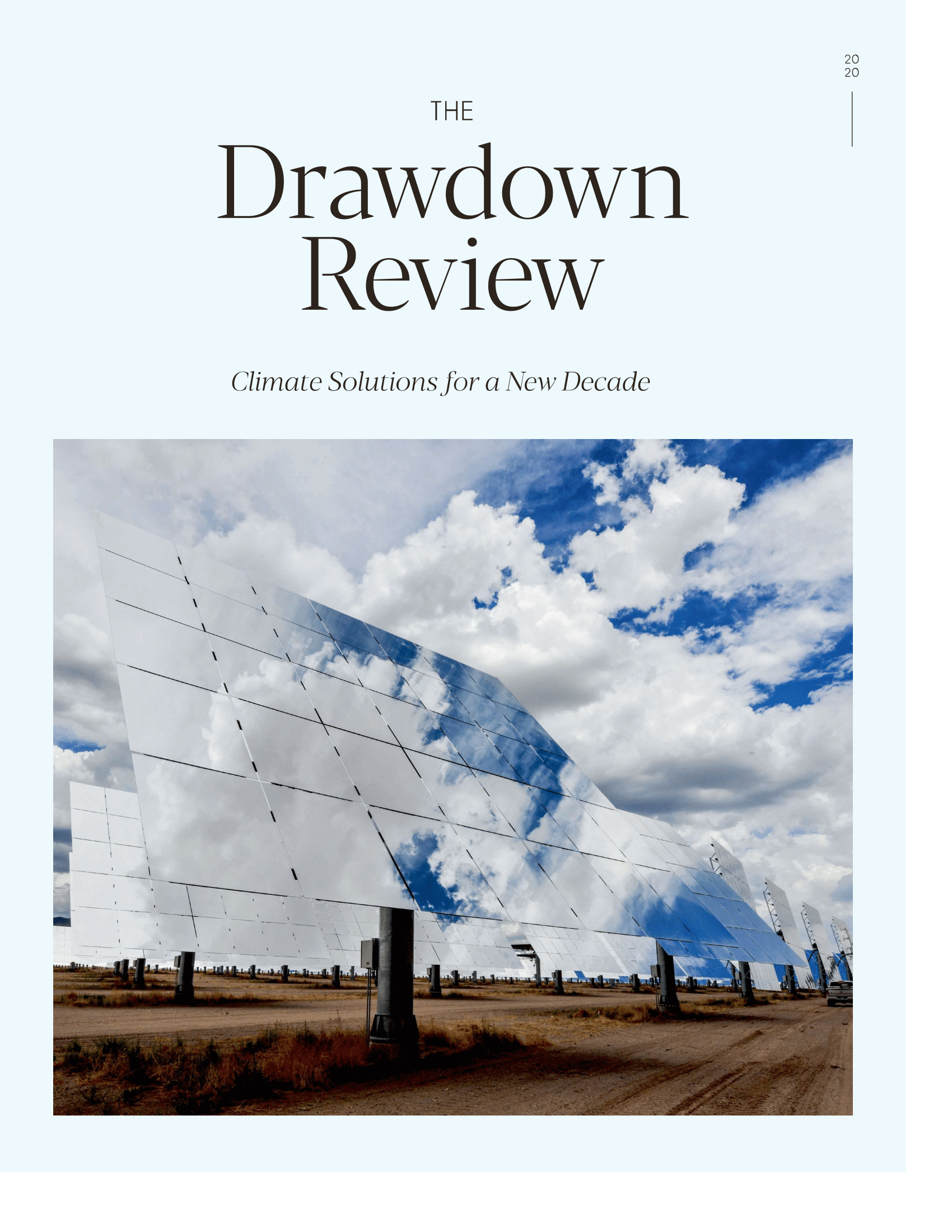
The drawdown review 2020: Climate solutions for a new decade
This report analyses climate solutions that are proven, exist and will help reach drawdown. Drawdown is the point where greenhouse gases in the atmosphere are steadily declining, preventing further climate change. The climate solutions proposed are organised across three categories: reducing sources of emissions, supporting carbon sinks, and improving society.
Blueprint for business leadership on the SDGs: A principles-based approach
Business cannot thrive unless people and planet are thriving. This publication presents a framework for the next generation of business leadership with the intention to foster contribution to the United Nations Sustainable Development Goals at scale.
Corporate governance principles and recommendations: 4th edition
The report sets out eight principles and thirty-five recommendations of corporate governance practices for listed entities on the Australian Securities Exchange (ASX). The principles and recommendations address emerging issues around culture, values, and trust. It includes governance standards around disclosure, gender diversity, corporate reporting, risk management and director remuneration.

The carbon boomerang: Litigation risk as a driver and consequence of the energy transition
This report discusses and identifies climate change related litigation risks as drivers and consequences of an energy transition. It presents a taxonomy of those risks and analyses them in the broader context of the financial risk associated with them.

Safeguarding human rights defenders: Practical guidance for investors
Provides targeted guidance for minority shareholders with investments in public equities and limited partners in private equities on how to identify, prevent, and mitigate risks to human rights defenders throughout their investments. Human rights defenders are individuals who, individually or with others, act peacefully to promote or protect human rights.

Inclusive business: What it is and why it matters
This report examines the concept of inclusive business as a means of enabling disadvantaged populations to participate in economic activity and share economic value. The report provides a comprehensive discussion of what an inclusive business initiative comprises and contains examples showing how they address social challenges.
Can government policies that drive strong economic outcomes for the private sector alleviate poverty?
The report examines how the adoption of policies that drive strong economic outcomes for the private sector often reduce poverty in the developing world, primarily through opportunities for job creation. In particular, the report calls for policies that promote greater access to credit and the protection of minority investors.

Governing the commons: The evolution of institutions for collective action
Elinor Ostrom examines the management of common-pool resources such as rivers, bridges and grazing areas. Ostrom discusses the ‘tragedy of the commons’ and environmental, economic and social threats to common-pool resources. Ostrom applies political and economic theory and policy literature to discuss potential solutions and challenge conventional approaches.

Women on boards and the human capital connection
Companies with a gender diverse board and stronger talent management practices enjoyed higher growth in employee productivity compared to companies with a diverse board only or with strong talent management practices only. Companies with mostly male boards and lagging talent management practices had the lowest rates of employee productivity growth.

Providing decent work for young workers, parents and caregivers
Provides guidance for companies to fulfil their responsibility to support the decent work of young workers, parents and caregivers across their supply chains. Includes a case study on IKEA’s approach to supporting children’s rights and a second case study on Wipro’s approach to gender diversity.

How to report on the SDGs: What good looks like and why it matters
Corporate action towards the United Nations Sustainable Development Goals (SDGs) will be fundamental to achieve necessary progress. This report aims to guide corporations on how and why to report on the SDGs and gives an overview of current progress based on the top 250 global companies.
Universal circular economy policy goals: Enabling the transition to scale
As industries and governments move towards the circular economy, clear and aligned direction is needed for a rapid transition to scale. This paper proposes five universal policy goals that can help governments build healthier economic recoveries and lower the costs of transition for businesses across sectors.


