
Library | Finance relevance
Insurance and risk professionals
Refine
346 results
REFINE
SHOW: 16


RIAA policy platform: Sustainable finance for a thriving Aotearoa New Zealand 2023 and beyond
This report outlines RIAA’s policy platform to strengthen sustainable finance in Aotearoa New Zealand. It recommends a national strategy, clearer ESG disclosures, taxonomy alignment with global standards, anti-greenwashing measures, Māori inclusion, human rights protections, and alignment with biodiversity and the Sustainable Development Goals.

Corporate value chain (scope 3) accounting and reporting standard: Supplement to the GHG protocol corporate accounting and reporting standard
The Corporate Value Chain (Scope 3) Accounting and Reporting Standard provides a consistent framework for measuring and reporting indirect greenhouse gas (GHG) emissions across a company’s value chain. It outlines 15 categories of Scope 3 emissions, offers guidance on boundary setting, data collection, and reporting, and aims to improve transparency, enable emissions reduction, and support strategic decision-making.

Counterproductive sustainable investing: The impact elasticity of brown and green firms
Sustainable investing strategies that reallocate capital from brown to green firms may unintentionally worsen environmental outcomes. This study finds that green firms show minimal environmental improvement from lower capital costs, while brown firms become more polluting when financially constrained. Current investment approaches offer weak incentives for impactful emissions reductions.

Corporate climate litigation in Australasia: (Re)shaping the private law-climate interface
The report examines how corporate climate litigation in Australia and New Zealand is shaping private law. It highlights legal actions involving directors’ duties, disclosure obligations, consumer protections, and tort law. The analysis shows incremental adaptations in private law to address climate change impacts, especially through anti-greenwashing and climate accountability claims.
Targeting net zero: The need to redesign bank decarbonization targets
This report examines the limitations of current bank decarbonisation targets and proposes design reforms to align with net zero. It analyses scope coverage, target types, and sector alignment, offering practical recommendations for enhancing climate credibility and effectiveness in financial institutions’ transition planning.

Kantar
Kantar is a global leader in marketing data, insights and analytics, supporting over 96 of the world’s top 100 advertisers across 90+ markets. It combines behavioural and attitudinal data to inform brand strategy, creative testing, media effectiveness, customer experience and sustainable growth.

Market Forces
Market Forces works to hold financial institutions accountable for funding environmentally harmful projects. Based in Australia, it campaigns for banks, superannuation funds and governments to align investments with climate goals. Market Forces provides research, advocacy tools and transparency on fossil fuel financing to support climate-conscious financial decision-making.

Howden Group
Howden Insurance Brokers Australia is a global insurance intermediary offering tailored insurance and risk management solutions for businesses and individuals. With offices across Australia and access to international markets, Howden provides services in corporate risks, people risk, private clients, and alternative risk solutions. Their employee-owned model fosters a client-focused approach, delivering personalised service backed by global expertise.
RIAA Policy Platform 2025: Harnessing sustainable finance for a thriving Australia
The RIAA Policy Platform 2025 outlines nine policy priorities and two principles to align Australia’s finance system with sustainability goals. It recommends regulatory reforms, improved data, Indigenous inclusion, and stronger accountability to mobilise capital for a net zero, nature-positive economy that supports long-term economic resilience and societal wellbeing.
Impact economies tractions and trends: Insights from 34 GSG National Partners
This report presents insights from 34 national ecosystems advancing impact investing. It highlights trends in policy, capital mobilisation, and transparency, showing governments and institutions integrating social and environmental outcomes into investment strategies. It tracks growth in green finance, outcome-based funding, and investment readiness across emerging and developed economies.
The root cause of nature loss: Forests, why they matter, and how to assess deforestation risk in investment portfolios through nature-related data
This report outlines how deforestation, particularly in tropical forests, is a key driver of biodiversity loss and climate change. It presents the risks to institutional investors—physical, transition, and systemic—and offers a framework to assess deforestation exposure in portfolios using nature-related data and metrics across sectors and geographies..
Pursuing impact within a portfolio: Insights from institutional asset owners
This report explores how institutional asset owners integrate impact goals into portfolio strategy. Through four case studies, it examines aligning financial returns with social and environmental outcomes using an impact lens. It highlights investment approaches addressing climate change, health, regional development and systemic inequality across diverse asset classes and geographies.
Climate risk and adaptation in global food
The report outlines rising climate risks to global food supply chains, projecting up to $38 trillion in damages by 2050. It explores mitigation and adaptation strategies across crops, livestock, and fisheries, and highlights investor actions to build resilience, support sustainable practices, and adapt to shifting market, environmental, and regulatory conditions.
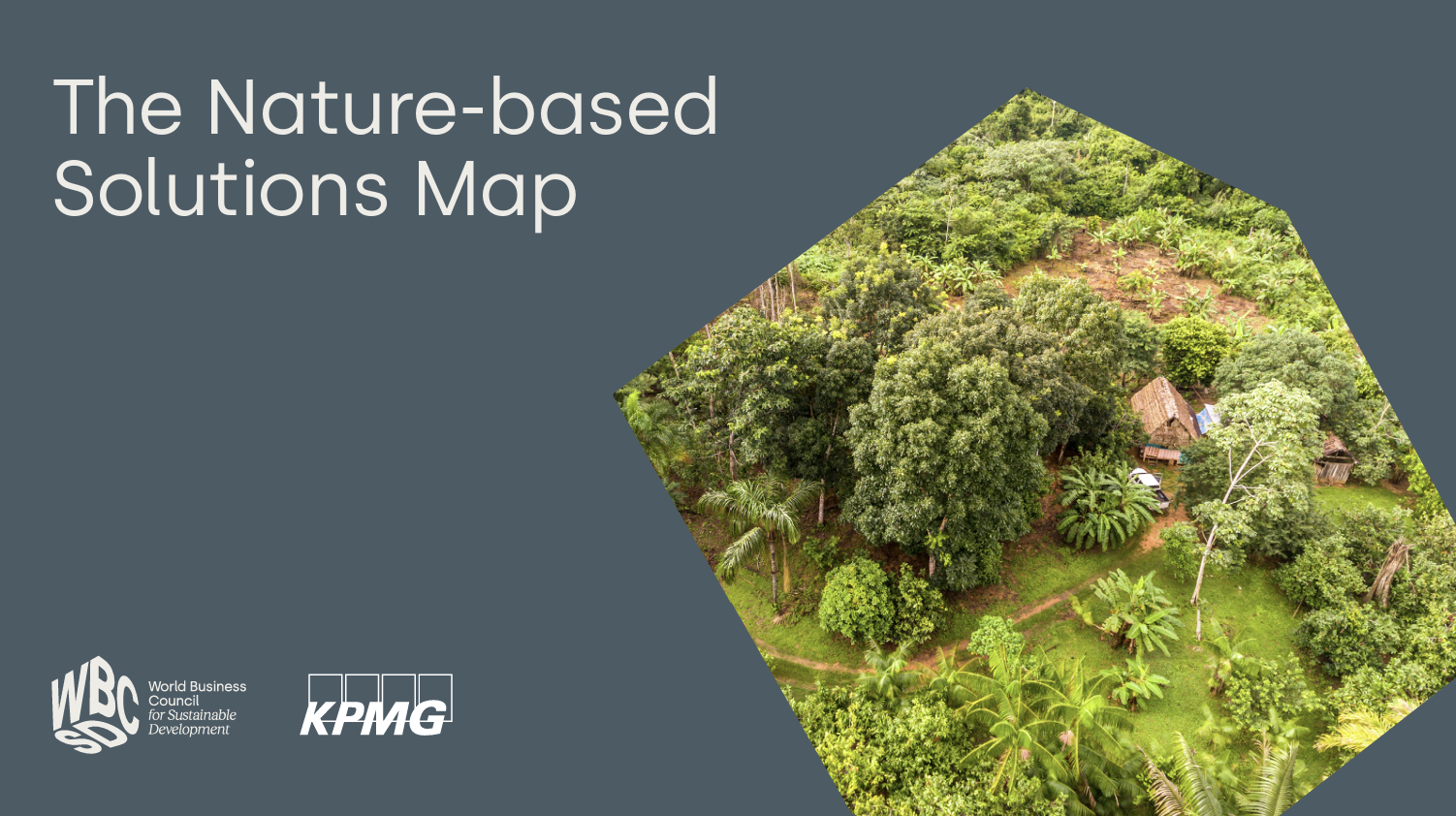
The nature-based solutions map
This tool is designed to help businesses identify relevant nature-based solutions (NbS) for addressing challenges related to core business operations, climate, nature, water, and social equity. It categorises NbS based on business needs and biomes, facilitating decision-making. The map serves as a starting point, requiring further development for implementation.
The blended finance playbook for nature-based solutions
This playbook contains a collection of useful case studies for investors, highlighting growing evidence of investment opportunities in nature. The playbook also contains guidance for investors looking to grow their blended finance portfolio.

Conservation investment blueprint: Environmental impact bond for green infrastructure
This blueprint details the application of Environmental Impact Bonds (EIBs) to finance green infrastructure projects. It illustrates how EIBs can be used to attract private investment to public infrastructure projects that offer significant environmental benefits, such as enhanced stormwater management and increased urban resilience. The document provides a framework for structuring these bonds to ensure both financial returns and positive environmental outcomes.


