
Library | Sustainable Finance Practices
Issue/sector focused research
General research and analysis that provides deep dives and insights into specific sustainability issues or industry sectors, addressing the current status, trends, risks, and opportunities for the issue but not specifically addressing a finance or business audience.
Refine
761 results
REFINE
SHOW: 16


BNP Paribas Foundation
BNP Paribas Foundation is a corporate philanthropic foundation funding projects in climate and biodiversity, social inclusion, education, and culture. Backed by BNP Paribas Group, it supports NGOs, researchers and cultural organisations through grants, partnerships and long-term programmes, promoting sustainable development, environmental protection and social impact worldwide across multiple global regions.

EuroGeoSurveys
EuroGeoSurveys (EGS) is a not-for-profit association representing national geological surveys across Europe.EGS provides geoscience data, research and policy-relevant expertise on raw materials, groundwater, energy transition and geohazards, supporting European decision-making through EU-funded projects, shared data infrastructure and coordinated scientific collaboration across member organisations.

Secretariat of the Convention on Biological Diversity (CBD)
Secretariat of the Convention on Biological Diversity (CBD) supports implementation of the UN Convention on Biological Diversity by coordinating global biodiversity policy, meetings, and reporting. It provides technical, scientific and administrative support to governments, promotes biodiversity conservation, sustainable use, and equitable benefit-sharing, and facilitates international cooperation on nature and ecosystems.

Germanwatch
Germanwatch is an independent development, environmental and human rights non-governmental organisation advocating sustainable global development based on social equity, ecological protection and economic stability. It influences climate, trade and corporate policy, produces research and indices like the Climate Change Performance Index, and promotes fair, equitable climate action globally.

Arms availability and the situation of civilians in armed conflict: A study presented by the ICRC
The ICRC study finds that widespread availability of small arms intensifies civilian harm in armed conflict. Drawing on field data, case studies and staff surveys, it links unregulated arms flows to higher civilian casualties, humanitarian access constraints and weakened compliance with international humanitarian law.
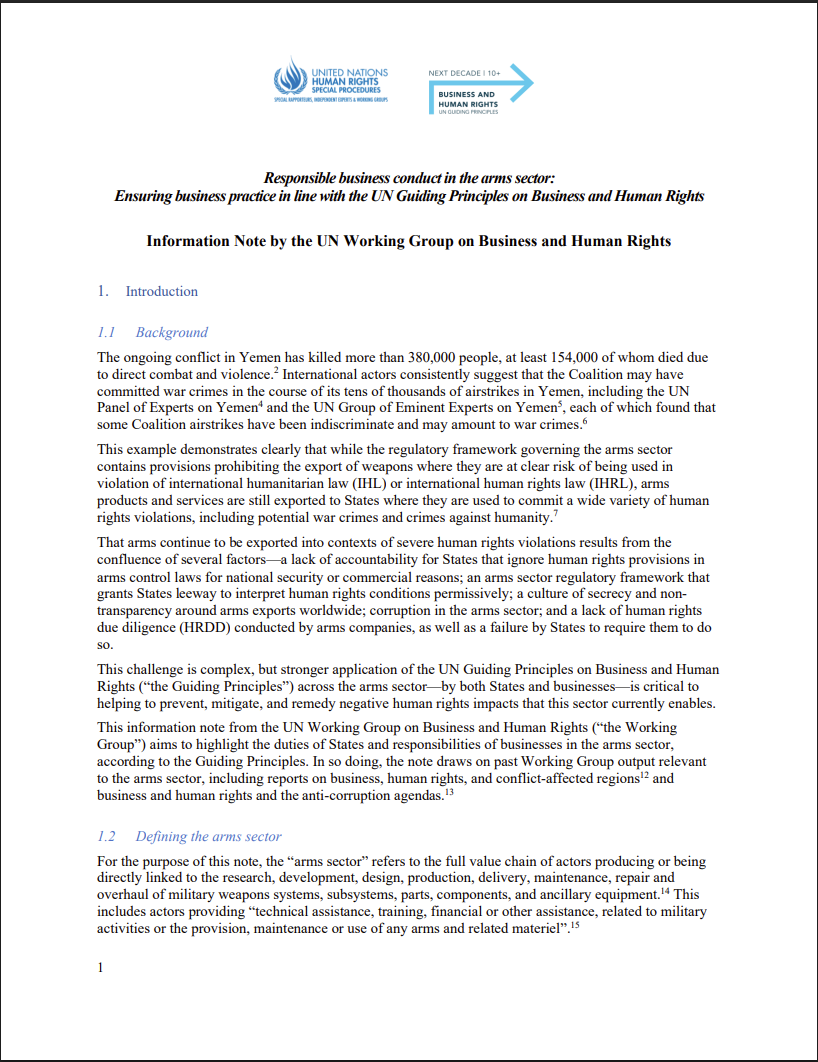
Responsible business conduct in the arms sector: Ensuring business practice in line with the UN guiding principles on business and human rights
The UN Working Group reviews arms sector regulation, finding persistent exports linked to humanitarian and human rights law violations. It identifies weak political will, opaque oversight and limited human rights due diligence, and urges stronger application of the UN Guiding Principles by states and companies.
Report of the working group on the universal periodic review
The report presents Norway’s fourth Universal Periodic Review, outlining human rights commitments, recent legal reforms, and policy measures. It records peer State feedback and extensive recommendations covering equality, child welfare, Indigenous rights, migration, climate action, and business and human rights, for Norway’s consideration and follow-up.
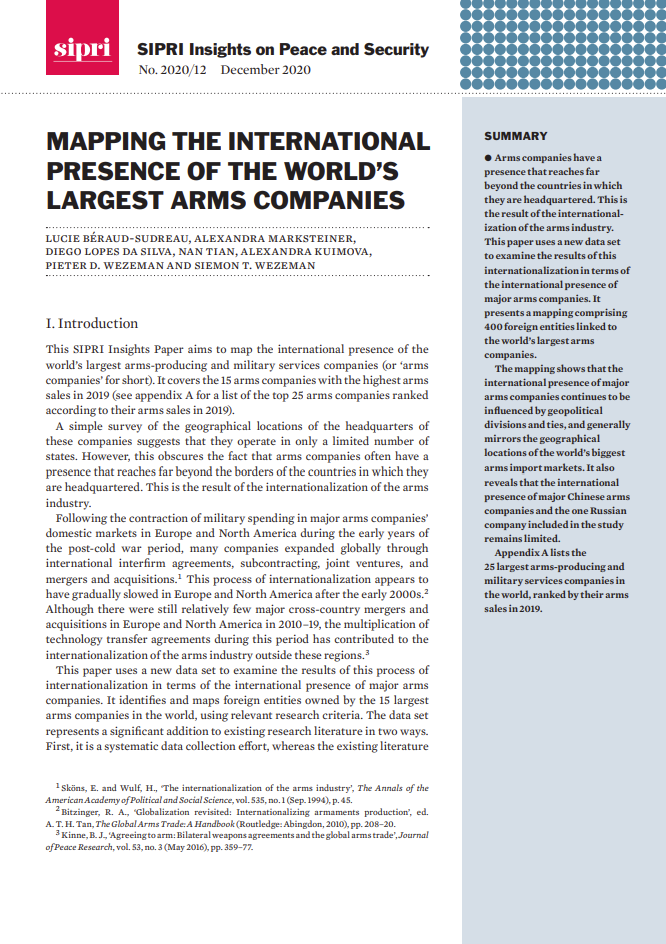
Mapping the international presence of the world's largest arms companies
SIPRI maps the global footprint of the 15 largest arms companies, identifying 400 majority-owned foreign entities. International presence aligns with geopolitical ties and major arms markets. US and European firms dominate; Chinese and Russian companies show limited overseas reach.
Integrating nature & biodiversity into investment: An asset owner perspective
The report examines how asset owners integrate nature and biodiversity into investment. Based on interviews with 20 global asset owners and managers, it finds growing recognition of financial materiality, limited governance and data maturity, early TNFD adoption, and reliance on climate-aligned ESG processes.
Repurposing power markets: The path to sustainable and affordable energy for all
IFC’s report argues that repurposing power market designs is critical to achieving affordable, reliable and sustainable electricity. Drawing on global data, it finds competitive markets attract private capital, improve access and accelerate renewables, while recommending tailored reforms guided by innovation, integration and institutional strength.
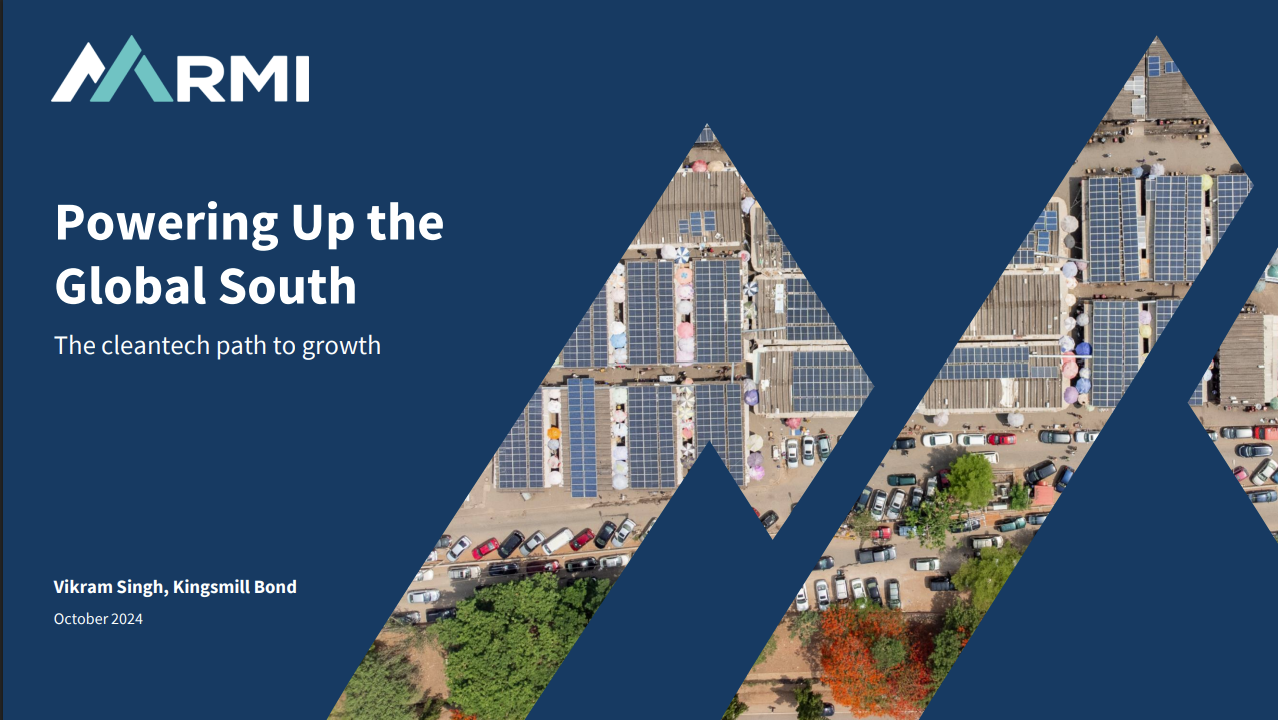
Powering up the global south: The cleantech path to growth
The report argues the Global South is rapidly adopting cleantech as its cheapest growth pathway, driven by low energy access, limited fossil resources and abundant renewables. Falling costs, electrification and Chinese supply underpin accelerating solar and wind deployment, with fossil fuel demand for electricity expected to peak by 2030.
Banking on business as usual: The energy finance imbalance
The report assesses energy financing by 65 major banks (2021–2024), finding fossil fuel finance more than double sustainable power supply. The energy supply financing ratio stagnates around 0.42:1, far below net-zero benchmarks, with regional disparities and weak translation of climate commitments into financing shifts.
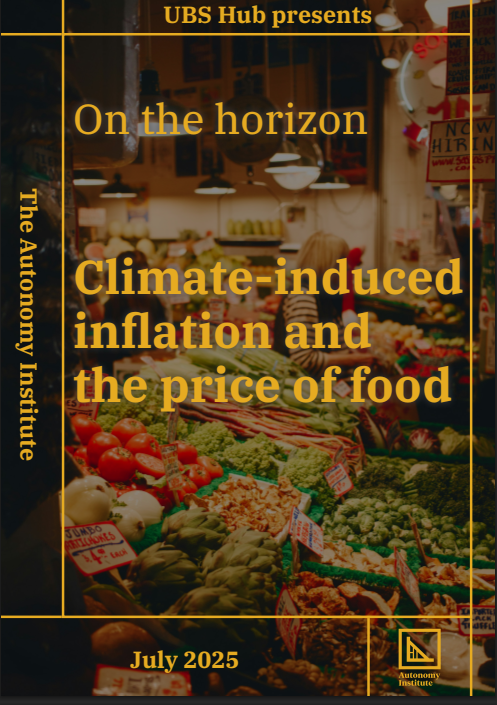
On the horizon: Climate-induced inflation and the price of food
This report analyses climate-driven food price inflation in the UK, linking global heat and drought shocks to rising import costs. It projects 25–34% cumulative food inflation by 2050, with disproportionate impacts on low-income households and increased poverty risks.
The global human impact on biodiversity
Global meta-analysis of 2,133 studies finds human pressures consistently shift community composition and reduce local biodiversity across terrestrial, freshwater and marine systems, but do not cause uniform biotic homogenisation. Impacts vary by pressure, organism group and spatial scale, informing conservation benchmarking.
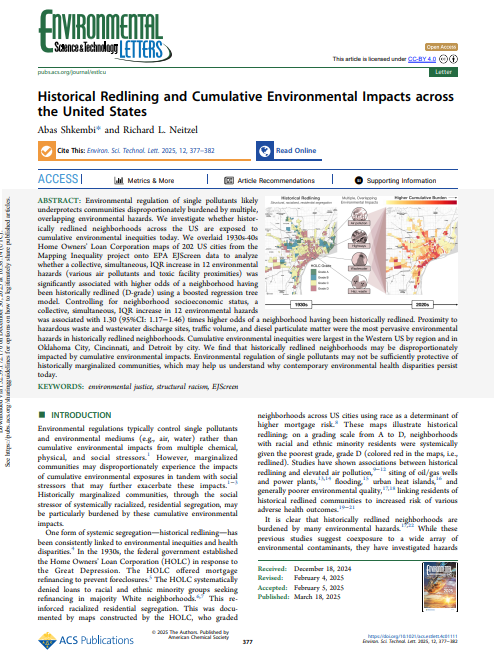
Historical redlining and cumulative environmental impacts across the United States
This study analyses 202 US cities, linking historic redlining to higher present-day cumulative environmental burdens. Using EJScreen data and modelling, it finds redlined neighbourhoods face significantly greater combined pollution exposures, particularly from traffic, hazardous waste and wastewater sites, with strongest disparities in western regions.
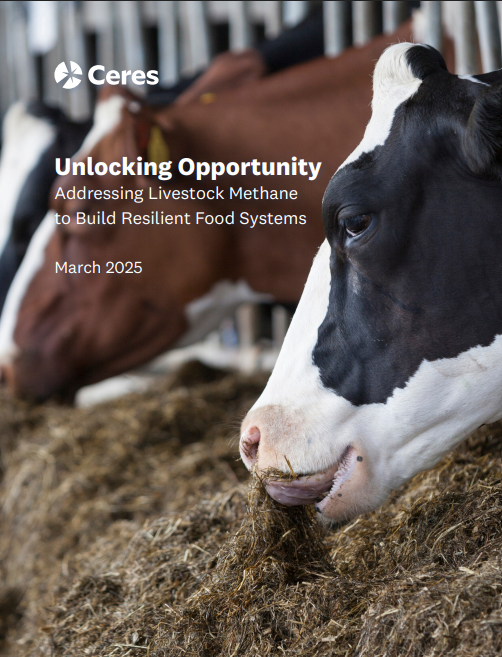
Unlocking opportunity: Addressing livestock methane to build resilient food systems
This Ceres report outlines the financial and climate case for reducing livestock methane. It maps methane exposure across food supply chains and sets out strategies for companies and investors to manage risk, strengthen resilience, and capture value through near-term methane mitigation.


