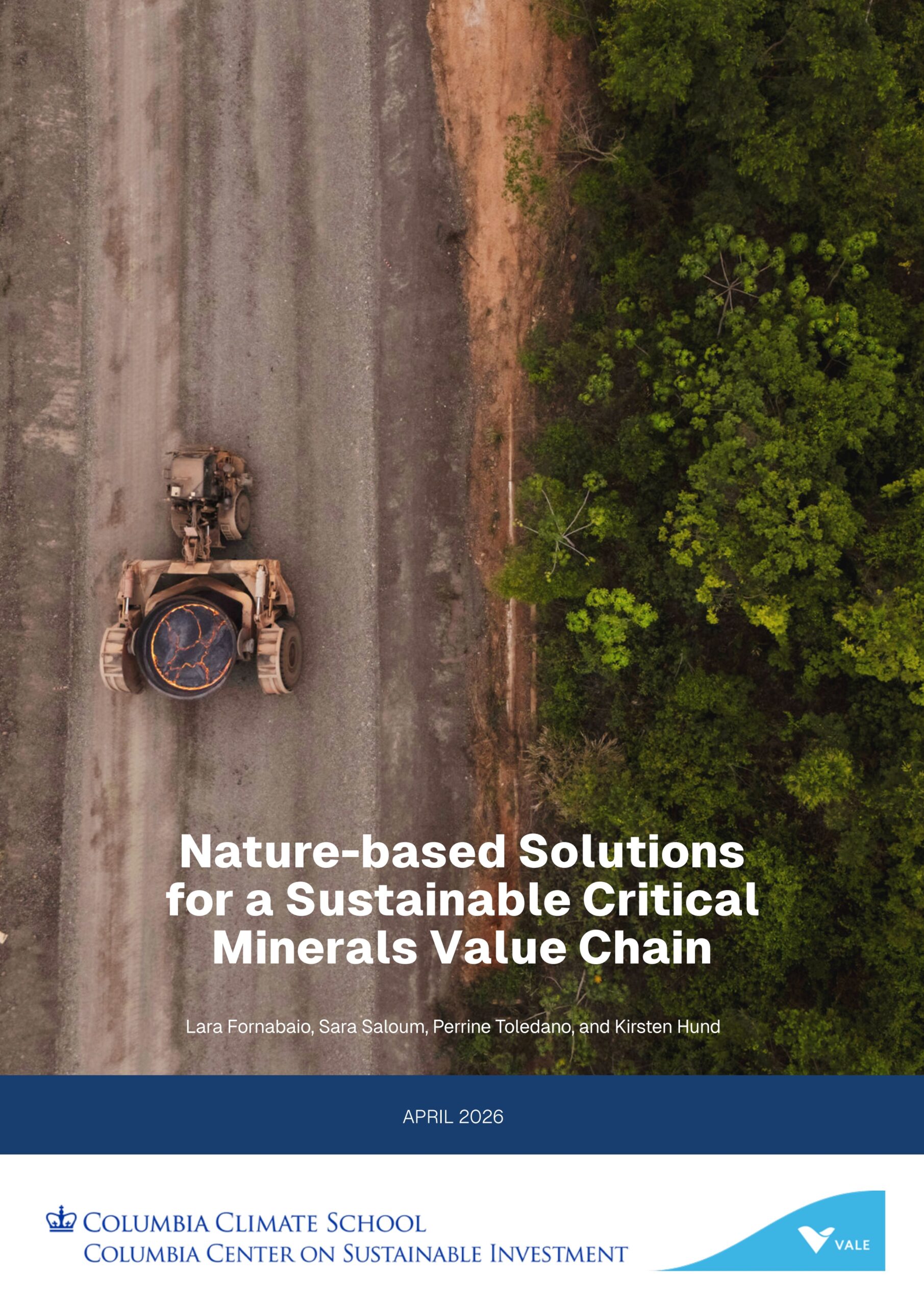
Nature-based solutions for a sustainable critical minerals value chain
This report examines how nature-based solutions (NbS) can be integrated into critical minerals mining. Drawing on case study research and expert events at Climate Week NYC and COP30, it identifies six resilience-building NbS categories and highlights the need for systems-based planning, community collaboration, and improved financing mechanisms.
Please login or join for free to read more.

OVERVIEW
Introduction
Global demand for minerals is accelerating, placing the mining sector at the centre of pressing sustainability challenges. Of the sector’s 101,583 square kilometres of mining concessions, 7% are in biodiversity hotspots, 8% are in protected areas, and 16% are in “wilderness” areas of high ecological integrity (p.3). CCSI and Vale Base Metals conducted joint research combining case study analysis and expert engagement, supplemented by events at Climate Week NYC and COP30 in Belém.
Nature-based solutions and mining
NbS are defined as actions to protect, sustainably manage, and restore ecosystems addressing societal challenges while providing human well-being and biodiversity benefits (p.3). CCSI proposes six resilience-building categories: Water Abstraction, Pollution Management, Land Stabilisation, Landscape Recovery, Land-use Planning, and Livelihood Management (p.3–5). Opportunities exist throughout the mining lifecycle, with planning particularly important (p.5).
Climate week NYC event summary
Mining’s role: Reimagining land management
Mining companies can turn negative externalities into beneficial outcomes by embedding nature-positive thinking across the lifecycle, co-designing solutions with communities, and integrating IPLC knowledge. Asset transfers after closure can ensure responsible land management beyond project timescales (p.7).
Government’s role: Enabling policy frameworks
Governments can align company behaviour with environmental objectives through standards, contracts, and permits. The UK’s Biodiversity Net Gain (BNG) legislation, introduced in 2024, legally requires a quantifiable increase in biodiversity — such as a 10% net gain — with independent bodies appointed for oversight (p.7–8).
Finance’s role: Aligning capital with nature
Funding security remains a significant barrier. Mechanisms discussed include a nature risk premium, biodiversity compensation markets, and voluntary carbon markets such as REDD+. Dedicated instruments — including nature-linked bonds and legally mandated mine closure funds — could help mobilise capital, but must not erode existing legal protections (p.8).
Designing effective NbS
Effective design requires strong data collection, early integration within the mining lifecycle, and tailoring solutions to local contexts. NbS often fail when implemented without knowledge of local conditions (p.9).
Community collaboration and co-creation
Co-design and co-management with communities are essential. Sustained engagement at legacy mining sites enabled effective remediation of water quality and wetland restoration. Community capacity building is critical for the best outcomes (p.9).
Challenges
The spatial and temporal ambiguity of mining sites is a major barrier, as projects often outlast governments. The absence of a standardised framework for “nature positive” hinders progress, and industry-wide collective action is more effective than individual company efforts (p.9–10).
COP events summary
Systems-based approach to mine planning
Integrating NbS from the planning stage embeds biodiversity and social considerations in core strategy, generating community income opportunities, enhanced ecosystem function, and improved water quality, rather than treating these as secondary concerns (p.11).
Collaborative implementation is essential
NbS require sustained, cross-disciplinary collaboration throughout the mine’s lifecycle. IPLC perspectives are especially important near IPLC land, and community engagement must be iterative rather than a one-off exercise (p.12).
Financing and valuation challenges persist
Measuring and valuing NbS benefits is challenging as they unfold gradually and do not align with short-term benchmarks. NbS should be integrated into initial cost structures and supported by monitoring frameworks connecting ecological outcomes to financial performance and operational resilience (p.12).
Conclusions
Both events underscored the need for systems-based planning, iterative collaboration, and better evaluation methods. Financing remains a barrier despite the cost-effective nature of NbS, and addressing this is critical for translating shared ambitions into scalable, sector-wide practice (p.15).